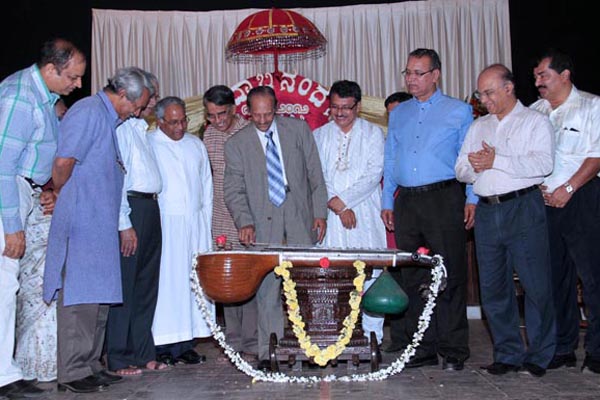
Nisar Ahmed flags off 'Nadabhinandana', literary giants heap praises on Na Damodar Shetty

February 11, 2012

nada_abhinandane_1

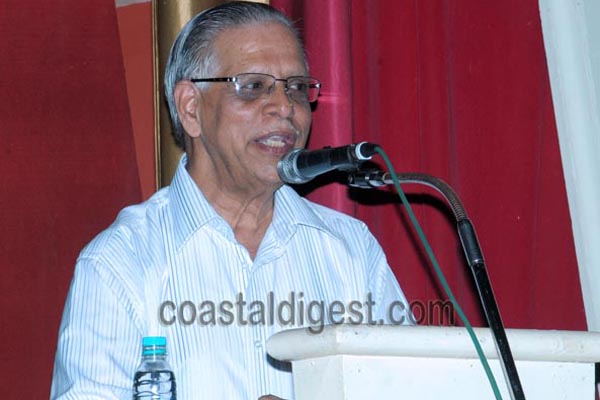
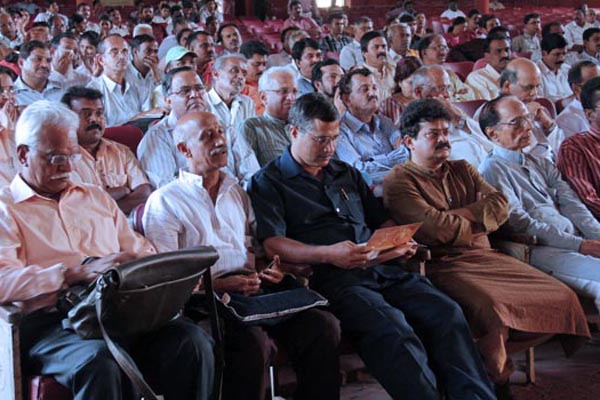
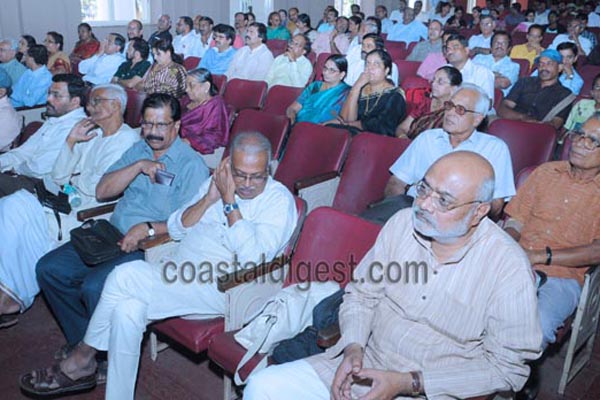
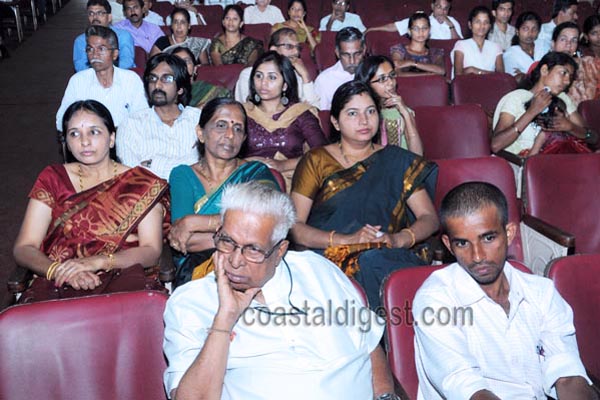
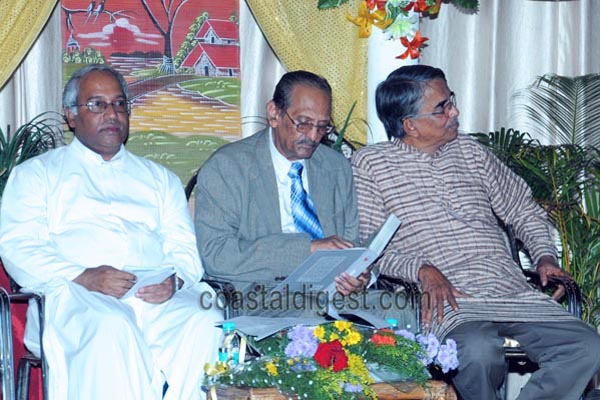
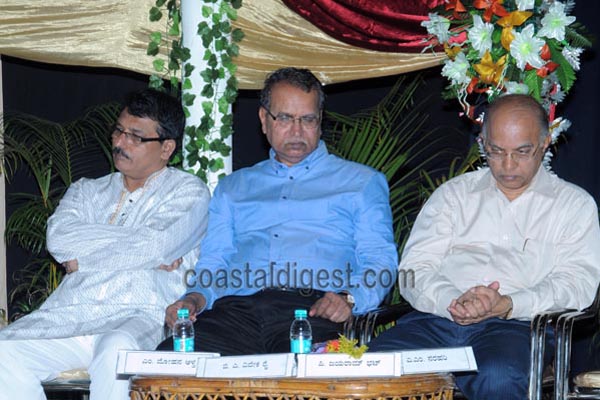
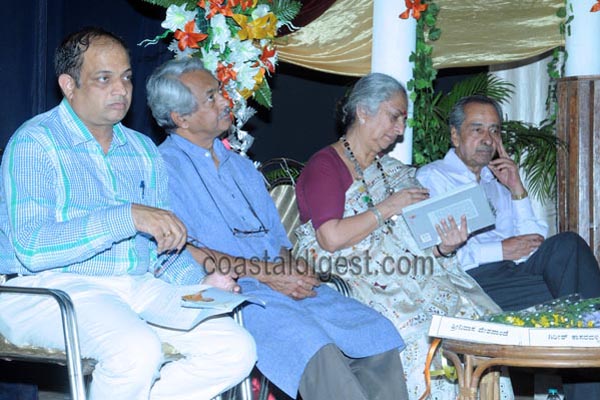
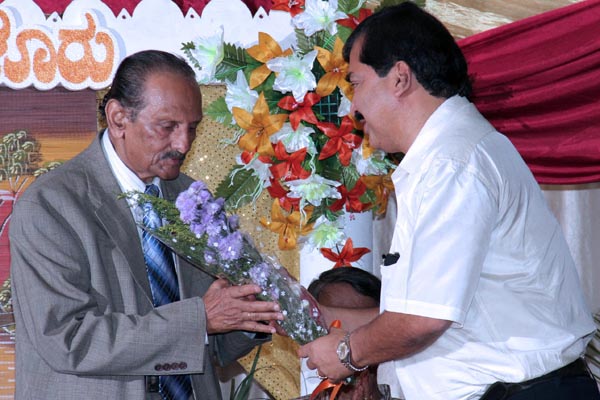
Mangalore, February 11: Encomiums were showered in good measure on writer and stage artiste Na. Damodar Shetty on Saturday at the 'Nadabhinandana', a felicitation programme held at Town Hall to mark the 60th birthday of the multifaceted genius, who recently retired as the professor of Kannada department of St. Aloysius College.

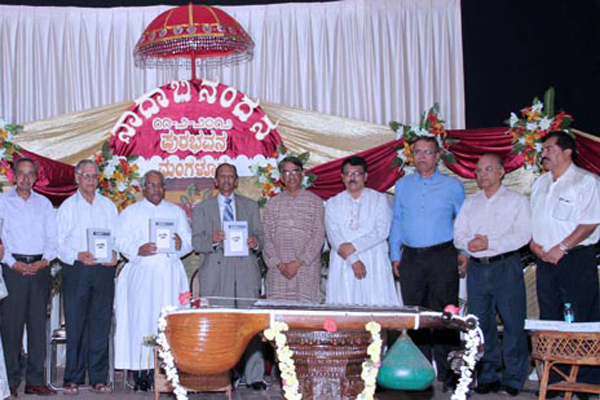
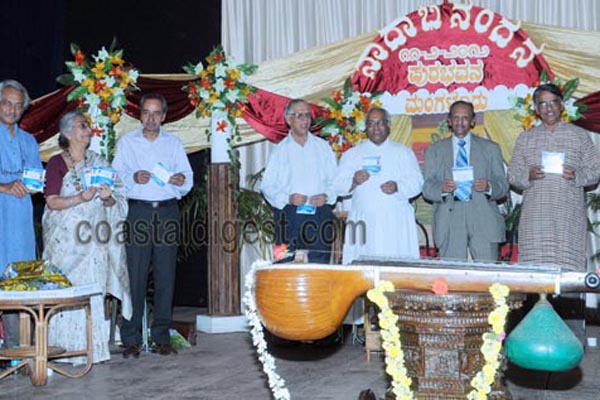
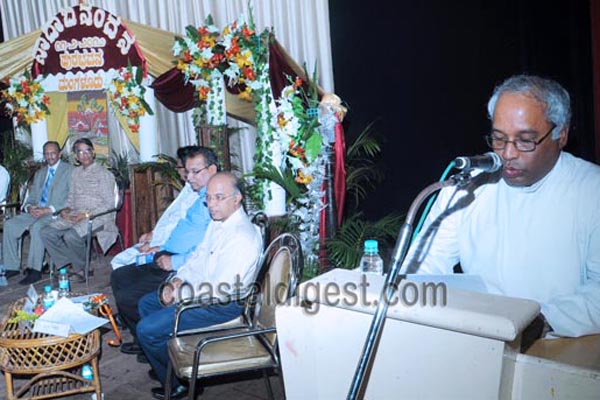
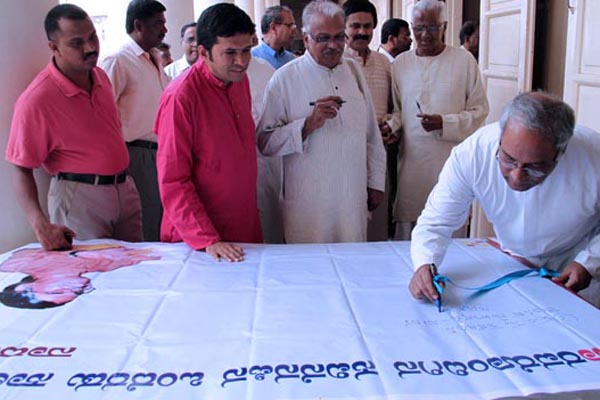
The programme got off in a unique way, with veteran Kannada poet, Nadoja K.S. Nisar Ahmed, playing Veena, which was decorated with flowers. In fact, the novelty left Mr. Ahmed and other guests flabbergasted as most of them appeared to be novices when it came to playing a musical instrument. Mr. Ahmed, who ambled towards the instrument, was seen asking fellow guests on the dais on how to play the instrument. After getting some quick tips from Mr. Shetty, he hesitatingly fiddled with the strings, but did not succeed in producing any musical sound.

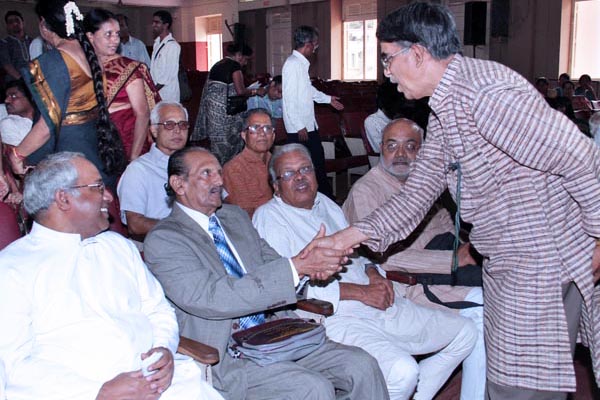
The guests on the dais namely Girish Kasaravalli, celebrated film director, B.A Vivek Rai, visiting professor at the Wurzburg University of Germany, Fr. Francis Serrao, new Provincial of Karnataka Jesuits, B. Jyashri, Rajyasabha M.P., Pradhan Gurudatt, linguist, Dr. C.N. Ramachandran, retired professor of English, among others, also tried to play a tune or two. But, it was Na Damodar Shetty, popularly known as Nada, who was able to play the instrument properly, befitting of a man who is known to don several hats with aplomb, and won a big round of applause from the audience.

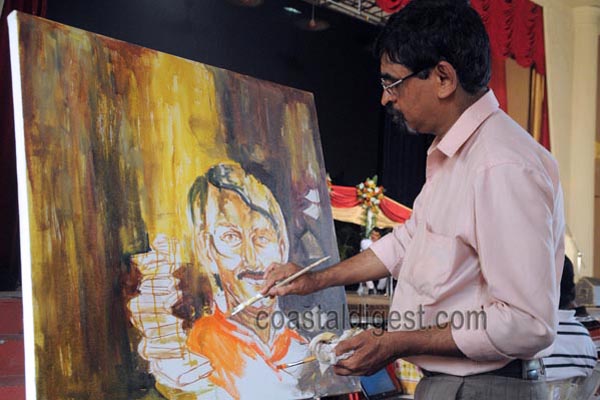
Even as the inauguration ceremony was underway on the stage, an artistic tribute to the writer was paid by Sunil Abraham, who painted a caricature of Nada on the canvas erected in front of the dais. By the time the inaugural ceremony was over, the artist, with the help of Praveen Poojary, an artist from Yenepoya University, had completed the painting.

Speaking after inaugurating the programme, Mr. Nisar Ahmed highlighted the importance of preparing Kannada to face the onslaught of globalization and liberalization. “We cannot remain immune to the influences of globalization. We have to brace ourselves to the challenges. We should make sure that Kannada retains its primacy even as our children learn English,” he said.

Lauding the efforts of Nada in promoting the language and culture, Mr. Ahmed said, the contribution of Nada as an organizer and a promoter of literature needs to be acknowledged because, only through sustained campaigning and publicity, literary books can reach the masses. “Nada has played a phenomenal role in popularizing Kannada literature and art in this part of the State through his tireless work as an organisor, a teacher, a writer and a dramatist. Today Kannada literature is starved of adequate readership. The number of readers is dwindling. The younger generation is attracted towards new media of communication like CDs and DVDs. We need to safeguard the book culture, which is increasingly confined to libraries now,” he said.

Heaping praises on Nada, he said: “Through his writings and personality, Nada has set an example for the younger generations. He is a man with a brain of a genius and a noble heart.”

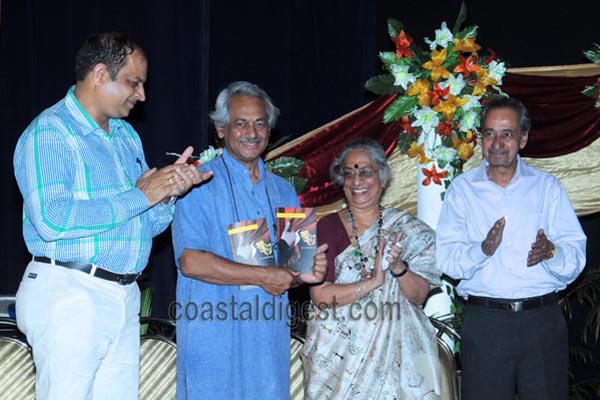
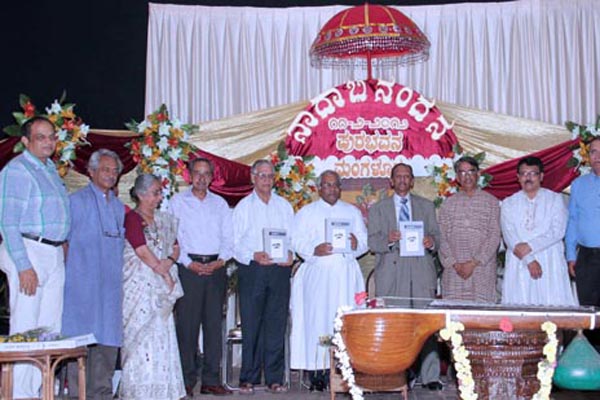
Speaking after releasing “Nadaloka” a commemorative book on Nada, Mr Gurudatt, said by instituting an award in the name of S.V. Parameshwar Bhat, Mr. Nada along with his friends has tried to immortalize the genius, who served Dakshina Kannada district with rare distinction. “Even people in Mysore could not make any effort to immortalize the name of Parameshwar Bhat who had spent several years in the erstwhile capital of Mysore Kings. By instituting an award in the name of Parameshwar, Nada and his friends have done a commendable job,” Mr. Gurudatt said.

He also lauded the translation skills of Nada and said, the books he translated appeared as if they were original Kannada titles. “He has played the role of a bridge between Kannada and Malayalam languages. The young writers have lot to learn from his translation skills. The book on K.V. Subbanna, he had edited for the Kuvempu Bhasha Bharathi left us with hardly any scope for revision. He is a perfectionist,” Mr. Gurudatt said.

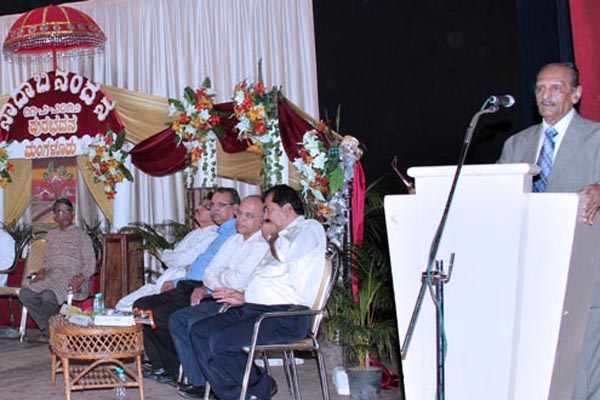
Speaking on the occasion, P. Jayaram Bhat, Karnataka Bank managing director, said, Nada was a rare jewel, that all the people of Dakshina Kannada can be proud of. Dr. Sabiha, Kannada Department, Mangalore University, spoke on behalf of the editorial board of Nadaloka.

Jayashri, released a CD titled 'Nada Bhava' a musical tribute to the writer consisting eight songs.

Francis Serrao, in his presidential address, hailed his contribution as a teacher at the St. Aloysius College. “He always tried to infuse life into textbooks. He introduced novel approaches to teaching by interacting with the students and exposing them to the world beyond the textbooks. He was a generous man who helped poor students by paying their fee. He brought laurels to the institution with his multiple talents. Even when he had a difference of opinion, he used to express his dissent with lot of patience,” Mr. Serrao said.

Professor A.M. Narahari welcomed the gathering. Srinivas Deshpande, delivered a vote of thanks. Dr. Mohan Alva, the chairman of the felicitation committee, was present on the occasion.

The inaugural programme was followed by literary sessions and Sugama Sangeetha.

nada_abhinandane_2

nada_abhinandane_2a

nada_abhinandane_3

nada_abhinandane_4

nada_abhinandane_5

nada_abhinandane_6

nada_abhinandane_7

nada_abhinandane_8

nada_abhinandane_9

nada_abhinandane_10

nada_abhinandane_11

nada_abhinandane_12

nada_abhinandane_13

nada_abhinandane_14

nada_abhinandane_15

nada_abhinandane_16

nada_abhinandane_17

Comments

Add new comment

  • Coastaldigest.com reserves the right to delete or block any comments.
  • Coastaldigset.com is not responsible for its readers’ comments.
  • Comments that are abusive, incendiary or irrelevant are strictly prohibited.
  • Please use a genuine email ID and provide your name to avoid reject.
News Network
January 23,2026

Karnataka Governor Thaawarchand Gehlot read only three lines from the 122-paragraph address prepared by the Congress-led state government while addressing the joint session of the Legislature on Thursday, effectively bypassing large sections critical of the BJP-led Union government.

The omitted portions of the customary Governor’s address outlined what the state government described as a “suppressive situation in economic and policy matters” under India’s federal framework. The speech also sharply criticised the Centre’s move to replace the Mahatma Gandhi National Rural Employment Guarantee Act (MGNREGA) with the Viksit Bharat–Guarantee for Rozgar and Ajeevika Mission (Gramin) Act, commonly referred to as the VB-GRAM (G) Act.

Governor Gehlot had earlier conveyed his objection to several paragraphs that were explicitly critical of the Union government. On Thursday, he confined himself to the opening lines — “I extend a warm welcome to all of you to the joint session of the State legislature. I am extremely pleased to address this august House” — before jumping directly to the concluding sentence of the final paragraph.

He ended the address by reading the last line of paragraph 122: “Overall, my government is firmly committed to doubling the pace of the State’s economic, social and physical development. Jai Hind — Jai Karnataka.”

According to the prepared speech, the Karnataka government demanded the scrapping of the VB-GRAM (G) Act, describing it as “contractor-centric” and detrimental to rural livelihoods, and called for the full restoration of MGNREGA. The state government argued that the new law undermines decentralisation, weakens labour protections, and centralises decision-making in violation of constitutional norms.

Key points from the unread sections of the speech:

•    Karnataka facing a “suppressive” economic and policy environment within the federal system

•    Repeal of MGNREGA described as a blow to rural livelihoods

•    VB-GRAM (G) Act accused of protecting corporate and contractor interests

•    New law alleged to weaken decentralised governance

•    Decision-making said to be imposed by the Centre without consulting states

•    Rights of Adivasis, women, backward classes and agrarian communities curtailed

•    Labourers allegedly placed under contractor control

•    States facing mounting fiscal stress due to central policies

•    VB-GRAM (G) Act accused of enabling large-scale corruption

Comments

Add new comment

  • Coastaldigest.com reserves the right to delete or block any comments.
  • Coastaldigset.com is not responsible for its readers’ comments.
  • Comments that are abusive, incendiary or irrelevant are strictly prohibited.
  • Please use a genuine email ID and provide your name to avoid reject.
News Network
February 5,2026

Bengaluru: As air quality continues to worsen across several parts of the city, hospitals in Bengaluru are reporting a steady rise in patients suffering from respiratory illnesses such as asthma, bronchitis and Chronic Obstructive Pulmonary Disease (COPD), health officials and doctors said.

Data from the Suvarna Arogya Suraksha Trust (SAST) shows that 3,891 patients received treatment for respiratory ailments between April and November 2024. The figure rose to 4,187 during the same period in 2025.

Private hospitals, too, are witnessing a 10–15 per cent year-on-year increase in such cases.

While doctors caution that the rise cannot be attributed solely to air pollution, a significant number of patients are non-smokers with no prior history of respiratory disease.

“Nearly 70 per cent of the patients we see are non-smokers with no previous respiratory issues. When other causes are ruled out, air pollution emerges as the most likely factor,” said Dr Manjunath PH, consultant interventional pulmonologist at a hospital in Kengeri.

Doctors noted that patient footfall spikes during the winter months and around Deepavali, when air quality typically worsens.

“There is a clear correlation between poor air quality and the rise in cases. People commonly present with persistent cough, breathlessness and irritation of the respiratory tract, indicating the impact of polluted air on their health,” said Dr Sheetal Chaurasia, consultant in pulmonary medicine at a private hospital in Whitefield.

Dr Chaurasia added that respiratory tract infections are also on the rise.

“Poor air quality leads to chronic airway inflammation, making the airways more vulnerable to infections. We are seeing an increase in both upper and lower respiratory tract infections,” she said.

Patients with pre-existing respiratory conditions remain the worst affected.

“For those already diagnosed with respiratory illnesses, deteriorating air quality significantly worsens the condition. Both the frequency and severity of attacks increase sharply,” said Dr Vandana P, a pulmonologist at a hospital on Bannerghatta Road.

Doctors also flagged a worrying trend of rising respiratory problems among younger adults and children.

To reduce exposure, they advised people to wear masks while travelling on two-wheelers or autos and ensure adequate ventilation at home to minimise indoor air pollution.

Comments

Add new comment

  • Coastaldigest.com reserves the right to delete or block any comments.
  • Coastaldigset.com is not responsible for its readers’ comments.
  • Comments that are abusive, incendiary or irrelevant are strictly prohibited.
  • Please use a genuine email ID and provide your name to avoid reject.
News Network
February 1,2026

Bengaluru: Karnataka Deputy Chief Minister D K Shivakumar on Sunday criticised the Union Budget presented by Finance Minister Nirmala Sitharaman, claiming it offered no tangible benefit to the state.

Though he said he was yet to study the budget in detail, Shivakumar asserted that Karnataka had gained little from it. “There is no benefit for our state from the central budget. I was observing it. They have now named a programme after Mahatma Gandhi, after repealing the MGNREGA Act that was named after him,” he said.

Speaking to reporters here, the Deputy Chief Minister demanded the restoration of MGNREGA, and made it clear that the newly enacted rural employment scheme — VB-G RAM G — which proposes a 60:40 fund-sharing formula between the Centre and the states, would not be implemented in Karnataka.

“I don’t see any major share for our state in this budget,” he added.

Shivakumar, who also holds charge of Bengaluru development, said there were high expectations for the city from the Union Budget. “The Prime Minister calls Bengaluru a ‘global city’, but what has the Centre done for it?” he asked.

He also drew attention to the problems faced by sugar factories, particularly those in the cooperative sector, alleging a lack of timely decisions and support from the central government.

Noting that the Centre has the authority to fix the minimum support price (MSP) for agricultural produce, Shivakumar said the Union government must take concrete steps to protect farmers’ interests.

Comments

Add new comment

  • Coastaldigest.com reserves the right to delete or block any comments.
  • Coastaldigset.com is not responsible for its readers’ comments.
  • Comments that are abusive, incendiary or irrelevant are strictly prohibited.
  • Please use a genuine email ID and provide your name to avoid reject.