Increase efficiency, export value-added products: Expert

February 13, 2012

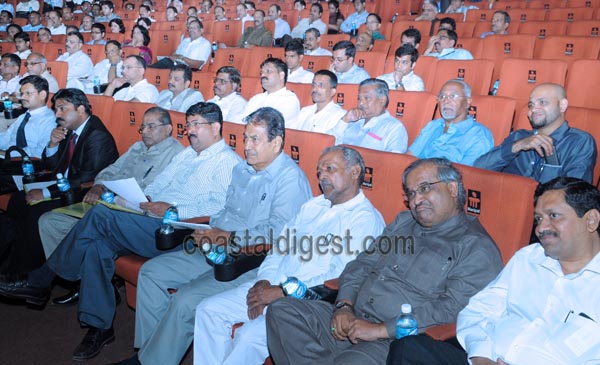
Mangalore, February 13: Export expert Anup K Pujari has laid emphasis on the need of increasing efficiency and exporting value-added products to new markets to increase the nations export.

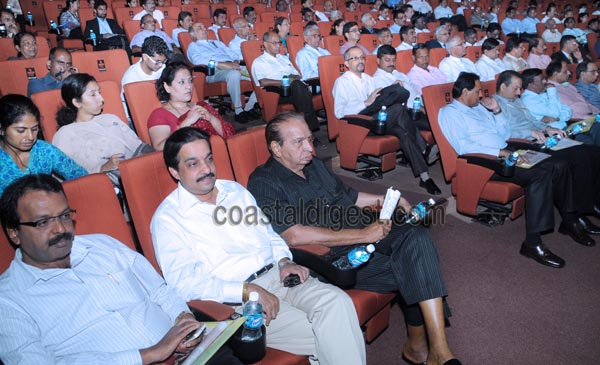
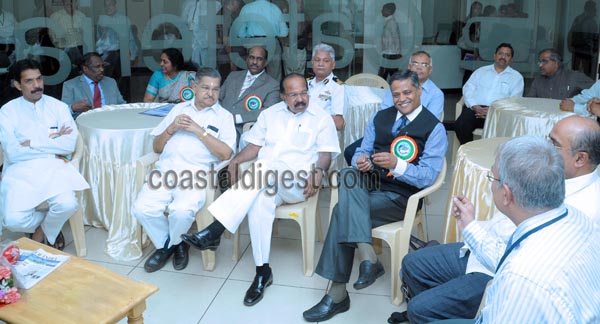
Speaking at a question and answer session at 'Karnataka: Export Vision-2020,' a convention of exporters organised by the Southern Region of Federation of Indian Export Organisations, he said that increasing port capacity would also be helpful in increasing exports.

Mr Pujari, who is the Director General Foreign Trade (DGFT), Union Ministry of Commerce, said that exporters must sell value-added products if India's exports should hit $ 300 billion-mark by the end of this financial year and $ 500 billion in two years.

He also suggested that instead of yarn, fashion garments could be exported.

Rafeeque Ahmad, president, FIEO, said that for exports to move up the value chain requires faster transport and clearances. While exporting traditional commodities could afford a time of two months and a further delay of a fortnight, clusters must be very active to reach consumers quickly.

He said exporters should identify clusters or combine two to three places into a cluster (so that they can send products together to containers and get clearances faster from the Ministry of Commerce).

Ajay Sahay said the Ministry of Commerce was studying clusters of exporters and their proximity to ports. The Government was looking at 70 clusters and their connectivity to ports and airports. The report would be ready by March 31, he said. In Chennai, despite units being close to the port, export products were going to ports other than Chennai, he said.

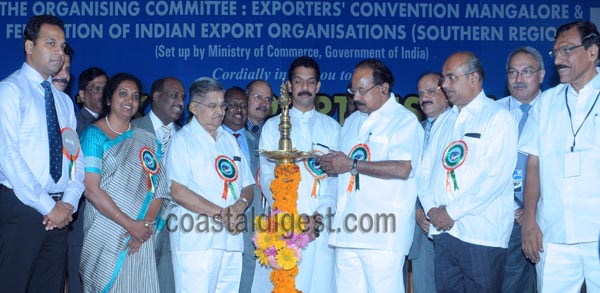
Earlier, inaugurating the convention, Mr. Ahmad said that if India had to increase exports to $ 500 billion by 2014, the Centre and the States must work together and States should think of exports as priority. States should not levy taxes on imports used in (production of goods meant for) exports. Exports should be treated as a public utility to avoid flash strikes (within export units), he said.

The concerns for exporters in Karnataka were a deficit of power and power quality, need for an air cargo complex with a cold chain in Mangalore, exports going through Chennai, which had a congested port, and lack of infrastructure.

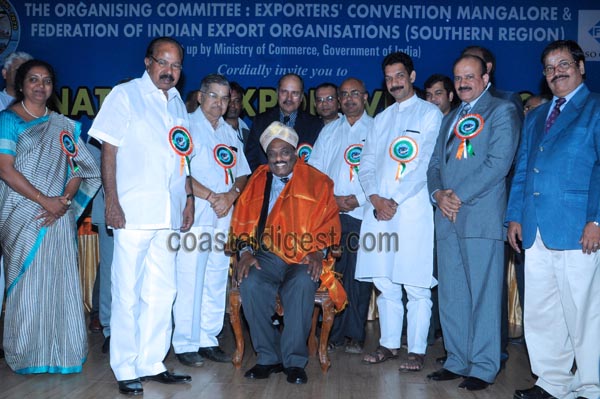
M. Veerappa Moily, Minister for Corporate Affairs, said that if India had to reach a share of 4 per cent of global trade by 2020, that is $ 2,480 billion, it would require massive capacity building in infrastructure and human resources. India's merchandise exports might fall short of the target of $ 300 billion set for 2011-12, he said. If companies in the U.S. and European Union reduced their IT budgets, it might affect prospects for India's software exports, he said.

Mr. Moily said that each district should have a research and development cell for exports, which should work on innovating exports. He said that Karnataka ranked lowest in the development of infrastructure among Southern States.

Speaking about the export potential of Mangalore, he said the city would be the gateway and the second commercial capital of India after Mumbai.

VSN_2020Feb13_2

VSN_2020Feb13_3

VSN_2020Feb13_4

VSN_2020Feb13_5

VSN_2020Feb13_6

VSN_2020Feb13_7

VSN_2020Feb13_8

VSN_2020Feb13_9

VSN_2020Feb13_10

VSN_2020Feb13_11

VSN_2020Feb13_13

Comments

Add new comment

  • Coastaldigest.com reserves the right to delete or block any comments.
  • Coastaldigset.com is not responsible for its readers’ comments.
  • Comments that are abusive, incendiary or irrelevant are strictly prohibited.
  • Please use a genuine email ID and provide your name to avoid reject.
News Network
February 5,2026

In an era where digital distractions are the primary rival to academic excellence, the Karnataka Education Department is taking the fight directly to the living room. As the SSLC (Class 10) annual examinations loom, officials have launched a localized "digital strike" to ensure students aren't losing their competitive edge to scrolling or soap operas.

The 7-to-9 Lockdown

The department has issued a formal directive urging—and in some cases, enforcing via home visits—a total blackout of mobile phones and television sets between 7:00 PM and 9:00 PM. This two-hour window is being designated as "sacred study time" across the state until the examinations conclude on April 2.

Key Pillars of the Initiative:

•    Doorstep Advocacy: Teachers are transitioning from classrooms to living rooms, meeting parents to explain the psychological benefits of a distraction-free environment.

•    Parental Accountability: The campaign shifts the burden of discipline from the student to the household, asking parents to lead by example and switch off their own devices.

•    The Timeline: The focus remains sharp on the upcoming exam block, scheduled from March 18 to April 2.

"The objective is simple: uninterrupted focus. We are reclaiming the evening hours for the students, ensuring their environment is as prepared as their minds," stated a senior department official.

Student vs. Reality

While the student community has largely welcomed the "forced focus"—with many admitting they lack the willpower to ignore notifications—the move has sparked a debate on enforceability. Without a "TV Police," the success of this initiative rests entirely on the shoulders of parents and the persuasive power of visiting educators.

Comments

Add new comment

  • Coastaldigest.com reserves the right to delete or block any comments.
  • Coastaldigset.com is not responsible for its readers’ comments.
  • Comments that are abusive, incendiary or irrelevant are strictly prohibited.
  • Please use a genuine email ID and provide your name to avoid reject.
News Network
January 31,2026

Roy.jpg

Bengaluru: The shooting incident involving CJ Roy, founder of the Confident Group, has once again put the spotlight on a businessman whose life has swung between flamboyant global success and persistent controversy at home.

Though Roy’s business interests extended across continents, his roots lay firmly in Karnataka. An alumnus of Christ School in Bengaluru, he later moved to Tumakuru to pursue an engineering degree. Those familiar with his early years describe him as intensely ambitious, beginning his career as a salesman at a small electronics firm dealing in computers.

Roy’s entry into large-scale real estate came through the Crystal Group, where he worked closely with Latha Namboothiri and rose from manager to director. However, the launch of the Confident Group in 2005 was clouded by industry speculation. Insiders speak of a fallout involving alleged “benami” properties and claims of deception that ultimately led to his independent venture—an episode Roy spent years trying to distance himself from, according to associates.

A tale of two cities

Roy’s professional trajectory diverged sharply across geographies.

In Dubai, he built a reputation as a bold and efficient developer, completing massive luxury residential projects in record time—some reportedly within 11 months. His rapid project delivery and lavish lifestyle in the Emirates earned him admiration and visibility in the real estate sector.

In Bengaluru, however, his image remained far more fractured. Sources say Roy stayed away from the city for several years amid disputes over unpaid dues to vendors and suppliers. Several projects were allegedly stalled, with accusations of unfulfilled commitments to cement and steel suppliers continuing to follow him.

Roy’s return to Bengaluru’s business and social circles began around 2018, marked by a conscious attempt at rebranding. His appointment as Honorary Consul of the Slovak Republic added diplomatic legitimacy, which he complemented with visible CSR initiatives, including ambulance donations and high-profile charity events.

Heavy police presence in Langford Town

Following the incident, police personnel from the Central division were deployed outside the Confident Group building in Langford Town, which also houses the Slovak Honorary Consulate in Bengaluru.

The otherwise busy premises near Hosur Road wore a deserted look on Friday, reflecting the shock and uncertainty that followed the tragedy.

Comments

Add new comment

  • Coastaldigest.com reserves the right to delete or block any comments.
  • Coastaldigset.com is not responsible for its readers’ comments.
  • Comments that are abusive, incendiary or irrelevant are strictly prohibited.
  • Please use a genuine email ID and provide your name to avoid reject.
coastaldigest.com news network
February 5,2026

protestkerala.jpg

Mangaluru: The KSRTC Mangaluru division has rolled back the fare hike on buses operating on the Mangaluru–Kasaragod route following the suspension of toll collection at the Arikkady toll plaza near Kumbala in Kasaragod district.

The fare revision had been implemented after the National Highways Authority of India (NHAI) began toll collection at the Arikkady plaza on NH-66. As a result, fares for ordinary and Rajahamsa services were increased by ₹7 and ₹10, respectively, raising the bus fare from Mangaluru to Kasaragod from ₹81 to ₹88.

Senior Divisional Controller of KSRTC’s Mangaluru division, Rajesh Shetty, said the fares were reduced after toll collection at the Arikkady plaza was stopped. “The tollgate began operations on January 13, and the toll amount was deducted from the FASTag accounts of KSRTC buses operating on the route. Following an order from the central government to suspend toll collection, KSRTC has also withdrawn the additional fare with immediate effect,” he said.

At present, vehicles travelling on the Mangaluru–Kasaragod route pay toll only at the Talapady toll plaza. The toll for light motor vehicles (LMVs) at Talapady is ₹80 for a same-day return, while heavy vehicles, including buses, are charged ₹250. At Arikkady, the toll rates were ₹130 for LMVs (same-day return) and ₹450 for buses.

Protests against Arikkady toll plaza

The Arikkady toll plaza witnessed widespread protests from January 12, the day toll collection commenced. On the second day, an action committee led by Manjeshwar MLA A K M Ashraf launched an indefinite protest at the site. Except for the BJP, leaders and workers of most major political parties participated in the agitation.

On the night of January 14, a large number of protesters gathered at the plaza and vandalised property, following which authorities temporarily suspended toll operations. The BJP later also expressed opposition to the toll plaza and criticised NHAI’s decision. 

Comments

Add new comment

  • Coastaldigest.com reserves the right to delete or block any comments.
  • Coastaldigset.com is not responsible for its readers’ comments.
  • Comments that are abusive, incendiary or irrelevant are strictly prohibited.
  • Please use a genuine email ID and provide your name to avoid reject.