No ban on mobile phones at MCC, but Mayor lays down restrictions

February 17, 2012

MCC_Feb17_1

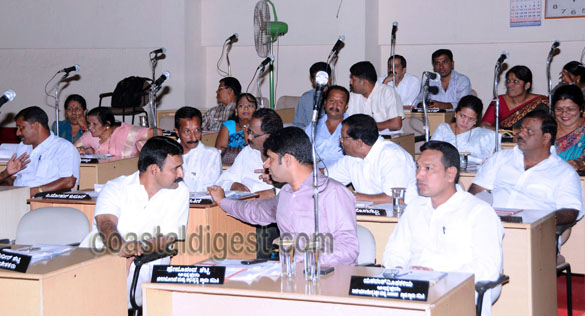
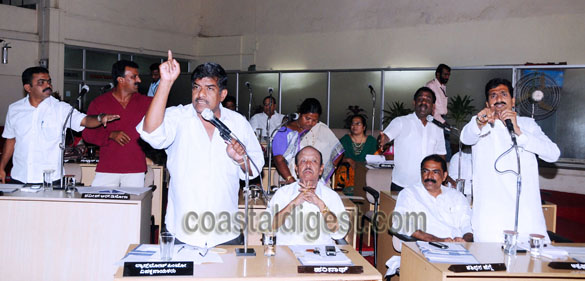
Mangalore, February 18: The use of mobile phones during the council meetings became an issue of debate at the Mangalore City Corporation council meeting, with majority of the members demanding restriction on the use of the modern communication gadget.

Initiating a discussion, former mayor K Ashraf demanded that use of mobile phones should be banned inside the house as it had become a huge nuisance.

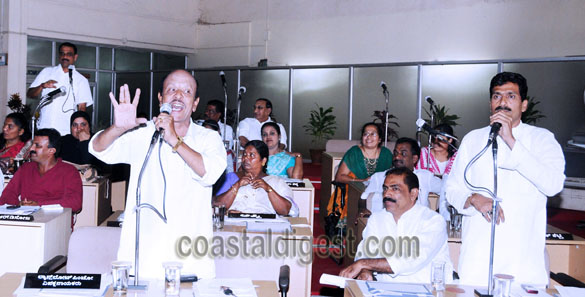
He urged mayor Praveen to pass a ruling banning use of mobile phone in the house, a suggestion which evoked support across party lines. However, there were dissenting voices also. Mariamma Thomas and some others pointed out that a blanket ban on use of mobile phone during the session would deprive them of a communication tool in the event of an emergency.

“This will also create a wrong impression among the voters, who would think that their calls are being deliberately left unanswered,” she said, with several nodding in support.

But, Ashraf, supported by some other members, said that the calls can be answered once the meeting was over. “You can also inform them that you were attending the council meeting,” he added.

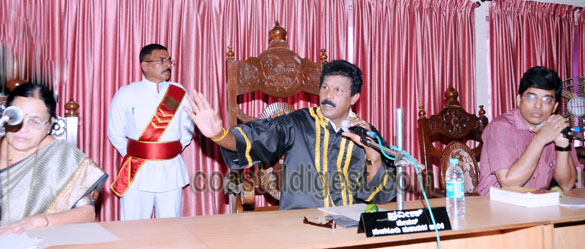
After a few minutes of animated discussion, the Mayor gave his ruling and laid some restrictions on use of mobile when the council is in meeting. "The mobile phones should be kept in the silent mode. Let members use mobile phones, but should go out of the house if they want to make or receive calls," he said.

Eariler, corporators, cutting across political lines, blamed officials for not ensuring proper supply of drinking water.

Members from BJP, the ruling party, Congress, JD(S) and CPI(M) alleged that water supply was being disrupted frequently in their respective wards. Earlier, member from Congress Lancelot Pinto had raised objection to MCC's decision to disconnect public taps in the city. "Many poor families, who live in rented houses in the city, use public taps for their daily water requirement. The city corporation officials should make alternative arrangements for those families, who use public taps, before disconnecting it," he demanded.

Members Mariamma, Vijayakumar Shetty, Nagendra, Harinath, Abdul Azeez, Shashidhar Hegde and others too criticized officials for not ensuring proper water supply. CommissionerHarish Kumar said that the city corporation would have to disconnect the public taps and fix meters to all water supply connections to qualify for getting a Rs 2,000 crore grant underJawaharlal Nehru National Urban Renewal Mission (JnNURM).

"There should be no public taps, no illegal water supply connections and 24x7 water supply should be ensured to all connections, which have meters compulsorily as per the norms of JNNURM. Hence, the city corporation will have to continue the drive against public taps and illegal water supply connections. However, we will disconnect those public taps, which is being used by many poor families, only after providing legal connections to all of them," he said.

Harish said that there is no scarcity of water in the city, but due to the shifting process and other technical reasons supply was being disrupted in some areas.

"A special meet in this regard will be convened by the mayor soon," he added.
MCC_Feb17_2

MCC_Feb17_3

MCC_Feb17_4

Comments

Add new comment

  • Coastaldigest.com reserves the right to delete or block any comments.
  • Coastaldigset.com is not responsible for its readers’ comments.
  • Comments that are abusive, incendiary or irrelevant are strictly prohibited.
  • Please use a genuine email ID and provide your name to avoid reject.
News Network
February 5,2026

In an era where digital distractions are the primary rival to academic excellence, the Karnataka Education Department is taking the fight directly to the living room. As the SSLC (Class 10) annual examinations loom, officials have launched a localized "digital strike" to ensure students aren't losing their competitive edge to scrolling or soap operas.

The 7-to-9 Lockdown

The department has issued a formal directive urging—and in some cases, enforcing via home visits—a total blackout of mobile phones and television sets between 7:00 PM and 9:00 PM. This two-hour window is being designated as "sacred study time" across the state until the examinations conclude on April 2.

Key Pillars of the Initiative:

•    Doorstep Advocacy: Teachers are transitioning from classrooms to living rooms, meeting parents to explain the psychological benefits of a distraction-free environment.

•    Parental Accountability: The campaign shifts the burden of discipline from the student to the household, asking parents to lead by example and switch off their own devices.

•    The Timeline: The focus remains sharp on the upcoming exam block, scheduled from March 18 to April 2.

"The objective is simple: uninterrupted focus. We are reclaiming the evening hours for the students, ensuring their environment is as prepared as their minds," stated a senior department official.

Student vs. Reality

While the student community has largely welcomed the "forced focus"—with many admitting they lack the willpower to ignore notifications—the move has sparked a debate on enforceability. Without a "TV Police," the success of this initiative rests entirely on the shoulders of parents and the persuasive power of visiting educators.

Comments

Add new comment

  • Coastaldigest.com reserves the right to delete or block any comments.
  • Coastaldigset.com is not responsible for its readers’ comments.
  • Comments that are abusive, incendiary or irrelevant are strictly prohibited.
  • Please use a genuine email ID and provide your name to avoid reject.
News Network
February 1,2026

Bengaluru: Karnataka Deputy Chief Minister D K Shivakumar on Sunday criticised the Union Budget presented by Finance Minister Nirmala Sitharaman, claiming it offered no tangible benefit to the state.

Though he said he was yet to study the budget in detail, Shivakumar asserted that Karnataka had gained little from it. “There is no benefit for our state from the central budget. I was observing it. They have now named a programme after Mahatma Gandhi, after repealing the MGNREGA Act that was named after him,” he said.

Speaking to reporters here, the Deputy Chief Minister demanded the restoration of MGNREGA, and made it clear that the newly enacted rural employment scheme — VB-G RAM G — which proposes a 60:40 fund-sharing formula between the Centre and the states, would not be implemented in Karnataka.

“I don’t see any major share for our state in this budget,” he added.

Shivakumar, who also holds charge of Bengaluru development, said there were high expectations for the city from the Union Budget. “The Prime Minister calls Bengaluru a ‘global city’, but what has the Centre done for it?” he asked.

He also drew attention to the problems faced by sugar factories, particularly those in the cooperative sector, alleging a lack of timely decisions and support from the central government.

Noting that the Centre has the authority to fix the minimum support price (MSP) for agricultural produce, Shivakumar said the Union government must take concrete steps to protect farmers’ interests.

Comments

Add new comment

  • Coastaldigest.com reserves the right to delete or block any comments.
  • Coastaldigset.com is not responsible for its readers’ comments.
  • Comments that are abusive, incendiary or irrelevant are strictly prohibited.
  • Please use a genuine email ID and provide your name to avoid reject.
News Network
February 3,2026

wind.jpg

Dakshina Kannada MP Capt Brijesh Chowta has urged the Centre to give high priority to offshore wind energy generation along the Mangaluru coast, citing its strategic importance to India’s green energy and port-led development goals.

Raising the issue in the Lok Sabha under Rule 377, Chowta said studies by the National Institute of Oceanography have identified the Mangaluru coastline as part of India’s promising offshore wind ‘Zone-2’, covering nearly 6,490 sq km. He noted that the region’s relatively low exposure to cyclones and earthquakes makes it suitable for long-term offshore wind projects and called for its development as a dedicated offshore wind energy zone.

Highlighting the role of New Mangalore Port, Chowta said its modern infrastructure, multiple berths and heavy cargo-handling capacity position it well as a logistics hub for transporting and assembling large wind energy equipment.

He also pointed to the presence of major industrial units such as MRPL, OMPL, UPCL and the Mangaluru SEZ, which could serve as direct buyers of green power through power purchase agreements, improving project viability and speeding up execution.

With Karnataka’s peak power demand crossing 18,000 MW in early 2025, Chowta stressed the need to diversify renewable energy sources. He added that offshore wind projects in the Arabian Sea are strategically safer compared to the cyclone-prone Bay of Bengal.

Calling the project vital to India’s target of 500 GW of renewable energy by 2030, Chowta urged the Ministry of New and Renewable Energy to initiate resource assessments, pilot projects and stakeholder consultations at the earliest.

Comments

Add new comment

  • Coastaldigest.com reserves the right to delete or block any comments.
  • Coastaldigset.com is not responsible for its readers’ comments.
  • Comments that are abusive, incendiary or irrelevant are strictly prohibited.
  • Please use a genuine email ID and provide your name to avoid reject.