No ban on mobile phones at MCC, but Mayor lays down restrictions

February 17, 2012

MCC_Feb17_1

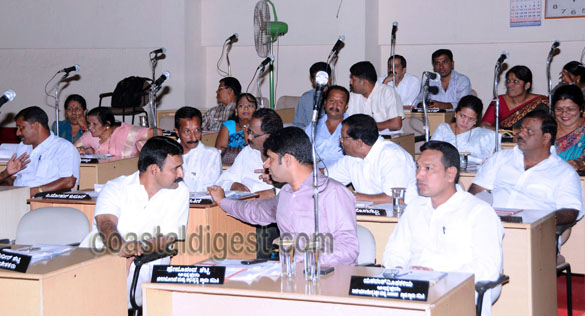
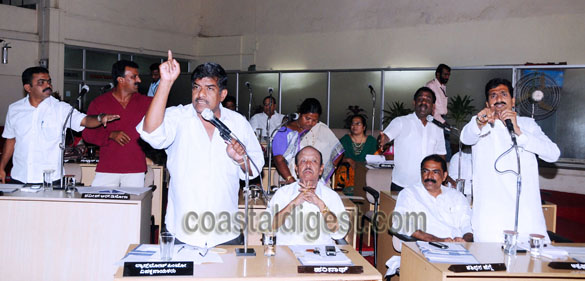
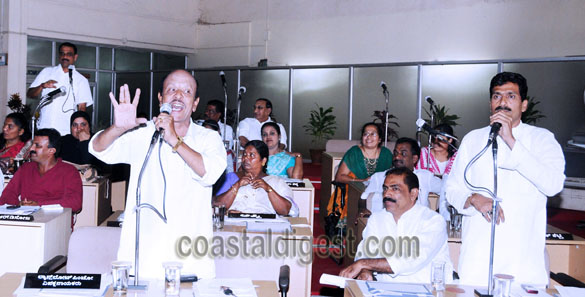
Mangalore, February 18: The use of mobile phones during the council meetings became an issue of debate at the Mangalore City Corporation council meeting, with majority of the members demanding restriction on the use of the modern communication gadget.

Initiating a discussion, former mayor K Ashraf demanded that use of mobile phones should be banned inside the house as it had become a huge nuisance.

He urged mayor Praveen to pass a ruling banning use of mobile phone in the house, a suggestion which evoked support across party lines. However, there were dissenting voices also. Mariamma Thomas and some others pointed out that a blanket ban on use of mobile phone during the session would deprive them of a communication tool in the event of an emergency.

“This will also create a wrong impression among the voters, who would think that their calls are being deliberately left unanswered,” she said, with several nodding in support.

But, Ashraf, supported by some other members, said that the calls can be answered once the meeting was over. “You can also inform them that you were attending the council meeting,” he added.

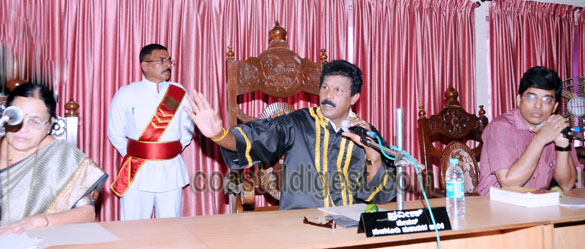
After a few minutes of animated discussion, the Mayor gave his ruling and laid some restrictions on use of mobile when the council is in meeting. "The mobile phones should be kept in the silent mode. Let members use mobile phones, but should go out of the house if they want to make or receive calls," he said.

Eariler, corporators, cutting across political lines, blamed officials for not ensuring proper supply of drinking water.

Members from BJP, the ruling party, Congress, JD(S) and CPI(M) alleged that water supply was being disrupted frequently in their respective wards. Earlier, member from Congress Lancelot Pinto had raised objection to MCC's decision to disconnect public taps in the city. "Many poor families, who live in rented houses in the city, use public taps for their daily water requirement. The city corporation officials should make alternative arrangements for those families, who use public taps, before disconnecting it," he demanded.

Members Mariamma, Vijayakumar Shetty, Nagendra, Harinath, Abdul Azeez, Shashidhar Hegde and others too criticized officials for not ensuring proper water supply. CommissionerHarish Kumar said that the city corporation would have to disconnect the public taps and fix meters to all water supply connections to qualify for getting a Rs 2,000 crore grant underJawaharlal Nehru National Urban Renewal Mission (JnNURM).

"There should be no public taps, no illegal water supply connections and 24x7 water supply should be ensured to all connections, which have meters compulsorily as per the norms of JNNURM. Hence, the city corporation will have to continue the drive against public taps and illegal water supply connections. However, we will disconnect those public taps, which is being used by many poor families, only after providing legal connections to all of them," he said.

Harish said that there is no scarcity of water in the city, but due to the shifting process and other technical reasons supply was being disrupted in some areas.

"A special meet in this regard will be convened by the mayor soon," he added.
MCC_Feb17_2

MCC_Feb17_3

MCC_Feb17_4

Comments

Add new comment

  • Coastaldigest.com reserves the right to delete or block any comments.
  • Coastaldigset.com is not responsible for its readers’ comments.
  • Comments that are abusive, incendiary or irrelevant are strictly prohibited.
  • Please use a genuine email ID and provide your name to avoid reject.
News Network
February 4,2026

shettigar.jpg

An Indian resident who won the Dh20 million (approximately Rs 50 crore) jackpot in Abu Dhabi's Big Ticket draw has told of his joy at sharing his life-changing fortune with a friend.

Shanthanu Shettigar, a shop manager in Muscat, regularly buys tickets for the monthly grand prize draw with one of his closest friends – and the pair won on February 3.

Mr Shettigar, 33, who is from Udyavar in Udupi district of the southern state of Karnataka and has lived in the Omani capital for eight years, said he was left speechless after learning of his success.

“When I first moved to Muscat, many of my colleagues were purchasing Big Ticket, which encouraged me to give it a try,” he said.

“I started buying tickets on my own, and later began sharing tickets with a close friend. The ticket that brought me this win was one we purchased together.”

“Like most people, I receive a lot of spam calls, and I was fully absorbed in my work as well. I knew the live draw was taking place tonight, but I never imagined my name would be announced,” he said.

“When I realised it was real and that I had won, I was honestly speechless. It still hasn’t fully sunk in, but I’m extremely happy.”

Mr Shettigar is not sure how he will spend his share of the money, but encouraged others to take part.

“This win was completely unexpected, so I want to take some time to think things through before deciding what to do next,” he said.

“I would definitely encourage others to participate with Big Ticket, whether with family or friends – you never know when your moment might come.”

The Big Ticket was established in 1992 with an initial first prize of Dh1 million. It is one of the most popular monthly raffles in the UAE.

It has transformed the lives of many people across the Emirates and beyond.

Entry to the Big Ticket Millionaire is Dh500. Tickets can be bought online or at counters at Zayed International Airport and Al Ain Airport.

Comments

Add new comment

  • Coastaldigest.com reserves the right to delete or block any comments.
  • Coastaldigset.com is not responsible for its readers’ comments.
  • Comments that are abusive, incendiary or irrelevant are strictly prohibited.
  • Please use a genuine email ID and provide your name to avoid reject.
News Network
February 1,2026

Bengaluru: The Karnataka High Court has refused to quash an investigation against a WhatsApp group administrator accused of allowing the circulation of obscene and offensive images depicting Hindutva politicians and idols in 2021.

Justice M Nagaprasanna observed that, prima facie, the ingredients of the offence under Section 295A of the Indian Penal Code were made out. “The offence under Section 295A of the IPC is met to every word of its ingredient, albeit prima facie,” the judge said.

The petitioner, Sirajuddin, a resident of Belthangady taluk in Dakshina Kannada district, had challenged the FIR registered against him at the CEN (Cyber, Economics and Narcotics) police station, Mangaluru, for offences under Section 295A of the IPC and Section 67 of the Information Technology Act. Section 295A relates to punishment for deliberate and malicious acts intended to outrage the religious feelings of any class of citizens.

According to the complaint filed by K Jayaraj Salian, also a resident of Belthangady taluk, he received a WhatsApp group link from an unknown source and was added to the group after accessing it. The group reportedly had six administrators and around 250 participants, where obscene and offensive images depicting Hindu deities and certain political figures were allegedly circulated repeatedly.

Sirajuddin was arrested in connection with the case and later released on bail on February 16, 2021. He argued before the court that he was being selectively targeted, while other administrators—including the creator of the group—were neither arrested nor investigated. He also contended that the Magistrate could not have taken cognisance of the offence under Section 295A without prior sanction under Section 196(1) of the CrPC.

Rejecting the argument, Justice Nagaprasanna held that prior sanction is required only at the stage of taking cognisance, and not at the stage of registration of the crime or during investigation.

The judge noted that the State had produced the entire investigation material before the court. “A perusal of the material reveals depictions of Hindu deities in an extraordinarily obscene, demeaning and profane manner. The content is such that its reproduction in a judicial order would itself be inappropriate,” the court said, adding that the material, on its face, had the tendency to outrage religious feelings and disturb communal harmony.

Observing that the case was still at the investigation stage, the court said it could not interdict the probe at this juncture. However, it expressed concern that the investigating officer appeared to have not proceeded uniformly against all administrators. The court clarified that if the investigation revealed the active involvement of any member in permitting the circulation of such content, they must also be proceeded against.

“At this investigative stage, any further observation by this Court would be unnecessary,” the order concluded.

Comments

Add new comment

  • Coastaldigest.com reserves the right to delete or block any comments.
  • Coastaldigset.com is not responsible for its readers’ comments.
  • Comments that are abusive, incendiary or irrelevant are strictly prohibited.
  • Please use a genuine email ID and provide your name to avoid reject.
News Network
February 4,2026

Mangaluru: Urban local bodies and gram panchayats should make the use of Kannada on signboards mandatory while issuing trade licences to commercial establishments, Dakshina Kannada Deputy Commissioner Darshan HV said. He also called for regular inspections to ensure compliance.

Presiding over the District Kannada Awareness Committee meeting at the deputy commissioner’s office, Darshan said the city corporation would be directed to ensure that shops operating in malls prominently display their names in Kannada. “All commercial establishments, including shops, companies, offices and hotels, must mandatorily display their names in Kannada on signboards,” he said.

The deputy commissioner added that the National Highways Authority of India (NHAI) would be instructed to include Kannada on signboards along national highways. Banks, he said, would be directed through committee meetings to provide application forms in Kannada.

“Even if English-medium schools and colleges impart education in English, their signboards must display the institution’s name in Kannada. Steps will also be taken to ensure that private buses display place names in Kannada,” Darshan said.

During the meeting, committee members raised concerns over the closure of Kannada-medium schools in rural areas due to a shortage of teachers and stressed the need for immediate corrective measures. They also pointed out that several industries employ workers from other states while overlooking local candidates.

Members further demanded that nationalised banks provide deposit and withdrawal slips in Kannada. It was brought to the deputy commissioner’s notice that the presence of staff without knowledge of Kannada in rural branches of nationalised banks is causing hardship to local customers.

Meanwhile, MP Srinath, president of the District Kannada Sahitya Parishat, urged the district administration to allot land for the construction of a district Kannada Bhavana in Mangaluru.

Comments

Add new comment

  • Coastaldigest.com reserves the right to delete or block any comments.
  • Coastaldigset.com is not responsible for its readers’ comments.
  • Comments that are abusive, incendiary or irrelevant are strictly prohibited.
  • Please use a genuine email ID and provide your name to avoid reject.