



Preparations for Udupi-Chikmagalur bypoll begins

[email protected] (CD Network)
February 22, 2012

UDU

Udupi / Ckm, February 22 Preparations for the Udupi-Chikmagalur parliamentary constituency byelection has kicked off with both district administrations communicating each other ahead of issuing poll notification.

The parliamentary constituency comprises eight assembly segments -Udupi, Karkala, Kundapur and Kaup in Udupi district and Sringeri, Mudigere, Chikmagalur and Tarikere in Chikmagalur district.

There are nearly 1,510 polling booths in the constituency and additional 10 to 15 auxiliary booth centers might be set up depending on the need.

According to the Election Commission norms the number of voters for one polling booth should not exceed 1,300. There as many as 12,45,256 voters in the constituency of which, there are as many as 6,26,876 voters in Udupi district and 6,18,390 voters in Chikmagalur district.

The number of voters may increase as applications for epic card is accepted for the purpose of poll till February 23 and the electoral list will be uploaded on February 29.

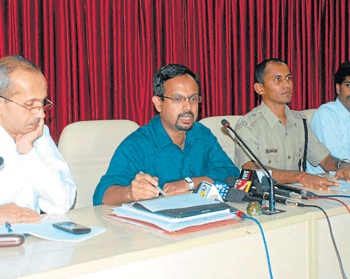
Udupi Deputy Commissioner Dr M T Reju on Tuesday told media persons that the notification for the election will be issued on Wednesday. The last date for filing nominations is February 29. The model code of conduct is already in force. The scrutiny of the nominations will be done on March 1 and the last date for the withdrawal of candidatures is on March 3. The counting will be held on March 21, he added.

Dr Reju, who is also the returning officer, said that the nomination will be accepted at the Udupi DC's office.

A meeting of district-level officials including sectoral magistrates and nodal officers is held to discuss the poll preparations, he added.

As many as 99.66 per cent of epic cards with photo is made available to the voters in Udupi district and in Chikmagalur it is 95.89 percentage. There seems to be no complications in the electoral list. However, substitutes like driving license and other proofs recommended by Election Commission can be produced in the absence of epic card. There is enough number of EVMs in the constituency.

As many as 7,500 officials and 1,500 police personnel will be deployed for the election purpose.

The campaign will end on March 16, he informed.

Superintendent of Police Dr Boralingaiah M B informed that during last Udupi-Chikmagalur Lok Sabha polls, there were 1,593 polling booths, of which 573 were normal, 559 are sensitive and 261 are hyper sensitive. However, the list of booths will be available only after the revised list of auxiliary polling booths is finalised, he added.


Comments

Add new comment

  • Coastaldigest.com reserves the right to delete or block any comments.
  • Coastaldigset.com is not responsible for its readers’ comments.
  • Comments that are abusive, incendiary or irrelevant are strictly prohibited.
  • Please use a genuine email ID and provide your name to avoid reject.
News Network
January 23,2026

Karnataka Governor Thaawarchand Gehlot read only three lines from the 122-paragraph address prepared by the Congress-led state government while addressing the joint session of the Legislature on Thursday, effectively bypassing large sections critical of the BJP-led Union government.

The omitted portions of the customary Governor’s address outlined what the state government described as a “suppressive situation in economic and policy matters” under India’s federal framework. The speech also sharply criticised the Centre’s move to replace the Mahatma Gandhi National Rural Employment Guarantee Act (MGNREGA) with the Viksit Bharat–Guarantee for Rozgar and Ajeevika Mission (Gramin) Act, commonly referred to as the VB-GRAM (G) Act.

Governor Gehlot had earlier conveyed his objection to several paragraphs that were explicitly critical of the Union government. On Thursday, he confined himself to the opening lines — “I extend a warm welcome to all of you to the joint session of the State legislature. I am extremely pleased to address this august House” — before jumping directly to the concluding sentence of the final paragraph.

He ended the address by reading the last line of paragraph 122: “Overall, my government is firmly committed to doubling the pace of the State’s economic, social and physical development. Jai Hind — Jai Karnataka.”

According to the prepared speech, the Karnataka government demanded the scrapping of the VB-GRAM (G) Act, describing it as “contractor-centric” and detrimental to rural livelihoods, and called for the full restoration of MGNREGA. The state government argued that the new law undermines decentralisation, weakens labour protections, and centralises decision-making in violation of constitutional norms.

Key points from the unread sections of the speech:

•    Karnataka facing a “suppressive” economic and policy environment within the federal system

•    Repeal of MGNREGA described as a blow to rural livelihoods

•    VB-GRAM (G) Act accused of protecting corporate and contractor interests

•    New law alleged to weaken decentralised governance

•    Decision-making said to be imposed by the Centre without consulting states

•    Rights of Adivasis, women, backward classes and agrarian communities curtailed

•    Labourers allegedly placed under contractor control

•    States facing mounting fiscal stress due to central policies

•    VB-GRAM (G) Act accused of enabling large-scale corruption

Comments

Add new comment

  • Coastaldigest.com reserves the right to delete or block any comments.
  • Coastaldigset.com is not responsible for its readers’ comments.
  • Comments that are abusive, incendiary or irrelevant are strictly prohibited.
  • Please use a genuine email ID and provide your name to avoid reject.
News Network
January 23,2026

Mangaluru: The Karnataka Government Polytechnic (KPT), Mangaluru, has achieved autonomous status from the All India Council for Technical Education (AICTE), becoming the first government polytechnic in the country to receive such recognition in its 78-year history. The status was granted by AICTE, New Delhi, and subsequently approved by the Karnataka Board of Technical Education in October last year.

Officials said the autonomy was conferred a few months ago. Until recently, AICTE extended autonomous status only to engineering colleges, excluding diploma institutions. However, with a renewed national focus on skill development, several government polytechnics across India have now been granted autonomy.

KPT, the second-largest polytechnic in Karnataka, was established in 1946 with four branches and has since expanded to offer eight diploma programmes, including computer science and polymer technology. The institution is spread across a 19-acre campus.

Ravindra M Keni, the first dean of the institution, told The Times of India that AICTE had proposed autonomous status for polytechnic institutions that are over 25 years old. “Many colleges applied. In the first round, 100 institutions were shortlisted, which was further narrowed down to 15 in the second round. We have already completed one semester after becoming an autonomous institution,” he said. He added that nearly 500 students are admitted annually across eight three-year diploma courses.

Explaining the factors that helped KPT secure autonomy, Keni said the institution has consistently recorded 100 per cent admissions and placements for its graduates. He also noted its strong performance in sports, with the college emerging champions for 12 consecutive years, along with active student participation in NCC and NSS activities.

Autonomous status allows KPT to design industry-oriented curricula, conduct examinations, prepare question papers, and manage academic documentation independently. The institution can also directly collaborate with industries and receive priority funding from AICTE or the Ministry of Education. While academic autonomy has been granted, financial control will continue to rest with the state government.

“There will be separate committees for examinations, question paper setting, boards of studies, and boards of examiners. The institution will now have the freedom to conduct admissions without government notifications and issue its own marks cards,” Keni said, adding that new academic initiatives would be planned after a year of functioning under the autonomous framework.

Comments

Add new comment

  • Coastaldigest.com reserves the right to delete or block any comments.
  • Coastaldigset.com is not responsible for its readers’ comments.
  • Comments that are abusive, incendiary or irrelevant are strictly prohibited.
  • Please use a genuine email ID and provide your name to avoid reject.
News Network
February 5,2026

Bengaluru: As air quality continues to worsen across several parts of the city, hospitals in Bengaluru are reporting a steady rise in patients suffering from respiratory illnesses such as asthma, bronchitis and Chronic Obstructive Pulmonary Disease (COPD), health officials and doctors said.

Data from the Suvarna Arogya Suraksha Trust (SAST) shows that 3,891 patients received treatment for respiratory ailments between April and November 2024. The figure rose to 4,187 during the same period in 2025.

Private hospitals, too, are witnessing a 10–15 per cent year-on-year increase in such cases.

While doctors caution that the rise cannot be attributed solely to air pollution, a significant number of patients are non-smokers with no prior history of respiratory disease.

“Nearly 70 per cent of the patients we see are non-smokers with no previous respiratory issues. When other causes are ruled out, air pollution emerges as the most likely factor,” said Dr Manjunath PH, consultant interventional pulmonologist at a hospital in Kengeri.

Doctors noted that patient footfall spikes during the winter months and around Deepavali, when air quality typically worsens.

“There is a clear correlation between poor air quality and the rise in cases. People commonly present with persistent cough, breathlessness and irritation of the respiratory tract, indicating the impact of polluted air on their health,” said Dr Sheetal Chaurasia, consultant in pulmonary medicine at a private hospital in Whitefield.

Dr Chaurasia added that respiratory tract infections are also on the rise.

“Poor air quality leads to chronic airway inflammation, making the airways more vulnerable to infections. We are seeing an increase in both upper and lower respiratory tract infections,” she said.

Patients with pre-existing respiratory conditions remain the worst affected.

“For those already diagnosed with respiratory illnesses, deteriorating air quality significantly worsens the condition. Both the frequency and severity of attacks increase sharply,” said Dr Vandana P, a pulmonologist at a hospital on Bannerghatta Road.

Doctors also flagged a worrying trend of rising respiratory problems among younger adults and children.

To reduce exposure, they advised people to wear masks while travelling on two-wheelers or autos and ensure adequate ventilation at home to minimise indoor air pollution.

Comments

Add new comment

  • Coastaldigest.com reserves the right to delete or block any comments.
  • Coastaldigset.com is not responsible for its readers’ comments.
  • Comments that are abusive, incendiary or irrelevant are strictly prohibited.
  • Please use a genuine email ID and provide your name to avoid reject.