



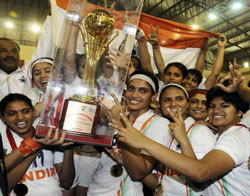
Patna, March 5: Asian gold medallist India etched its name on the first Women's World Cup Kabaddi Championship trophy after defeating Iran 25-19 in a pulsating final in the indoor hall of Patliputra Sports Complex at Kankarbagh here on Sunday. Japan was declared third and Thailand finished fourth in the championship.
Aggression was writ large on the players' faces as both the teams went all out in the final. India won the toss and elected to field. The first-half belonged to Indian skipper Mamatha Poojari and Iranian ace Ghazal Khalaj. Both players converted their maximum raids into points. They were the top scorers of their respective teams with 8 points each.
The match started at a fast pace with attacks and counter-attacks from both sides. Iran, who had lost the semifinals to India by just one point in extra time at the Guangzhou Asian Games, put their best foot forward but failed to match the strategy of Indian team.
Mamatha admitted the fact that the Indian team was under pressure because of the close encounter with Iran in the Asian Games. "But we were confident of winning the final with a handsome margin. It is our game and we will always try to keep the tricolour flying in kabaddi," an elated Mamatha said after the match.
Ghazal, who had earned 12 points out of her 16 raids in the semifinals against Thailand, was so aggressive in the first-half that the umpire had to show a green card as a warning. Mamatha, too, was overconfident and that cost India three points when she was caught by their rivals while trying to go deep into the Iranian defence in the first-half. India led 19-11 at half time.
The host team changed its strategy in the second-half and opted for a defensive game to keep the lead. Sedigheh Jafarikalokan, Hajar Shahin Kamal Aghaei and Salimeh Abdollahbakhsh were given the charge of Iranian raids in the second-half and Sedigheh earned some good points.
Earlier, India reached the final after defeating Japan 59-20 in the second semifinal of the championship. Indian captain Mamatha Poojari and her Japanese counterpart Aya Aoki led their teams from the front with their brilliant raids. While Mamatha, Priyanka Negi and Abhilasha Mhatre carried many successful raids, Suvarna Bartakhe and vice-captain Deepika Henary Joseph won points for India with good catching. Mamatha scored 19 points while Abhilasha earned 10 points in the match.
Japan, who had defeated strong contender Bangladesh 17-15 in the quarterfinals, won the toss and earned their first point through Yumi Kaneko, who carried out some lethal attacks on the strong Indian defence. But the Indians started blunting the Japanese attacks within minutes and earned their first out of the total four lonas with score reading 8-1. India led the first half 33-8.
Earlier, Iran defeated Guangzhou Asian Games silver medallist Thailand 46-26 in the first semifinal. Although both the teams were technically sound, Thailand succumbed to the better team coordination and power game of the Iranians. However, Iran had the dubious distinction of getting a yellow card slapped on Sedigheh Jafarikalokan. It was for the first time in the championship that a player was shown yellow card for jumping the rules.
Iran won the toss and Ghazal Khalaj piloted the raids on Thai defence from the left flank. She took the optimum advantage of her height and earned a lot many points for Iran. Ghazal was well supported by Zahra Masoumabadi whose side-kicks left the Thai catchers clueless. However, Namfon Kangkeeree and Nuchanart Maiwan scored some valuable points for Thailand in the second half.
Deputy CM Sushil Kumar Modi handed over the winner's trophy to Indian captain Mamatha. Shatrughan Sinha, MP, gave the runner-up trophy to Iran's skipper. President of the International Kabaddi Federation Janardan Singh, HRD minister P K Shahi and principal secretary of HRD Anjani Kumar Singh were also present on the occasion.

Comments
Add new comment