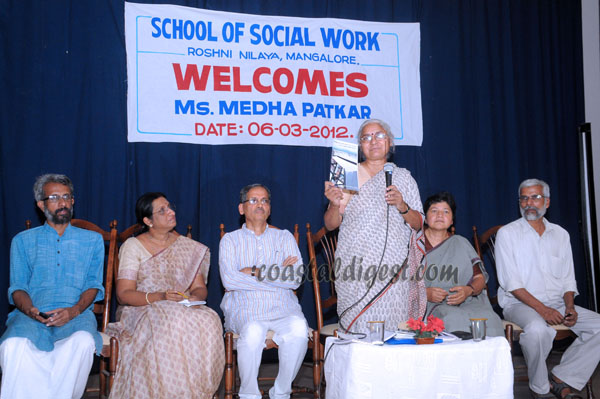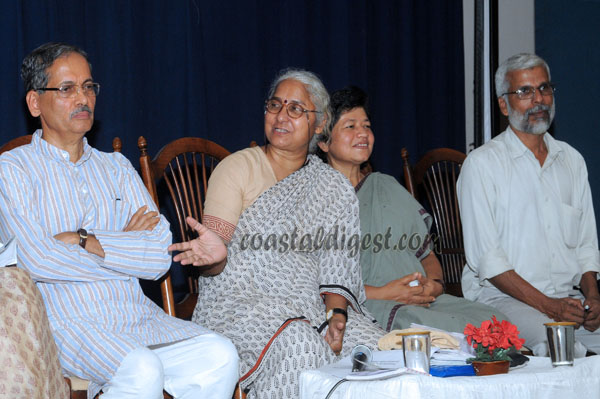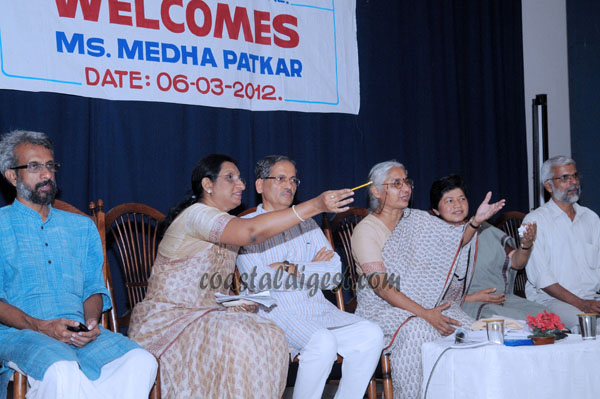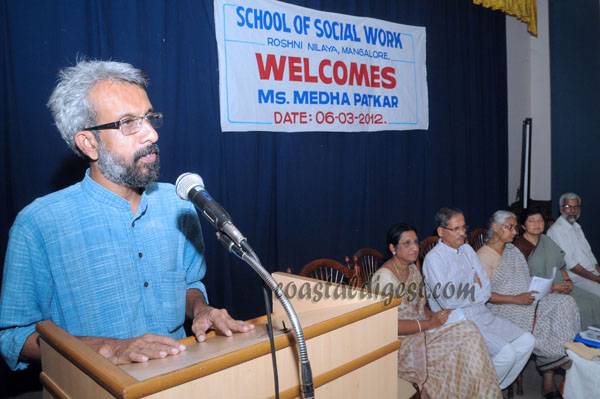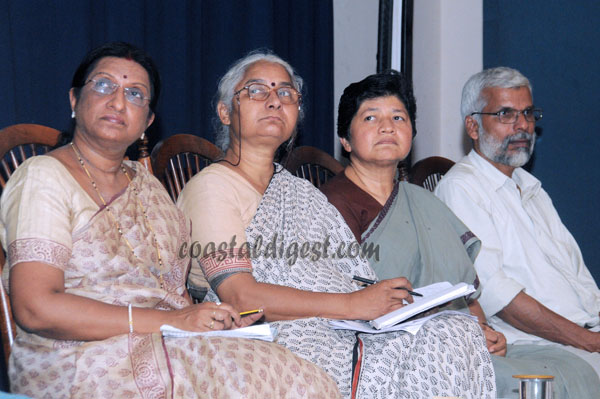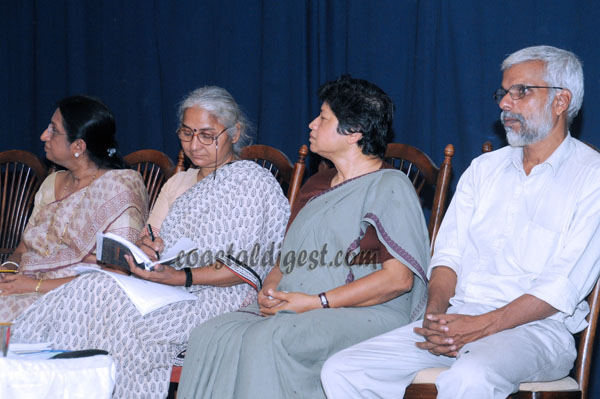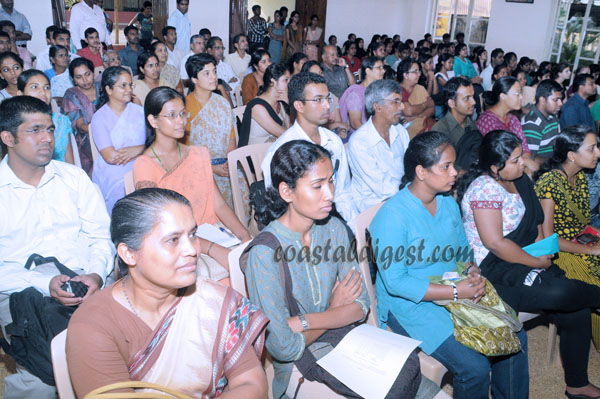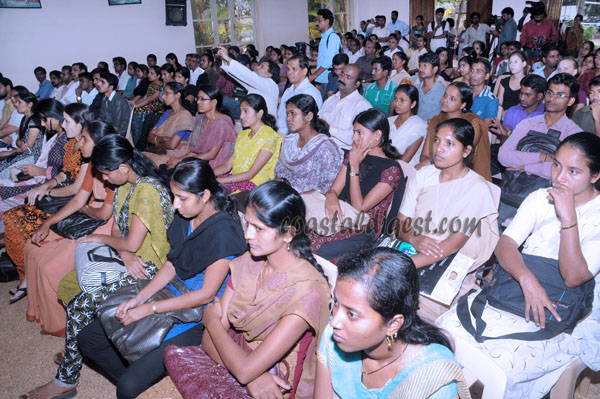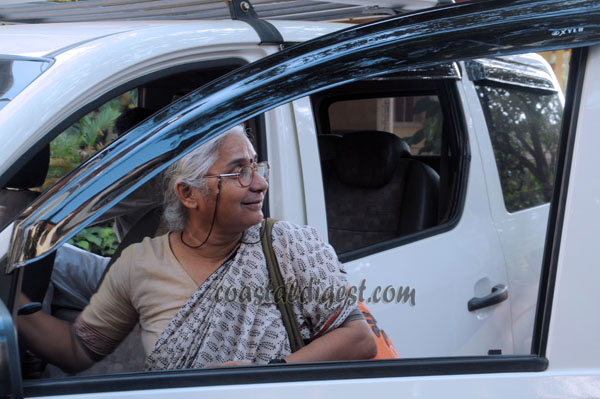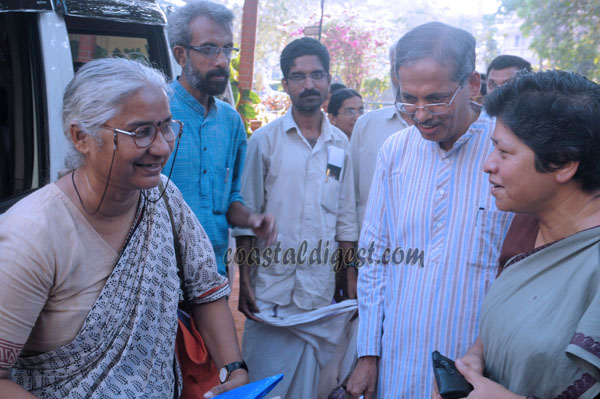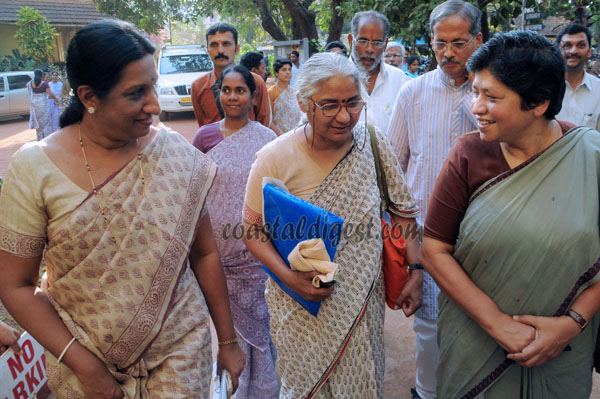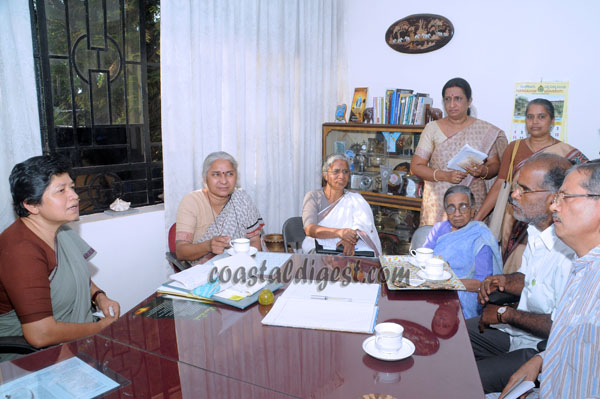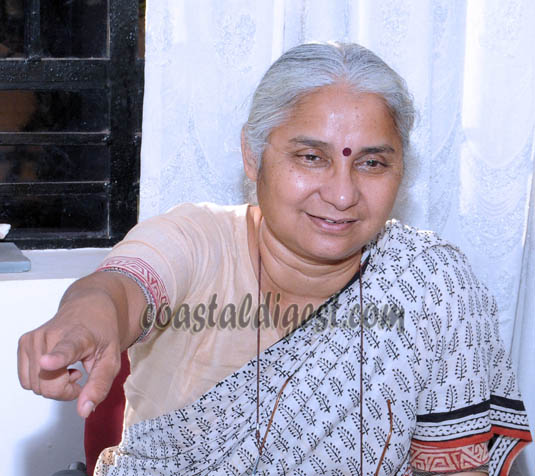
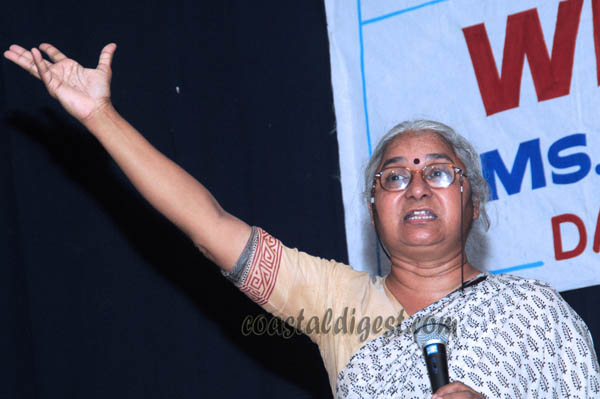
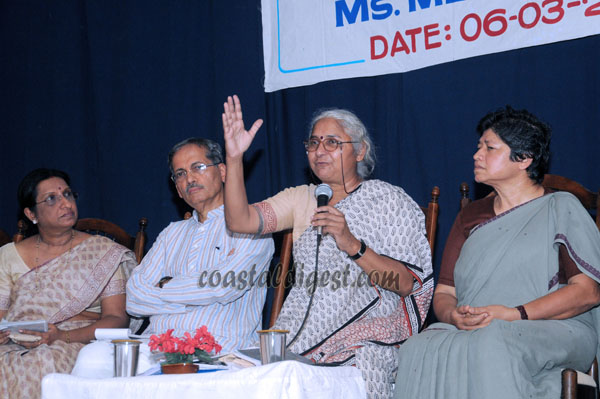
Medha Patkar interacts with students in Mangalore; lashes out at Govt for MSEZ, UPCL

[email protected] (CD Network, Photos by Ahmed Anwar)
March 6, 2012
medha1
Mangalore, March 6: Attempts to bring in Mangalore Special Economic Zone are in fact unjustifiable concessions being given by the government to loot natural resources which intends to give corporate players vulgar levels of profits, said Medha Patkar, renowned environment activist.

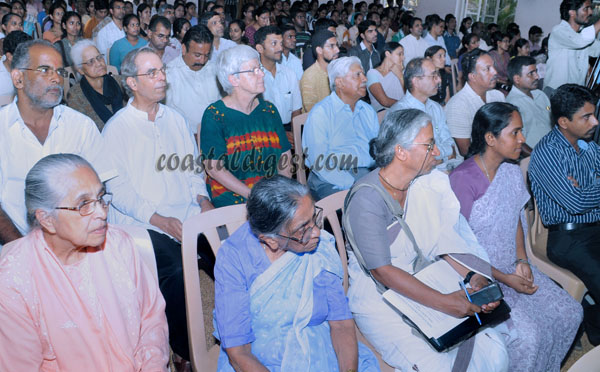
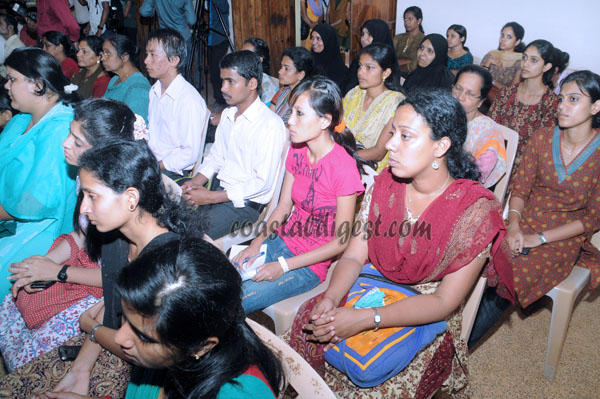
She was speaking at an interaction programme organized by Roshni Nilaya School of Social Work, Mangalore, on Tuesday.

Responding to questions from students and others in the gathering, Ms. Patkar threw light on the injustice being done to farmers and tribal people in the name of development and Special Economic Zones. “Uttara Kannada and Dakshina Kannada were districts with 80% of land under green cover. The ones behind Special Economic Zone are after this wealth. We challenge the Act (SEZ Act) itself. The ones who are ruling us today are worse than British administrators. The whites said no acquisition of land would be made for private purposes and only government projects would be considered. But today's rulers have gone to the extent of changing the very definition of public purpose, stating that even private players also serve the society in terms of public good. Due to protests and oppositions, many SEZs have stopped in quite a few places. It's good that in every place, people are waging a war against it”, she said.

Ms. Patkar asserted that she and her group are not against development. “What is needed is the right kind of planning through right kind of democratic process. We say no to unjust, wrong, and unconstitutional methods of development. Base the future development planning on the directive principles of the constitution. We demand that contents of Article 243 of the constitution be part of law in India. An answer to the question as to who needs to be given preference needs to be sought. Who has the natural resources - the Ambanis or the farmers? Who contributes more to public good? This 'hisaab' needs to be settled”, she said.

Inviting students, social activists and others in the gathering to the upcoming national 'People's Parliament' to be held from March 18 to 23 in New Delhi, Ms. Patkar said, an attempt to seek answers on development and handling natural resources would be sought on the occasion. “We want to raise key issues such as inequity, value for produce that comes from agriculture, fishing etc as against value for produce that comes from machines, labour charges and remuneration of rural folk, farmers and tribals etc. and many other issues in this meet”.

'Ameeri Rekha'

The nation has discussed 'Gareebi Rekha' (poverty line) enough, Ms. Patkar said, stating that there is a need to implement an 'Ameeri Rekha' (line of richness) to minimize social imbalance.

“Let there be a line of richness, an extent to which the rich can amass wealth. If they cross that limit and amass more wealth, let it be considered as public money in their control and tax it heavily. If this system is implemented, the rest of India can become tax free. The state exchequer will get 10 times more money in the form of taxes from these rich people, than what it is accumulating today,” she said.


UPCL plant just a business

Expressing her views on the Udupi Power Corporation Limited's (UPCL) thermal power plant project which has been a key issue in the region for quite some time now, Ms. Patkar said that although people argue that we need power and there are load shedding problems and every citizen has a 'right to energy', projects like UPCL thermal power plant are mere business endeavours to mint money and there is no real planning in terms of fulfilling the power needs of the region.

“The government's concerned authority in its energy policy has set a target of generating 8 lakh MW of power by 2032. Out of this 8 lakh MW of power 60% is to be generated via thermal power plants. Currently, 1, 60,000 MW of power has been generated. But going by the trends they are following, they will end up generating 6 lakh MW of power by 2032. This is not planning. This is business and financial exchange of resources”, she said.

Fight to save Narmada on

The 'Narmada Bachao' movement, for which Ms. Patkar is known for, is still on, she said. “The adivasis are still fighting the battle. In one part of Madhya Pradesh, tribals have been on a satyagraha for the past 100 days wherein they have occupied government land and even carried out cultivation on it. The government isn't daring to arrest us for doing it since it had a bitter experience when it arrested us for carrying out a similar Satyagraha in the past. The farmers in Gujarat are not willing to give their lands for government's canals as they have irrigated those lands with alternate methods. Chief Minister Narendra Modi attended a question answer session of ours at Indore and couldn't utter a word. In other places, the government tried to make tribals and farmers toe its line by doling out money to show that they have purchased the land. But our farmers were investigative and we found out that the government was maintaining fake registries, fake documents containing fake names and fake photographs. The Supreme Court has said that without rehabilitation and addressing environmental issues no construction work of dam should take place. But the government is trying to push it and we are trying to stop it”, she revealed.

Youth must step up

Ms. Patkar on the occasion advised students of social work and other youth to take part in social movements and help in eradicating the social imbalance.

“Our Narmada Bachao movement has now been strengthened by a 'Narmada Yuva Dal' unit. Students and youth must step up and contribute. If students decide that they would dedicate one year after their courses before taking up a job for a social movement, any movement for that matter, it can make a lot of difference”, Ms. Patkar opined.

She invited students in the gathering to take part as volunteers in the 'People's Parliament' in New Delhi as well.
medha2

medha3

medha5

MD__1

MD__2

MD__3

MD__4

MD__5

MD__6

MD__7

MD__8

MD__9

MD__10

MD__11

MD__12

MD__13

Comments

Add new comment

  • Coastaldigest.com reserves the right to delete or block any comments.
  • Coastaldigset.com is not responsible for its readers’ comments.
  • Comments that are abusive, incendiary or irrelevant are strictly prohibited.
  • Please use a genuine email ID and provide your name to avoid reject.
News Network
February 4,2026

Mangaluru: Urban local bodies and gram panchayats should make the use of Kannada on signboards mandatory while issuing trade licences to commercial establishments, Dakshina Kannada Deputy Commissioner Darshan HV said. He also called for regular inspections to ensure compliance.

Presiding over the District Kannada Awareness Committee meeting at the deputy commissioner’s office, Darshan said the city corporation would be directed to ensure that shops operating in malls prominently display their names in Kannada. “All commercial establishments, including shops, companies, offices and hotels, must mandatorily display their names in Kannada on signboards,” he said.

The deputy commissioner added that the National Highways Authority of India (NHAI) would be instructed to include Kannada on signboards along national highways. Banks, he said, would be directed through committee meetings to provide application forms in Kannada.

“Even if English-medium schools and colleges impart education in English, their signboards must display the institution’s name in Kannada. Steps will also be taken to ensure that private buses display place names in Kannada,” Darshan said.

During the meeting, committee members raised concerns over the closure of Kannada-medium schools in rural areas due to a shortage of teachers and stressed the need for immediate corrective measures. They also pointed out that several industries employ workers from other states while overlooking local candidates.

Members further demanded that nationalised banks provide deposit and withdrawal slips in Kannada. It was brought to the deputy commissioner’s notice that the presence of staff without knowledge of Kannada in rural branches of nationalised banks is causing hardship to local customers.

Meanwhile, MP Srinath, president of the District Kannada Sahitya Parishat, urged the district administration to allot land for the construction of a district Kannada Bhavana in Mangaluru.

Comments

Add new comment

  • Coastaldigest.com reserves the right to delete or block any comments.
  • Coastaldigset.com is not responsible for its readers’ comments.
  • Comments that are abusive, incendiary or irrelevant are strictly prohibited.
  • Please use a genuine email ID and provide your name to avoid reject.
News Network
February 1,2026

Golf.jpg

The coastal city of Mangaluru is gearing up for a major sporting milestone with the launch of a Golf Excellence Academy at the Pilikula Golf Club (PGC), scheduled to open on May 31. The initiative aims to position Mangaluru firmly on India’s national golfing map.

Speaking to reporters on Saturday during PGC’s first-ever floodlit Pro-Am tournament, club captain Manoj Kumar Shetty said the project is being funded by UAE-based philanthropist Michael D’Souza and is currently in the design phase. Experts from leading golf academies across the country are expected to visit Mangaluru to help shape the training programme and infrastructure.

The academy will train 20 young golfers at a time, with a long-term vision of producing national-level players from the region. Until now, PGC relied on an in-house coach, but the recent renovation of the course and the introduction of floodlights have opened new possibilities for expanding the sport.

Shetty said discussions are underway with two reputed coaching academies, whose heads are expected to visit PGC shortly. “A dormitory for trainers is already under construction. We are inviting academies to assess the facilities and suggest changes so we can build a truly world-class Golf Excellence Academy,” he said.

Professional golfer Aryan Roopa Anand noted that the floodlit course would be a game-changer for young players. “Students can now practise after school hours, even up to 8 or 9 pm, without compromising on academics,” he said.

Comments

Add new comment

  • Coastaldigest.com reserves the right to delete or block any comments.
  • Coastaldigset.com is not responsible for its readers’ comments.
  • Comments that are abusive, incendiary or irrelevant are strictly prohibited.
  • Please use a genuine email ID and provide your name to avoid reject.
News Network
January 31,2026

Roy.jpg

Bengaluru: The shooting incident involving CJ Roy, founder of the Confident Group, has once again put the spotlight on a businessman whose life has swung between flamboyant global success and persistent controversy at home.

Though Roy’s business interests extended across continents, his roots lay firmly in Karnataka. An alumnus of Christ School in Bengaluru, he later moved to Tumakuru to pursue an engineering degree. Those familiar with his early years describe him as intensely ambitious, beginning his career as a salesman at a small electronics firm dealing in computers.

Roy’s entry into large-scale real estate came through the Crystal Group, where he worked closely with Latha Namboothiri and rose from manager to director. However, the launch of the Confident Group in 2005 was clouded by industry speculation. Insiders speak of a fallout involving alleged “benami” properties and claims of deception that ultimately led to his independent venture—an episode Roy spent years trying to distance himself from, according to associates.

A tale of two cities

Roy’s professional trajectory diverged sharply across geographies.

In Dubai, he built a reputation as a bold and efficient developer, completing massive luxury residential projects in record time—some reportedly within 11 months. His rapid project delivery and lavish lifestyle in the Emirates earned him admiration and visibility in the real estate sector.

In Bengaluru, however, his image remained far more fractured. Sources say Roy stayed away from the city for several years amid disputes over unpaid dues to vendors and suppliers. Several projects were allegedly stalled, with accusations of unfulfilled commitments to cement and steel suppliers continuing to follow him.

Roy’s return to Bengaluru’s business and social circles began around 2018, marked by a conscious attempt at rebranding. His appointment as Honorary Consul of the Slovak Republic added diplomatic legitimacy, which he complemented with visible CSR initiatives, including ambulance donations and high-profile charity events.

Heavy police presence in Langford Town

Following the incident, police personnel from the Central division were deployed outside the Confident Group building in Langford Town, which also houses the Slovak Honorary Consulate in Bengaluru.

The otherwise busy premises near Hosur Road wore a deserted look on Friday, reflecting the shock and uncertainty that followed the tragedy.

Comments

Add new comment

  • Coastaldigest.com reserves the right to delete or block any comments.
  • Coastaldigset.com is not responsible for its readers’ comments.
  • Comments that are abusive, incendiary or irrelevant are strictly prohibited.
  • Please use a genuine email ID and provide your name to avoid reject.