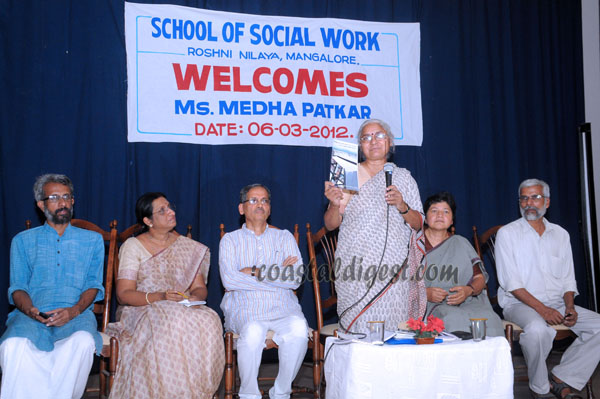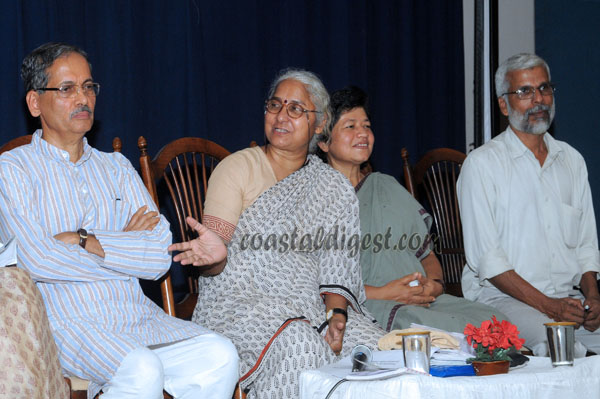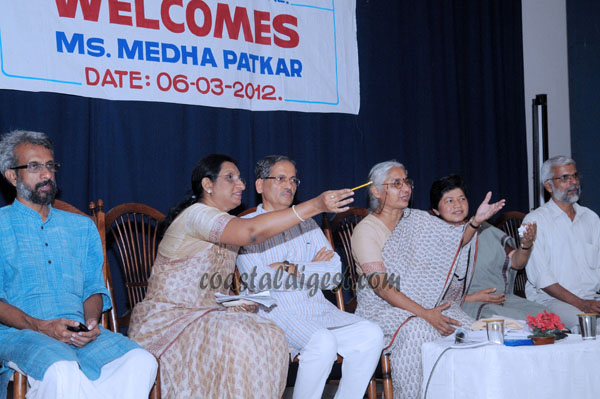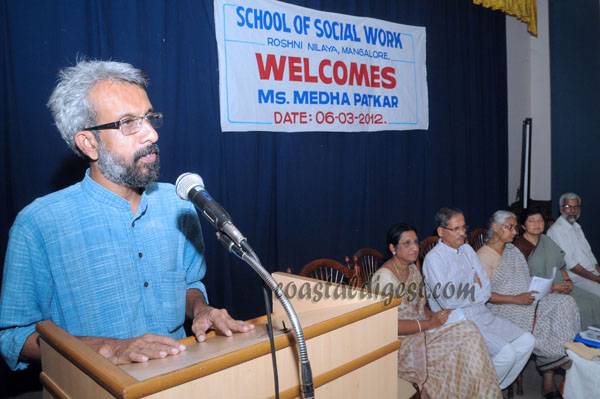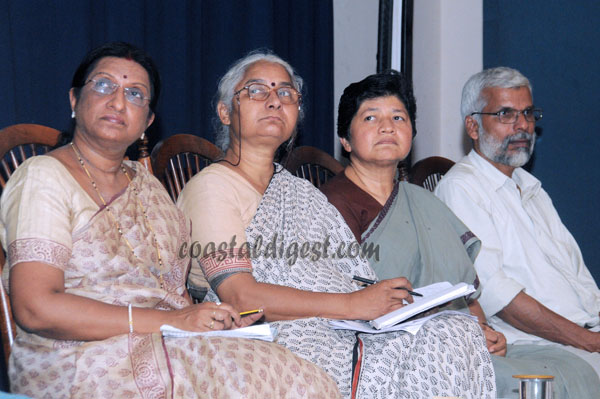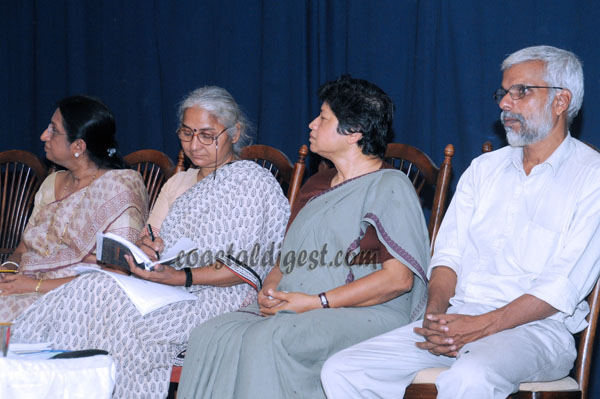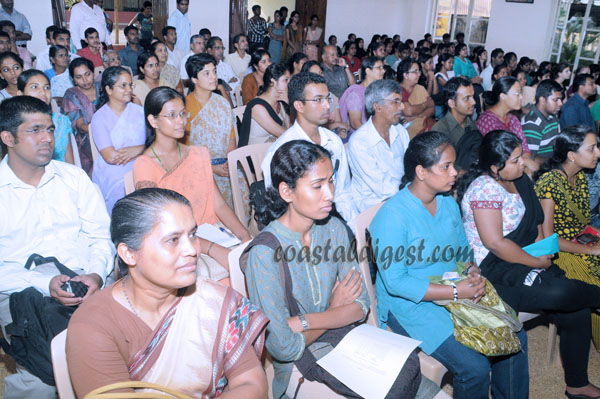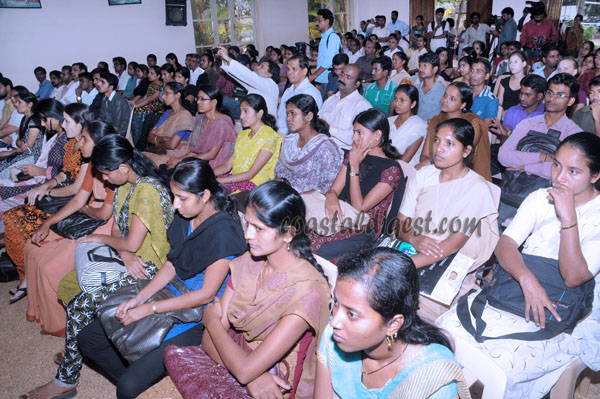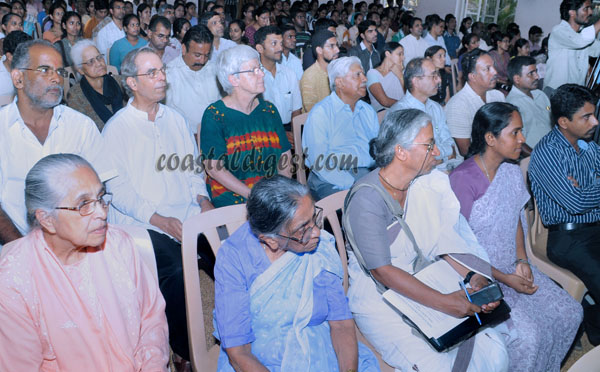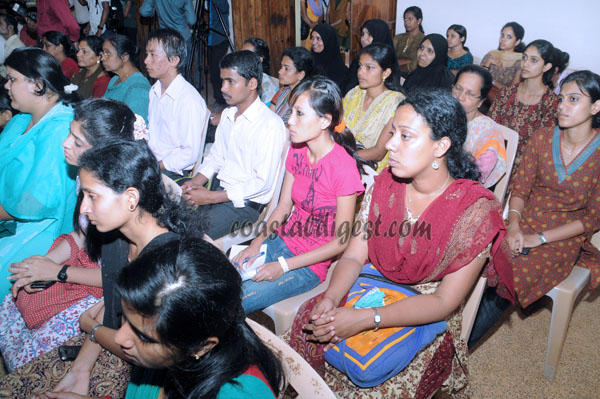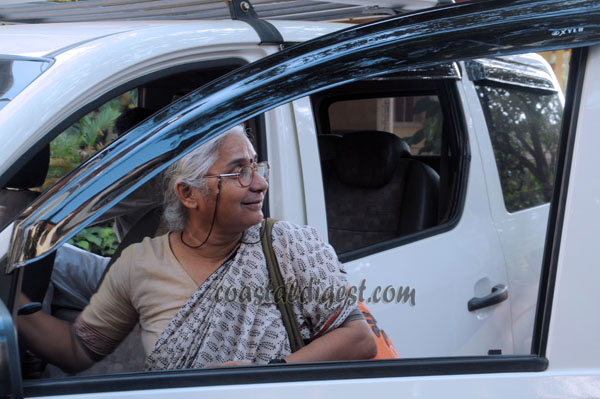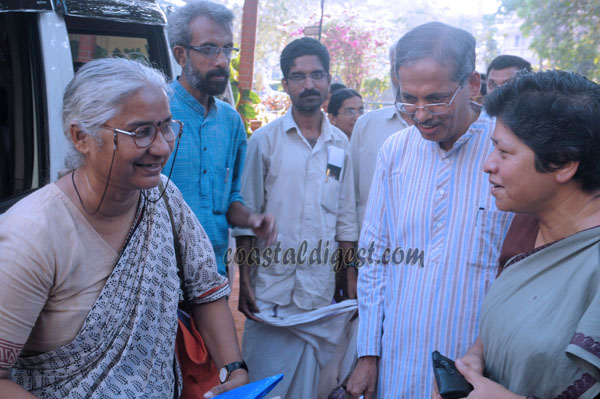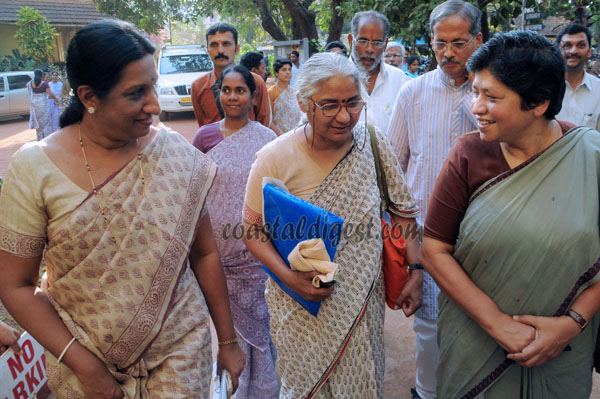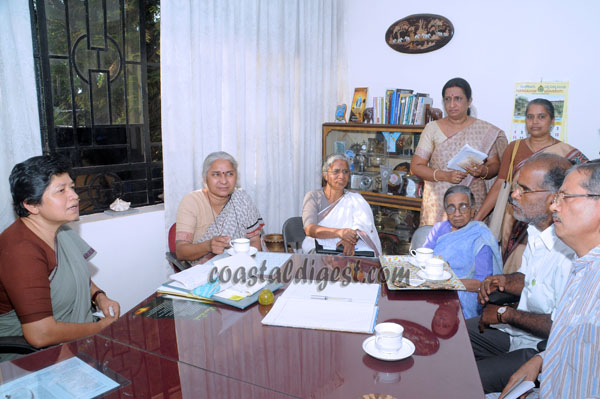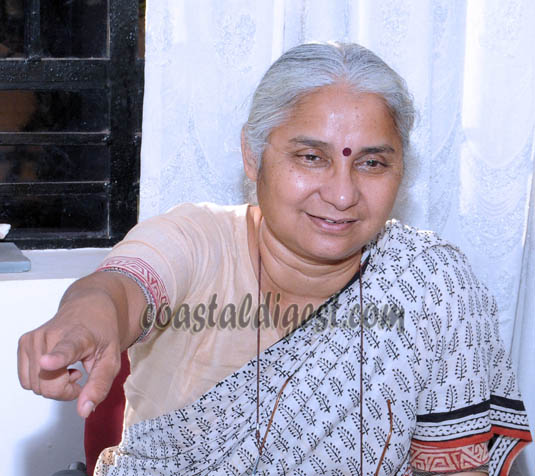
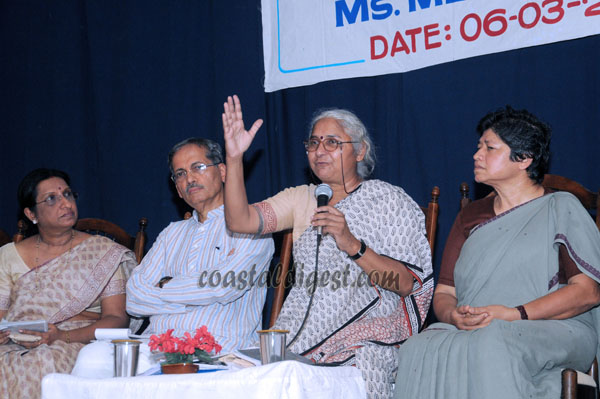
Medha Patkar interacts with students in Mangalore; lashes out at Govt for MSEZ, UPCL

[email protected] (CD Network, Photos by Ahmed Anwar)
March 6, 2012
medha1
Mangalore, March 6: Attempts to bring in Mangalore Special Economic Zone are in fact unjustifiable concessions being given by the government to loot natural resources which intends to give corporate players vulgar levels of profits, said Medha Patkar, renowned environment activist.

She was speaking at an interaction programme organized by Roshni Nilaya School of Social Work, Mangalore, on Tuesday.

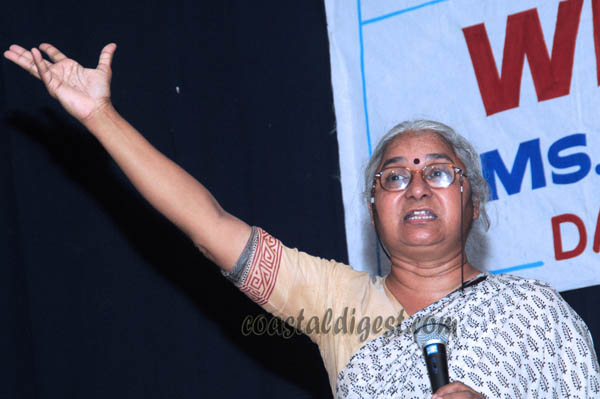
Responding to questions from students and others in the gathering, Ms. Patkar threw light on the injustice being done to farmers and tribal people in the name of development and Special Economic Zones. “Uttara Kannada and Dakshina Kannada were districts with 80% of land under green cover. The ones behind Special Economic Zone are after this wealth. We challenge the Act (SEZ Act) itself. The ones who are ruling us today are worse than British administrators. The whites said no acquisition of land would be made for private purposes and only government projects would be considered. But today's rulers have gone to the extent of changing the very definition of public purpose, stating that even private players also serve the society in terms of public good. Due to protests and oppositions, many SEZs have stopped in quite a few places. It's good that in every place, people are waging a war against it”, she said.

Ms. Patkar asserted that she and her group are not against development. “What is needed is the right kind of planning through right kind of democratic process. We say no to unjust, wrong, and unconstitutional methods of development. Base the future development planning on the directive principles of the constitution. We demand that contents of Article 243 of the constitution be part of law in India. An answer to the question as to who needs to be given preference needs to be sought. Who has the natural resources - the Ambanis or the farmers? Who contributes more to public good? This 'hisaab' needs to be settled”, she said.

Inviting students, social activists and others in the gathering to the upcoming national 'People's Parliament' to be held from March 18 to 23 in New Delhi, Ms. Patkar said, an attempt to seek answers on development and handling natural resources would be sought on the occasion. “We want to raise key issues such as inequity, value for produce that comes from agriculture, fishing etc as against value for produce that comes from machines, labour charges and remuneration of rural folk, farmers and tribals etc. and many other issues in this meet”.

'Ameeri Rekha'

The nation has discussed 'Gareebi Rekha' (poverty line) enough, Ms. Patkar said, stating that there is a need to implement an 'Ameeri Rekha' (line of richness) to minimize social imbalance.

“Let there be a line of richness, an extent to which the rich can amass wealth. If they cross that limit and amass more wealth, let it be considered as public money in their control and tax it heavily. If this system is implemented, the rest of India can become tax free. The state exchequer will get 10 times more money in the form of taxes from these rich people, than what it is accumulating today,” she said.


UPCL plant just a business

Expressing her views on the Udupi Power Corporation Limited's (UPCL) thermal power plant project which has been a key issue in the region for quite some time now, Ms. Patkar said that although people argue that we need power and there are load shedding problems and every citizen has a 'right to energy', projects like UPCL thermal power plant are mere business endeavours to mint money and there is no real planning in terms of fulfilling the power needs of the region.

“The government's concerned authority in its energy policy has set a target of generating 8 lakh MW of power by 2032. Out of this 8 lakh MW of power 60% is to be generated via thermal power plants. Currently, 1, 60,000 MW of power has been generated. But going by the trends they are following, they will end up generating 6 lakh MW of power by 2032. This is not planning. This is business and financial exchange of resources”, she said.

Fight to save Narmada on

The 'Narmada Bachao' movement, for which Ms. Patkar is known for, is still on, she said. “The adivasis are still fighting the battle. In one part of Madhya Pradesh, tribals have been on a satyagraha for the past 100 days wherein they have occupied government land and even carried out cultivation on it. The government isn't daring to arrest us for doing it since it had a bitter experience when it arrested us for carrying out a similar Satyagraha in the past. The farmers in Gujarat are not willing to give their lands for government's canals as they have irrigated those lands with alternate methods. Chief Minister Narendra Modi attended a question answer session of ours at Indore and couldn't utter a word. In other places, the government tried to make tribals and farmers toe its line by doling out money to show that they have purchased the land. But our farmers were investigative and we found out that the government was maintaining fake registries, fake documents containing fake names and fake photographs. The Supreme Court has said that without rehabilitation and addressing environmental issues no construction work of dam should take place. But the government is trying to push it and we are trying to stop it”, she revealed.

Youth must step up

Ms. Patkar on the occasion advised students of social work and other youth to take part in social movements and help in eradicating the social imbalance.

“Our Narmada Bachao movement has now been strengthened by a 'Narmada Yuva Dal' unit. Students and youth must step up and contribute. If students decide that they would dedicate one year after their courses before taking up a job for a social movement, any movement for that matter, it can make a lot of difference”, Ms. Patkar opined.

She invited students in the gathering to take part as volunteers in the 'People's Parliament' in New Delhi as well.
medha2

medha3

medha5

MD__1

MD__2

MD__3

MD__4

MD__5

MD__6

MD__7

MD__8

MD__9

MD__10

MD__11

MD__12

MD__13

Comments

Add new comment

  • Coastaldigest.com reserves the right to delete or block any comments.
  • Coastaldigset.com is not responsible for its readers’ comments.
  • Comments that are abusive, incendiary or irrelevant are strictly prohibited.
  • Please use a genuine email ID and provide your name to avoid reject.
News Network
February 3,2026

wind.jpg

Dakshina Kannada MP Capt Brijesh Chowta has urged the Centre to give high priority to offshore wind energy generation along the Mangaluru coast, citing its strategic importance to India’s green energy and port-led development goals.

Raising the issue in the Lok Sabha under Rule 377, Chowta said studies by the National Institute of Oceanography have identified the Mangaluru coastline as part of India’s promising offshore wind ‘Zone-2’, covering nearly 6,490 sq km. He noted that the region’s relatively low exposure to cyclones and earthquakes makes it suitable for long-term offshore wind projects and called for its development as a dedicated offshore wind energy zone.

Highlighting the role of New Mangalore Port, Chowta said its modern infrastructure, multiple berths and heavy cargo-handling capacity position it well as a logistics hub for transporting and assembling large wind energy equipment.

He also pointed to the presence of major industrial units such as MRPL, OMPL, UPCL and the Mangaluru SEZ, which could serve as direct buyers of green power through power purchase agreements, improving project viability and speeding up execution.

With Karnataka’s peak power demand crossing 18,000 MW in early 2025, Chowta stressed the need to diversify renewable energy sources. He added that offshore wind projects in the Arabian Sea are strategically safer compared to the cyclone-prone Bay of Bengal.

Calling the project vital to India’s target of 500 GW of renewable energy by 2030, Chowta urged the Ministry of New and Renewable Energy to initiate resource assessments, pilot projects and stakeholder consultations at the earliest.

Comments

Add new comment

  • Coastaldigest.com reserves the right to delete or block any comments.
  • Coastaldigset.com is not responsible for its readers’ comments.
  • Comments that are abusive, incendiary or irrelevant are strictly prohibited.
  • Please use a genuine email ID and provide your name to avoid reject.
News Network
January 23,2026

Karnataka Governor Thaawarchand Gehlot read only three lines from the 122-paragraph address prepared by the Congress-led state government while addressing the joint session of the Legislature on Thursday, effectively bypassing large sections critical of the BJP-led Union government.

The omitted portions of the customary Governor’s address outlined what the state government described as a “suppressive situation in economic and policy matters” under India’s federal framework. The speech also sharply criticised the Centre’s move to replace the Mahatma Gandhi National Rural Employment Guarantee Act (MGNREGA) with the Viksit Bharat–Guarantee for Rozgar and Ajeevika Mission (Gramin) Act, commonly referred to as the VB-GRAM (G) Act.

Governor Gehlot had earlier conveyed his objection to several paragraphs that were explicitly critical of the Union government. On Thursday, he confined himself to the opening lines — “I extend a warm welcome to all of you to the joint session of the State legislature. I am extremely pleased to address this august House” — before jumping directly to the concluding sentence of the final paragraph.

He ended the address by reading the last line of paragraph 122: “Overall, my government is firmly committed to doubling the pace of the State’s economic, social and physical development. Jai Hind — Jai Karnataka.”

According to the prepared speech, the Karnataka government demanded the scrapping of the VB-GRAM (G) Act, describing it as “contractor-centric” and detrimental to rural livelihoods, and called for the full restoration of MGNREGA. The state government argued that the new law undermines decentralisation, weakens labour protections, and centralises decision-making in violation of constitutional norms.

Key points from the unread sections of the speech:

•    Karnataka facing a “suppressive” economic and policy environment within the federal system

•    Repeal of MGNREGA described as a blow to rural livelihoods

•    VB-GRAM (G) Act accused of protecting corporate and contractor interests

•    New law alleged to weaken decentralised governance

•    Decision-making said to be imposed by the Centre without consulting states

•    Rights of Adivasis, women, backward classes and agrarian communities curtailed

•    Labourers allegedly placed under contractor control

•    States facing mounting fiscal stress due to central policies

•    VB-GRAM (G) Act accused of enabling large-scale corruption

Comments

Add new comment

  • Coastaldigest.com reserves the right to delete or block any comments.
  • Coastaldigset.com is not responsible for its readers’ comments.
  • Comments that are abusive, incendiary or irrelevant are strictly prohibited.
  • Please use a genuine email ID and provide your name to avoid reject.
News Network
February 1,2026

Bengaluru: The Karnataka High Court has refused to quash an investigation against a WhatsApp group administrator accused of allowing the circulation of obscene and offensive images depicting Hindutva politicians and idols in 2021.

Justice M Nagaprasanna observed that, prima facie, the ingredients of the offence under Section 295A of the Indian Penal Code were made out. “The offence under Section 295A of the IPC is met to every word of its ingredient, albeit prima facie,” the judge said.

The petitioner, Sirajuddin, a resident of Belthangady taluk in Dakshina Kannada district, had challenged the FIR registered against him at the CEN (Cyber, Economics and Narcotics) police station, Mangaluru, for offences under Section 295A of the IPC and Section 67 of the Information Technology Act. Section 295A relates to punishment for deliberate and malicious acts intended to outrage the religious feelings of any class of citizens.

According to the complaint filed by K Jayaraj Salian, also a resident of Belthangady taluk, he received a WhatsApp group link from an unknown source and was added to the group after accessing it. The group reportedly had six administrators and around 250 participants, where obscene and offensive images depicting Hindu deities and certain political figures were allegedly circulated repeatedly.

Sirajuddin was arrested in connection with the case and later released on bail on February 16, 2021. He argued before the court that he was being selectively targeted, while other administrators—including the creator of the group—were neither arrested nor investigated. He also contended that the Magistrate could not have taken cognisance of the offence under Section 295A without prior sanction under Section 196(1) of the CrPC.

Rejecting the argument, Justice Nagaprasanna held that prior sanction is required only at the stage of taking cognisance, and not at the stage of registration of the crime or during investigation.

The judge noted that the State had produced the entire investigation material before the court. “A perusal of the material reveals depictions of Hindu deities in an extraordinarily obscene, demeaning and profane manner. The content is such that its reproduction in a judicial order would itself be inappropriate,” the court said, adding that the material, on its face, had the tendency to outrage religious feelings and disturb communal harmony.

Observing that the case was still at the investigation stage, the court said it could not interdict the probe at this juncture. However, it expressed concern that the investigating officer appeared to have not proceeded uniformly against all administrators. The court clarified that if the investigation revealed the active involvement of any member in permitting the circulation of such content, they must also be proceeded against.

“At this investigative stage, any further observation by this Court would be unnecessary,” the order concluded.

Comments

Add new comment

  • Coastaldigest.com reserves the right to delete or block any comments.
  • Coastaldigset.com is not responsible for its readers’ comments.
  • Comments that are abusive, incendiary or irrelevant are strictly prohibited.
  • Please use a genuine email ID and provide your name to avoid reject.