



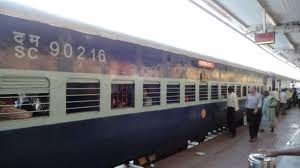
Railway Budget disappoints people of coastal districts

[email protected] (Govind D. Belgaumkar, The Hindu)
March 15, 2012

rail

Mangalore, March 15: With the key demands of railway commuters from coastal Karnataka finding no mention in the Railway Budget, disappointment was in the air in the districts of Dakshina Kannada, Udupi and Uttara Kannada on Wednesday.

Railway commuters' organisations from the districts had a hope that the Railways would at least consider splitting the night train between Yeshwanthpur and Kannur at Mangalore and divert few of the coaches to Karwar thereby providing connectivity to the town with the State's capital. The other key demands placed by the West Coast Rail Yathri Development Committee included increasing the frequency of day train from Yeshwanthpur to Mangalore from thrice a week to daily and ensuring that the work regarding developing Mangalore into World-class railway station began. An announcement in this regard was made two years ago.

'Upset'

The Committee chairman Hanumanth Kamath told The Hindu that the MPs from the State, who included four Union Ministers, had failed to put up a united show to seek justice for the State as far as State's demands were concerned.

He was upset that the MPs, unlike those from Kerala, were busy more in politics, than in getting benefits for the people. He said the four Union Ministers – M. Veerappa Moily, K.H. Muniyappa, S.M. Krishna and Mallikarjun Kharge — should resign owning moral responsibility for this.

He noted that Mr. Moily, had in an interaction with presspersons, had claimed in Mangalore that he had taken the issues to Railway Minister Dinesh Trivedi, he wondered why no key facility had been announced for coastal Karnataka. Though Moily is elected from Chikballapur, he is from Dakshina Kannada, Mr. Kamath pointed out.

The Committee's convenor Anil Hedge described the budget as a “total disappointment”. The long-standing demand for introduction of train to Bijapur from Mangalore should have been considered, he said.

Rajeev Gaonkar Hiregutti, a Karwar-based activist and vice-president of the committee, said what coastal Karnataka had got in the budget was “absolutely zero.”

He said the activists, who had secured an order from the High Court regarding the extension of the night train from Yeshwanthpur to Karwar was left with no option but to continue the fight in High Court.

Not considered

The people from Karwar wanted a train to Karwar from Hubli via Madgaon as large number of people commute between the two destinations, but this has not been considered despite the assurances given to this effect.

The activists pointed out that the extension of Mangalore-Palakkad Express to Coimbatore and Mangalore-Thiruvanthapuram Express to Nagercoil could hardly benefit the commuters from coastal Karnataka. It would benefit commuters in Kerala, they said.

The announcements of a survey for electrification of Mysore-Hassan-Mangalore line has hardly enthused the commuters. So is the case with Mangalore-Chennai train (12685/86) the frequency of which has been increased from six days to seven days a week. Only announcement that could benefit people here is the new Thirunelveli-Dadar train via Konkan Railway.

Comments

Add new comment

  • Coastaldigest.com reserves the right to delete or block any comments.
  • Coastaldigset.com is not responsible for its readers’ comments.
  • Comments that are abusive, incendiary or irrelevant are strictly prohibited.
  • Please use a genuine email ID and provide your name to avoid reject.
News Network
February 5,2026

In an era where digital distractions are the primary rival to academic excellence, the Karnataka Education Department is taking the fight directly to the living room. As the SSLC (Class 10) annual examinations loom, officials have launched a localized "digital strike" to ensure students aren't losing their competitive edge to scrolling or soap operas.

The 7-to-9 Lockdown

The department has issued a formal directive urging—and in some cases, enforcing via home visits—a total blackout of mobile phones and television sets between 7:00 PM and 9:00 PM. This two-hour window is being designated as "sacred study time" across the state until the examinations conclude on April 2.

Key Pillars of the Initiative:

•    Doorstep Advocacy: Teachers are transitioning from classrooms to living rooms, meeting parents to explain the psychological benefits of a distraction-free environment.

•    Parental Accountability: The campaign shifts the burden of discipline from the student to the household, asking parents to lead by example and switch off their own devices.

•    The Timeline: The focus remains sharp on the upcoming exam block, scheduled from March 18 to April 2.

"The objective is simple: uninterrupted focus. We are reclaiming the evening hours for the students, ensuring their environment is as prepared as their minds," stated a senior department official.

Student vs. Reality

While the student community has largely welcomed the "forced focus"—with many admitting they lack the willpower to ignore notifications—the move has sparked a debate on enforceability. Without a "TV Police," the success of this initiative rests entirely on the shoulders of parents and the persuasive power of visiting educators.

Comments

Add new comment

  • Coastaldigest.com reserves the right to delete or block any comments.
  • Coastaldigset.com is not responsible for its readers’ comments.
  • Comments that are abusive, incendiary or irrelevant are strictly prohibited.
  • Please use a genuine email ID and provide your name to avoid reject.
News Network
January 23,2026

Mangaluru: The Karnataka Government Polytechnic (KPT), Mangaluru, has achieved autonomous status from the All India Council for Technical Education (AICTE), becoming the first government polytechnic in the country to receive such recognition in its 78-year history. The status was granted by AICTE, New Delhi, and subsequently approved by the Karnataka Board of Technical Education in October last year.

Officials said the autonomy was conferred a few months ago. Until recently, AICTE extended autonomous status only to engineering colleges, excluding diploma institutions. However, with a renewed national focus on skill development, several government polytechnics across India have now been granted autonomy.

KPT, the second-largest polytechnic in Karnataka, was established in 1946 with four branches and has since expanded to offer eight diploma programmes, including computer science and polymer technology. The institution is spread across a 19-acre campus.

Ravindra M Keni, the first dean of the institution, told The Times of India that AICTE had proposed autonomous status for polytechnic institutions that are over 25 years old. “Many colleges applied. In the first round, 100 institutions were shortlisted, which was further narrowed down to 15 in the second round. We have already completed one semester after becoming an autonomous institution,” he said. He added that nearly 500 students are admitted annually across eight three-year diploma courses.

Explaining the factors that helped KPT secure autonomy, Keni said the institution has consistently recorded 100 per cent admissions and placements for its graduates. He also noted its strong performance in sports, with the college emerging champions for 12 consecutive years, along with active student participation in NCC and NSS activities.

Autonomous status allows KPT to design industry-oriented curricula, conduct examinations, prepare question papers, and manage academic documentation independently. The institution can also directly collaborate with industries and receive priority funding from AICTE or the Ministry of Education. While academic autonomy has been granted, financial control will continue to rest with the state government.

“There will be separate committees for examinations, question paper setting, boards of studies, and boards of examiners. The institution will now have the freedom to conduct admissions without government notifications and issue its own marks cards,” Keni said, adding that new academic initiatives would be planned after a year of functioning under the autonomous framework.

Comments

Add new comment

  • Coastaldigest.com reserves the right to delete or block any comments.
  • Coastaldigset.com is not responsible for its readers’ comments.
  • Comments that are abusive, incendiary or irrelevant are strictly prohibited.
  • Please use a genuine email ID and provide your name to avoid reject.
News Network
February 4,2026

shettigar.jpg

An Indian resident who won the Dh20 million (approximately Rs 50 crore) jackpot in Abu Dhabi's Big Ticket draw has told of his joy at sharing his life-changing fortune with a friend.

Shanthanu Shettigar, a shop manager in Muscat, regularly buys tickets for the monthly grand prize draw with one of his closest friends – and the pair won on February 3.

Mr Shettigar, 33, who is from Udyavar in Udupi district of the southern state of Karnataka and has lived in the Omani capital for eight years, said he was left speechless after learning of his success.

“When I first moved to Muscat, many of my colleagues were purchasing Big Ticket, which encouraged me to give it a try,” he said.

“I started buying tickets on my own, and later began sharing tickets with a close friend. The ticket that brought me this win was one we purchased together.”

“Like most people, I receive a lot of spam calls, and I was fully absorbed in my work as well. I knew the live draw was taking place tonight, but I never imagined my name would be announced,” he said.

“When I realised it was real and that I had won, I was honestly speechless. It still hasn’t fully sunk in, but I’m extremely happy.”

Mr Shettigar is not sure how he will spend his share of the money, but encouraged others to take part.

“This win was completely unexpected, so I want to take some time to think things through before deciding what to do next,” he said.

“I would definitely encourage others to participate with Big Ticket, whether with family or friends – you never know when your moment might come.”

The Big Ticket was established in 1992 with an initial first prize of Dh1 million. It is one of the most popular monthly raffles in the UAE.

It has transformed the lives of many people across the Emirates and beyond.

Entry to the Big Ticket Millionaire is Dh500. Tickets can be bought online or at counters at Zayed International Airport and Al Ain Airport.

Comments

Add new comment

  • Coastaldigest.com reserves the right to delete or block any comments.
  • Coastaldigset.com is not responsible for its readers’ comments.
  • Comments that are abusive, incendiary or irrelevant are strictly prohibited.
  • Please use a genuine email ID and provide your name to avoid reject.