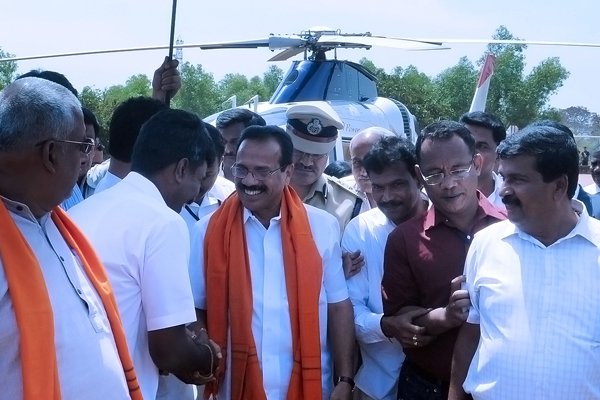
Udupi byelection: leaders use choppers 'intelligently' and hoodwink poll panel

March 15, 2012

sada_copy

Udupi, March 15: Leaders of political parties have been extensively using helicopters during electioneering for the byelection to the Lok Sabha from Udupi-Chikmagalur constituency. They are using helicopters “intelligently” to make sure that the expenditure incurred on air travel is not added to the candidate's expenditure. But while doing so, political parties are misusing official machinery and are attracting the model code of conduct.

Chief Minister D.V. Sadananda Gowda was scheduled to campaign in Tarikere and Chikmagalur constituencies on Tuesday. He chose to travel by air from Bangalore to BRP helipad in Shimoga district. On papers, he conducted a “review meeting” of development projects in Shimoga, the district for which he is in-charge Minister.

In other words, the Chief Minister travelled by a chopper at the government's expense. From BRP helipad, he travelled by road to Lakkavalli in Tarikere taluk. The Chief Minister chose the helipad nearest to Lakkavalli, where he began his day's campaign. While returning, he reached Belur in Hassan district by road and from there he took a helicopter.

Violation

This is in violation of the model code of conduct. As per the paragraph VII (i)(a) of the model code of conduct hosted on the election commission website, the Ministers shall not combine their official visit with electioneering work and shall not also make use of official machinery or personnel during the electioneering work.

The Chief Minister has combined the official visit with electioneering on previous occasions too. On March 10, he reached Shimoga by a helicopter. For the record, he attended a workshop for librarians of gram panchayat libraries, an insignificant programme to have Chief Minister as guest, in Shimoga. Within minutes he left for Chikmagalur by road. It is said the Chief Minister's participation in the programme was decided at the last minute on the previous day.

Similarly, on March 6, the Chief Minister was supposed to leave for Bangalore before evening to attend a meeting with representatives of journalists and advocates after campaigning in Balehonnur in Koppa taluk.

His office made arrangements for his air travel from Belur to Bangalore. He reached Belur by road and got into a helicopter. Belur, about 25 km from Chikmagalur, is a strategic point to reach by helicopter. The Chief Minister again visited Belur on March 9 only to pick BJP State unit president K.S. Eshwarappa, who was campaigning in Chikmagalur, on his way to Goa where they participated in the swearing-in ceremony of Manohar Parrikar. Whenever he visited Belur, his visit was “official” and he was received by senior officers of the district.

Union Minister for Labour Mallikarjun Kharge has been made in-charge of campaigning in Sringeri.

He reached Shimoga on March 4 by air and from there he travelled by car to Sringeri. The Minister, however, did not attend any official programme in Shimoga.

Union Minister for External Affairs S.M. Krishna, during his visit to Chikmagalur on March 6, reached a private resort in the town by a helicopter. He travelled to Mudigere by air as well to address a public meeting. Both Mr. Kharge and Mr. Krishna visited Koppa on Tuesday.

This time, they travelled by one helicopter, which landed in Koppa.

The observers appointed by the Election Commission generally keep track of expenditure made by candidates and parties. They can keep track of landings and departures happening in the constituency limits. However, if the operations are made outside the constituency, chances of the observers receiving details are remote.

As per the model code of conduct the expenditure incurred by campaigners for travel will be included in the candidate's poll expenditure.

A candidate can spend a maximum of Rs. 40 lakh on campaigning. Charges for helicopters vary from Rs. 1.25 to Rs. 2 lakh per hour.


Comments

Add new comment

  • Coastaldigest.com reserves the right to delete or block any comments.
  • Coastaldigset.com is not responsible for its readers’ comments.
  • Comments that are abusive, incendiary or irrelevant are strictly prohibited.
  • Please use a genuine email ID and provide your name to avoid reject.
News Network
January 23,2026

Karnataka Governor Thaawarchand Gehlot read only three lines from the 122-paragraph address prepared by the Congress-led state government while addressing the joint session of the Legislature on Thursday, effectively bypassing large sections critical of the BJP-led Union government.

The omitted portions of the customary Governor’s address outlined what the state government described as a “suppressive situation in economic and policy matters” under India’s federal framework. The speech also sharply criticised the Centre’s move to replace the Mahatma Gandhi National Rural Employment Guarantee Act (MGNREGA) with the Viksit Bharat–Guarantee for Rozgar and Ajeevika Mission (Gramin) Act, commonly referred to as the VB-GRAM (G) Act.

Governor Gehlot had earlier conveyed his objection to several paragraphs that were explicitly critical of the Union government. On Thursday, he confined himself to the opening lines — “I extend a warm welcome to all of you to the joint session of the State legislature. I am extremely pleased to address this august House” — before jumping directly to the concluding sentence of the final paragraph.

He ended the address by reading the last line of paragraph 122: “Overall, my government is firmly committed to doubling the pace of the State’s economic, social and physical development. Jai Hind — Jai Karnataka.”

According to the prepared speech, the Karnataka government demanded the scrapping of the VB-GRAM (G) Act, describing it as “contractor-centric” and detrimental to rural livelihoods, and called for the full restoration of MGNREGA. The state government argued that the new law undermines decentralisation, weakens labour protections, and centralises decision-making in violation of constitutional norms.

Key points from the unread sections of the speech:

•    Karnataka facing a “suppressive” economic and policy environment within the federal system

•    Repeal of MGNREGA described as a blow to rural livelihoods

•    VB-GRAM (G) Act accused of protecting corporate and contractor interests

•    New law alleged to weaken decentralised governance

•    Decision-making said to be imposed by the Centre without consulting states

•    Rights of Adivasis, women, backward classes and agrarian communities curtailed

•    Labourers allegedly placed under contractor control

•    States facing mounting fiscal stress due to central policies

•    VB-GRAM (G) Act accused of enabling large-scale corruption

Comments

Add new comment

  • Coastaldigest.com reserves the right to delete or block any comments.
  • Coastaldigset.com is not responsible for its readers’ comments.
  • Comments that are abusive, incendiary or irrelevant are strictly prohibited.
  • Please use a genuine email ID and provide your name to avoid reject.
News Network
February 4,2026

Mangaluru: Urban local bodies and gram panchayats should make the use of Kannada on signboards mandatory while issuing trade licences to commercial establishments, Dakshina Kannada Deputy Commissioner Darshan HV said. He also called for regular inspections to ensure compliance.

Presiding over the District Kannada Awareness Committee meeting at the deputy commissioner’s office, Darshan said the city corporation would be directed to ensure that shops operating in malls prominently display their names in Kannada. “All commercial establishments, including shops, companies, offices and hotels, must mandatorily display their names in Kannada on signboards,” he said.

The deputy commissioner added that the National Highways Authority of India (NHAI) would be instructed to include Kannada on signboards along national highways. Banks, he said, would be directed through committee meetings to provide application forms in Kannada.

“Even if English-medium schools and colleges impart education in English, their signboards must display the institution’s name in Kannada. Steps will also be taken to ensure that private buses display place names in Kannada,” Darshan said.

During the meeting, committee members raised concerns over the closure of Kannada-medium schools in rural areas due to a shortage of teachers and stressed the need for immediate corrective measures. They also pointed out that several industries employ workers from other states while overlooking local candidates.

Members further demanded that nationalised banks provide deposit and withdrawal slips in Kannada. It was brought to the deputy commissioner’s notice that the presence of staff without knowledge of Kannada in rural branches of nationalised banks is causing hardship to local customers.

Meanwhile, MP Srinath, president of the District Kannada Sahitya Parishat, urged the district administration to allot land for the construction of a district Kannada Bhavana in Mangaluru.

Comments

Add new comment

  • Coastaldigest.com reserves the right to delete or block any comments.
  • Coastaldigset.com is not responsible for its readers’ comments.
  • Comments that are abusive, incendiary or irrelevant are strictly prohibited.
  • Please use a genuine email ID and provide your name to avoid reject.
News Network
February 5,2026

In an era where digital distractions are the primary rival to academic excellence, the Karnataka Education Department is taking the fight directly to the living room. As the SSLC (Class 10) annual examinations loom, officials have launched a localized "digital strike" to ensure students aren't losing their competitive edge to scrolling or soap operas.

The 7-to-9 Lockdown

The department has issued a formal directive urging—and in some cases, enforcing via home visits—a total blackout of mobile phones and television sets between 7:00 PM and 9:00 PM. This two-hour window is being designated as "sacred study time" across the state until the examinations conclude on April 2.

Key Pillars of the Initiative:

•    Doorstep Advocacy: Teachers are transitioning from classrooms to living rooms, meeting parents to explain the psychological benefits of a distraction-free environment.

•    Parental Accountability: The campaign shifts the burden of discipline from the student to the household, asking parents to lead by example and switch off their own devices.

•    The Timeline: The focus remains sharp on the upcoming exam block, scheduled from March 18 to April 2.

"The objective is simple: uninterrupted focus. We are reclaiming the evening hours for the students, ensuring their environment is as prepared as their minds," stated a senior department official.

Student vs. Reality

While the student community has largely welcomed the "forced focus"—with many admitting they lack the willpower to ignore notifications—the move has sparked a debate on enforceability. Without a "TV Police," the success of this initiative rests entirely on the shoulders of parents and the persuasive power of visiting educators.

Comments

Add new comment

  • Coastaldigest.com reserves the right to delete or block any comments.
  • Coastaldigset.com is not responsible for its readers’ comments.
  • Comments that are abusive, incendiary or irrelevant are strictly prohibited.
  • Please use a genuine email ID and provide your name to avoid reject.