Polling gets underway in Udupi-Chikmagalur; Missing names in poll list spark protest

[email protected] (CD Network)
March 18, 2012

ud7


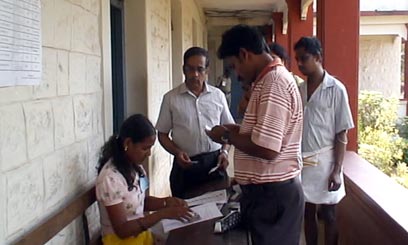
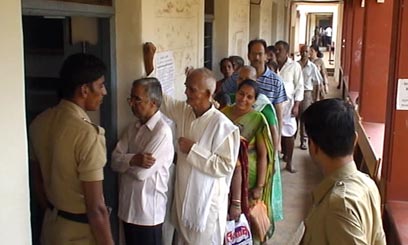
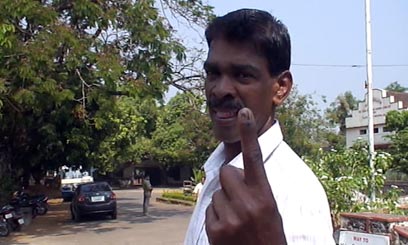
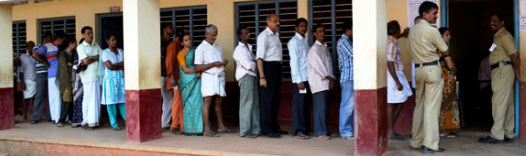
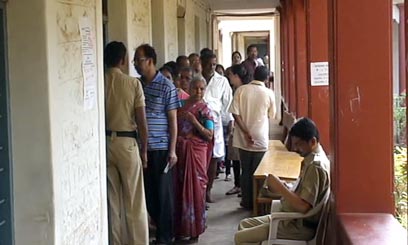
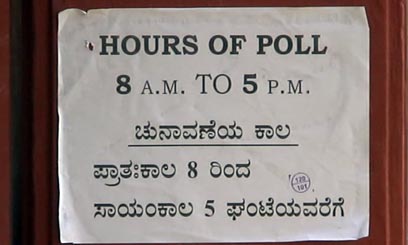
Udupi/ Chikmagalur, March 18: Voting for the by-poll in Udupi-Chikmagalur Lok Sabha constituency began amid tight security on Sunday morning.

Fourteen candidates including independents are in the fray vying for votes from 12,53,589 voters. Out of the 1,633 polling stations, 231 have been declared hyper-sensitive, 788 sensitive, while 77 booths are in naxal-hit areas.

AICC general secretary Oscar Fernandies casted his vote in Vivekananda school Ajjarkad. BJP candidate Sunil Kumar and Congress candidate Jayaprakash Hegde casted their votes in Prevaje Aided School and Korgi School respectively.

Missing names

Migrated labourers of Pragathi Nagara in Allevoor village protested near Nehru high school Alevoor for not finding their vote in the voter list. Namma bhoomi, an NGO is backing the protesters. Official source: at 10 am 9percent polling

This is the second bypoll being held in Karnataka after D V Sadananda Gowda assumed office as Chief Minister. The by-poll was necessitated after Gowda vacated the seat following his election to the assembly recently.
polling_copy

Arch Rivals

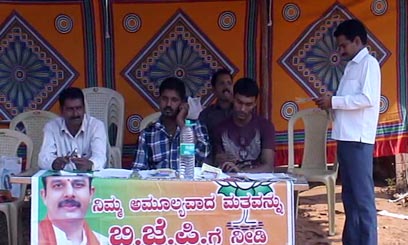
Although it is considered a triangular contest among the Congress, BJP and JD(S), it is a fact that the actual fight is between BJP and Congress, the arch rivals in the constituency.

Party leaders and candidates made last-minute efforts to woo the voters through door-to-door campaigning on Saturday. Congress candidate Jayaprakash Hegde visited temples in Kapu and other places as part of the campaigning.

On Saturday polling officials and police personnel had assembled in the respective de-mustering centers and were dispatched with the polling and security materials to the assigned polling stations. Micro-observers had reached the polling station limits that come under their jurisdiction.

The de-mustering centre for the Udupi and Kapu Assembly segments was set up at the St Cecily's High School. Kota Degree College and taluk office were the de-mustering centers for the Kundapur and Karkala Assembly segments respectively.

The taluk offices in Sringeri and N R Pura were the de-mustering centers for the respective taluks. The pre-university college in Mudigere, T M School in Chikmagalur and S J N College in Tarikere were the de-mustering centers in the respective taluks.

Security has been beefed up in Udupi and Chikmagalur districts. Chikmagalur Superintendent of Police Shiv Kumar said Central paramilitary forces (CRPF)?had been deployed in naxal-hit areas of the district.

Around 4,000 police personnel - including five companies of BSF and CISF and 10 platoons of KSRP - are working round-the-clock to ensure smooth conduct of the bypoll, he added.

Udupi SP Dr Boralingaiah M B said security had been tightened in naxal-hit areas in Udupi district.
ud1

ud2

ud3

ud4

ud5

ud6

ud8

Police use SIMPLEE-K

Meanwhile, the Western Range Police are using mobile phone network for speedy dissemination of information among policemen posted at various polling booths in Udupi-Chikmagalur constituency.


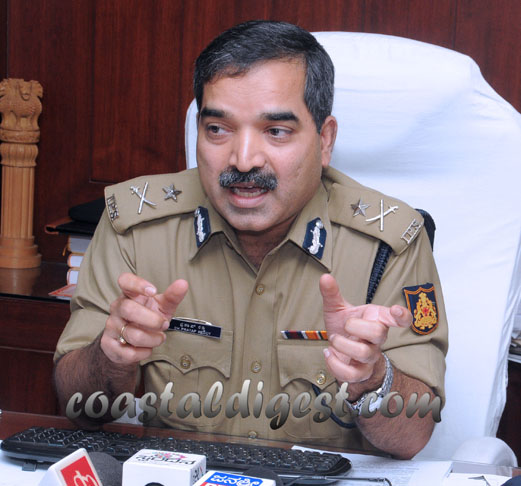
Called ‘SIMPLEE-K' (Smart Information Messenger For Public and Law Enforcement Engagement, Karnataka), this application will be used to pass on information to all personnel involved in the election duty. “We were looking for an effective medium to reach out to the polling personnel. We found this to be a good medium,” Inspector General of Police (Western Range) Pratap Reddy told presspersons on Saturday.

IG_1

Developed by Hyderabad based Zestwings IT Services for the police, this software has been programmed to receive messages from around 2,200-odd pre-registered users to a pre-fixed number '9901199011' on poll day.

These include 1,633 presiding officers in as many booth set up for the polls, and around 416 sector and supervisory officers with SMS containing details such as situation in polling booths and polling data at pre-fixed intervals.

In case, where there is no cell phone network coverage in any particular given area, sector police officers have to collect polling data in booths under their jurisdiction and SMS it to the above number as and when they reach network coverage area. SMS sent to above number is monitored by team of policemen at the control room of Inspector-General of Police (Western Range) and forwarded to officials concerned for necessary follow up/information.

Noting that this software has been developed for purpose of by-elections, Mr Reddy, said that software developed can send out simultaneous SMS to 5,424 police personnel working in 90 police stations of Western Range, including based on their ranks. "We can send out 5,000-odd SMS in a matter of 10 seconds," he said adding this was the easiest means to communicate in modern times where all carried a cell phone with them.

Clarifying that the above number is a stop gap arrangement for poll purpose only, Mr Reddy said it is up to state police top brass to take a call on scaling it up with improvisations as required,for entire state police.

"We have showcased this technology to head of police force," IGP said adding the capability in terms of rolling out citizen centric services with this is immense. We can migrate to national number planning once the technology is proven, he added.




Comments

Add new comment

  • Coastaldigest.com reserves the right to delete or block any comments.
  • Coastaldigset.com is not responsible for its readers’ comments.
  • Comments that are abusive, incendiary or irrelevant are strictly prohibited.
  • Please use a genuine email ID and provide your name to avoid reject.
News Network
February 1,2026

Golf.jpg

The coastal city of Mangaluru is gearing up for a major sporting milestone with the launch of a Golf Excellence Academy at the Pilikula Golf Club (PGC), scheduled to open on May 31. The initiative aims to position Mangaluru firmly on India’s national golfing map.

Speaking to reporters on Saturday during PGC’s first-ever floodlit Pro-Am tournament, club captain Manoj Kumar Shetty said the project is being funded by UAE-based philanthropist Michael D’Souza and is currently in the design phase. Experts from leading golf academies across the country are expected to visit Mangaluru to help shape the training programme and infrastructure.

The academy will train 20 young golfers at a time, with a long-term vision of producing national-level players from the region. Until now, PGC relied on an in-house coach, but the recent renovation of the course and the introduction of floodlights have opened new possibilities for expanding the sport.

Shetty said discussions are underway with two reputed coaching academies, whose heads are expected to visit PGC shortly. “A dormitory for trainers is already under construction. We are inviting academies to assess the facilities and suggest changes so we can build a truly world-class Golf Excellence Academy,” he said.

Professional golfer Aryan Roopa Anand noted that the floodlit course would be a game-changer for young players. “Students can now practise after school hours, even up to 8 or 9 pm, without compromising on academics,” he said.

Comments

Add new comment

  • Coastaldigest.com reserves the right to delete or block any comments.
  • Coastaldigset.com is not responsible for its readers’ comments.
  • Comments that are abusive, incendiary or irrelevant are strictly prohibited.
  • Please use a genuine email ID and provide your name to avoid reject.
News Network
January 23,2026

Karnataka Governor Thaawarchand Gehlot read only three lines from the 122-paragraph address prepared by the Congress-led state government while addressing the joint session of the Legislature on Thursday, effectively bypassing large sections critical of the BJP-led Union government.

The omitted portions of the customary Governor’s address outlined what the state government described as a “suppressive situation in economic and policy matters” under India’s federal framework. The speech also sharply criticised the Centre’s move to replace the Mahatma Gandhi National Rural Employment Guarantee Act (MGNREGA) with the Viksit Bharat–Guarantee for Rozgar and Ajeevika Mission (Gramin) Act, commonly referred to as the VB-GRAM (G) Act.

Governor Gehlot had earlier conveyed his objection to several paragraphs that were explicitly critical of the Union government. On Thursday, he confined himself to the opening lines — “I extend a warm welcome to all of you to the joint session of the State legislature. I am extremely pleased to address this august House” — before jumping directly to the concluding sentence of the final paragraph.

He ended the address by reading the last line of paragraph 122: “Overall, my government is firmly committed to doubling the pace of the State’s economic, social and physical development. Jai Hind — Jai Karnataka.”

According to the prepared speech, the Karnataka government demanded the scrapping of the VB-GRAM (G) Act, describing it as “contractor-centric” and detrimental to rural livelihoods, and called for the full restoration of MGNREGA. The state government argued that the new law undermines decentralisation, weakens labour protections, and centralises decision-making in violation of constitutional norms.

Key points from the unread sections of the speech:

•    Karnataka facing a “suppressive” economic and policy environment within the federal system

•    Repeal of MGNREGA described as a blow to rural livelihoods

•    VB-GRAM (G) Act accused of protecting corporate and contractor interests

•    New law alleged to weaken decentralised governance

•    Decision-making said to be imposed by the Centre without consulting states

•    Rights of Adivasis, women, backward classes and agrarian communities curtailed

•    Labourers allegedly placed under contractor control

•    States facing mounting fiscal stress due to central policies

•    VB-GRAM (G) Act accused of enabling large-scale corruption

Comments

Add new comment

  • Coastaldigest.com reserves the right to delete or block any comments.
  • Coastaldigset.com is not responsible for its readers’ comments.
  • Comments that are abusive, incendiary or irrelevant are strictly prohibited.
  • Please use a genuine email ID and provide your name to avoid reject.
News Network
January 23,2026

Mangaluru: The Karnataka Government Polytechnic (KPT), Mangaluru, has achieved autonomous status from the All India Council for Technical Education (AICTE), becoming the first government polytechnic in the country to receive such recognition in its 78-year history. The status was granted by AICTE, New Delhi, and subsequently approved by the Karnataka Board of Technical Education in October last year.

Officials said the autonomy was conferred a few months ago. Until recently, AICTE extended autonomous status only to engineering colleges, excluding diploma institutions. However, with a renewed national focus on skill development, several government polytechnics across India have now been granted autonomy.

KPT, the second-largest polytechnic in Karnataka, was established in 1946 with four branches and has since expanded to offer eight diploma programmes, including computer science and polymer technology. The institution is spread across a 19-acre campus.

Ravindra M Keni, the first dean of the institution, told The Times of India that AICTE had proposed autonomous status for polytechnic institutions that are over 25 years old. “Many colleges applied. In the first round, 100 institutions were shortlisted, which was further narrowed down to 15 in the second round. We have already completed one semester after becoming an autonomous institution,” he said. He added that nearly 500 students are admitted annually across eight three-year diploma courses.

Explaining the factors that helped KPT secure autonomy, Keni said the institution has consistently recorded 100 per cent admissions and placements for its graduates. He also noted its strong performance in sports, with the college emerging champions for 12 consecutive years, along with active student participation in NCC and NSS activities.

Autonomous status allows KPT to design industry-oriented curricula, conduct examinations, prepare question papers, and manage academic documentation independently. The institution can also directly collaborate with industries and receive priority funding from AICTE or the Ministry of Education. While academic autonomy has been granted, financial control will continue to rest with the state government.

“There will be separate committees for examinations, question paper setting, boards of studies, and boards of examiners. The institution will now have the freedom to conduct admissions without government notifications and issue its own marks cards,” Keni said, adding that new academic initiatives would be planned after a year of functioning under the autonomous framework.

Comments

Add new comment

  • Coastaldigest.com reserves the right to delete or block any comments.
  • Coastaldigset.com is not responsible for its readers’ comments.
  • Comments that are abusive, incendiary or irrelevant are strictly prohibited.
  • Please use a genuine email ID and provide your name to avoid reject.