Bhatkal: Jamia Islamia's 50th anniversary celebrations kick off

[email protected] (CD Network)
March 18, 2012

bhatkal1

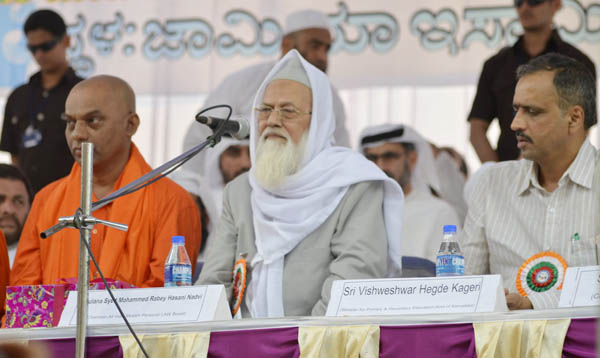
Bhatkal, March 18: There should be no such thing as majority and minority in a society. Even the majority is actually a cluster of minorities such as cultural minorities, lingual minorities and so on. Each and every citizen of the country should be considered as a fellow human being and deserves to be respected, said Moulana Rabey Hasan Nadvi, Chairman, All India Muslim Personal Law Board.

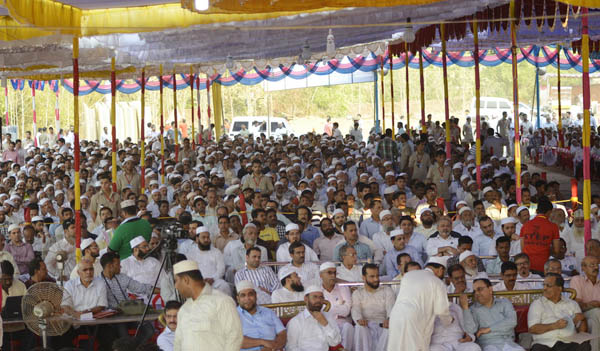
He was speaking at the inaugural ceremony of Jamia Islamia Bhatkal's 50th anniversary celebrations in Bhatkal on Sunday.

Addressing the gathering, Moulana said that India has always been a country of mixed cultures and where harmony and coexistence has been exemplary. The difference in cultures should not become a reason for disharmony. "If a person from north India comes down to the south and finds that the food habits and lifestyle here are not as per his taste, will he pick up a fight with the locals for this petty reason? No. He will adjust and respect the varied cultures that the land has. Similarly, difference in our religious beliefs and cultures should not become reasons for unrest. There has to be harmony, love and co-existence", Moulana Rabey said.

Recalling Moulana Abul Hasan Ali Nadvi's words, Moulana Rabey said that today the world has become selfish and this selfishness has made its way into the language and cultural sphere too. He recalled an incident where Moulana Alimiyan, although weak and old, had got up from his seat in a train when a person in his compartment had thrown a banana skin on the platform and went all the way down to put it aside. "On the occasion, Moulana had told that person that all you had to do was dispose it off in the right place and think about people who walk on the platform", Moulana Rabey said, stating that selfishness and not thinking about others must vanish from the society.

He also said that wars and fights are not solutions to any dispute or problem. "In a fight, irrespective of who wins or loses, both parties bear a loss. So fights are not the solution. Harmony is", he said.

Shri Shri Shri Brahamanand Saraswati Swamiji, Dharmasthala Devara Gudde, Shri Gurudeva Mathadesha

in his address said that the Quran is a great book that has seen no changes being made to it in spite of so many years passing by. Presenting before the gathering the gist of Islam and Hindu philosophies, he said that both religions call on their followers to worship one God. "The path of Kama and Krodha is the path of Iblees", he said, adding that the world today is busy with the "me, myself, and mine" thinking. Enlightening the gathering on how God protects his faithful servants, he narrated the incident of Prophet Muhammad (pbuh) and Hazrath Aboobakkar Siddiq (ra) who took shelter in a cave having learnt that the Meccan forces were after them. "God saved them through a spider's web. Although Aboobakkar (ra) was worried, the Prophet (pbuh) consoled him and said that God was with them and He showed that he was indeed with them", Swamiji said.

When there is an accident, and there is a need of blood, they dont ask whether a Brahmin blood is required or some other blood is required, they only ask A positive, B positive or other blood groups, he said. God is one. The routes of reaching God are different but the goal is one, so why fight? he said. The Prophet (pbuh) also did meditation and so is the case with saints like us. If there is an XYZ fault, why should the entire community be blamed, he said.

Sri Sri Prasannath Swamiji, Adi Chunchanagiri, said that Madrasas and Gurukuls have always been a centre of learning in India. "I read the Quran and the Bible and when I compare it with the Hindu scriptures, I only found that God is one and saints call him by various names. See the lives of the Prophet (pbuh), Shri Krishn and Jesus (pbuh)... they were either shepherds or spent lives with cows. Feelings and beliefs are more important than one's profession", he said. Swamijia added that to have harmony in society teh concept of 'We' should dominate and 'I' should reduce. "People have left Dharma and Moksha and held on to Artha and Kaama", he said. Swamiji also remarked that the Muslims prayer of salah, the ramadan fasting which teaches one about the pain and suffering of the poor and hungry, the teaching of the Prophet (pbuh) that pay a labourer before his sweat dries up..these are beautiful teachings of Islam. We have to learn from it and embrace all the good things", he said.

Vishweshwara Hegde Kageri, State Education Minister, in his address said that Muslims have a misconception that BJP is against them. "We belive in Save Jano Sukhino Bhavantu. The government of Karnataka has shelled out crores of rupees for the minorities. The Hajj Bhavan which remained a mere concept for the past 16 years, our Government has decided to make it a reality and has spent Rs 40 crore for the same. The Government has been working towards providing hostel, residential schools, more seats for minority students etc. Our leadership, be it Atal Bihari Vajpayeeji, Narendra Modi, Yeddyurappa or Sadananda Gowda, we have never tolerated injustice", he said.

An exhibition on Navayath culture and Islamic teachings was inaugurated by Moulana Rabey Hasan nadvi earlier in the day.

More seminars, conferences and programmes would be held as part of the six-day 50th anniversary celebrations.

bhatkal2


Comments

Add new comment

  • Coastaldigest.com reserves the right to delete or block any comments.
  • Coastaldigset.com is not responsible for its readers’ comments.
  • Comments that are abusive, incendiary or irrelevant are strictly prohibited.
  • Please use a genuine email ID and provide your name to avoid reject.
News Network
February 3,2026

wind.jpg

Dakshina Kannada MP Capt Brijesh Chowta has urged the Centre to give high priority to offshore wind energy generation along the Mangaluru coast, citing its strategic importance to India’s green energy and port-led development goals.

Raising the issue in the Lok Sabha under Rule 377, Chowta said studies by the National Institute of Oceanography have identified the Mangaluru coastline as part of India’s promising offshore wind ‘Zone-2’, covering nearly 6,490 sq km. He noted that the region’s relatively low exposure to cyclones and earthquakes makes it suitable for long-term offshore wind projects and called for its development as a dedicated offshore wind energy zone.

Highlighting the role of New Mangalore Port, Chowta said its modern infrastructure, multiple berths and heavy cargo-handling capacity position it well as a logistics hub for transporting and assembling large wind energy equipment.

He also pointed to the presence of major industrial units such as MRPL, OMPL, UPCL and the Mangaluru SEZ, which could serve as direct buyers of green power through power purchase agreements, improving project viability and speeding up execution.

With Karnataka’s peak power demand crossing 18,000 MW in early 2025, Chowta stressed the need to diversify renewable energy sources. He added that offshore wind projects in the Arabian Sea are strategically safer compared to the cyclone-prone Bay of Bengal.

Calling the project vital to India’s target of 500 GW of renewable energy by 2030, Chowta urged the Ministry of New and Renewable Energy to initiate resource assessments, pilot projects and stakeholder consultations at the earliest.

Comments

Add new comment

  • Coastaldigest.com reserves the right to delete or block any comments.
  • Coastaldigset.com is not responsible for its readers’ comments.
  • Comments that are abusive, incendiary or irrelevant are strictly prohibited.
  • Please use a genuine email ID and provide your name to avoid reject.
News Network
January 23,2026

Karnataka Governor Thaawarchand Gehlot read only three lines from the 122-paragraph address prepared by the Congress-led state government while addressing the joint session of the Legislature on Thursday, effectively bypassing large sections critical of the BJP-led Union government.

The omitted portions of the customary Governor’s address outlined what the state government described as a “suppressive situation in economic and policy matters” under India’s federal framework. The speech also sharply criticised the Centre’s move to replace the Mahatma Gandhi National Rural Employment Guarantee Act (MGNREGA) with the Viksit Bharat–Guarantee for Rozgar and Ajeevika Mission (Gramin) Act, commonly referred to as the VB-GRAM (G) Act.

Governor Gehlot had earlier conveyed his objection to several paragraphs that were explicitly critical of the Union government. On Thursday, he confined himself to the opening lines — “I extend a warm welcome to all of you to the joint session of the State legislature. I am extremely pleased to address this august House” — before jumping directly to the concluding sentence of the final paragraph.

He ended the address by reading the last line of paragraph 122: “Overall, my government is firmly committed to doubling the pace of the State’s economic, social and physical development. Jai Hind — Jai Karnataka.”

According to the prepared speech, the Karnataka government demanded the scrapping of the VB-GRAM (G) Act, describing it as “contractor-centric” and detrimental to rural livelihoods, and called for the full restoration of MGNREGA. The state government argued that the new law undermines decentralisation, weakens labour protections, and centralises decision-making in violation of constitutional norms.

Key points from the unread sections of the speech:

•    Karnataka facing a “suppressive” economic and policy environment within the federal system

•    Repeal of MGNREGA described as a blow to rural livelihoods

•    VB-GRAM (G) Act accused of protecting corporate and contractor interests

•    New law alleged to weaken decentralised governance

•    Decision-making said to be imposed by the Centre without consulting states

•    Rights of Adivasis, women, backward classes and agrarian communities curtailed

•    Labourers allegedly placed under contractor control

•    States facing mounting fiscal stress due to central policies

•    VB-GRAM (G) Act accused of enabling large-scale corruption

Comments

Add new comment

  • Coastaldigest.com reserves the right to delete or block any comments.
  • Coastaldigset.com is not responsible for its readers’ comments.
  • Comments that are abusive, incendiary or irrelevant are strictly prohibited.
  • Please use a genuine email ID and provide your name to avoid reject.
News Network
February 3,2026

Bengaluru: Following reports of fresh Nipah virus (NiV) cases in West Bengal and heightened vigilance across parts of Southeast Asia, the Karnataka Health Department has placed the state on high alert and activated emergency preparedness protocols.

Health officials said enhanced surveillance measures have been initiated after two healthcare workers in Barasat, West Bengal, tested positive for the virus earlier this month. While no cases have been reported in Karnataka so far, authorities said the state’s past exposure to Nipah outbreaks and high inter-state mobility warranted preventive action.

Officials have directed district health teams to intensify monitoring, particularly at hospitals and points of entry, and to ensure early detection and isolation of suspected cases.

High Mortality Virus with Multiple Transmission Routes

Nipah virus is a zoonotic disease that can spread from animals to humans and has a reported fatality rate ranging between 60 and 75 per cent. Fruit bats, also known as flying foxes, are the natural reservoirs of the virus and can transmit it by contaminating food sources with saliva or urine.

Known modes of transmission include:

•    Contaminated food: Consumption of fruits partially eaten by bats or raw date-palm sap
•    Animal contact: Exposure to infected pigs or other animals
•    Human-to-human transmission: Close contact with body fluids of infected persons, particularly in healthcare settings

Symptoms and Disease Progression

The incubation period typically ranges from 4 to 14 days, though delayed onset has also been reported. Early symptoms often resemble common viral infections, making prompt clinical suspicion critical.

•    Initial symptoms: Fever, headache, body aches, fatigue, sore throat
•    Progressive symptoms: Drowsiness, disorientation, altered mental state
•    Severe stage: Seizures, neck stiffness and acute encephalitis, which can rapidly progress to coma

Public Health Advisory

The Health Department has issued precautionary guidelines urging the public to adopt risk-avoidance practices to prevent any local spillover.

Do’s
•    Wash fruits thoroughly before consumption
•    Drink boiled and cooled water
•    Use protective equipment while handling livestock
•    Maintain strict hand hygiene

Don’ts
•    Avoid fruits found on the ground or showing bite marks
•    Do not consume beverages made from raw tree sap, including toddy
•    Avoid areas with dense bat populations
•    Do not handle sick or dead animals

Preparedness Measures

Officials confirmed that isolation wards are being readied in major government hospitals and that medical staff are being sensitised to identify early warning signs.

“There is no cause for panic, but there is a need for heightened vigilance,” a senior health official said, adding that there is currently no approved vaccine or specific antiviral treatment for Nipah, and care remains largely supportive.

Comments

Add new comment

  • Coastaldigest.com reserves the right to delete or block any comments.
  • Coastaldigset.com is not responsible for its readers’ comments.
  • Comments that are abusive, incendiary or irrelevant are strictly prohibited.
  • Please use a genuine email ID and provide your name to avoid reject.