



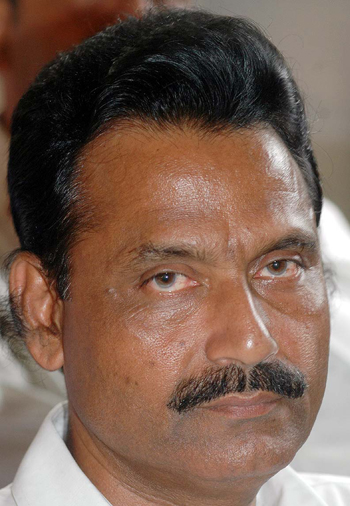
However, it recommended admonishment of Lakshman Savadi, another BJP MLA, by the Speaker, as the allegations against him seem to be valid.
The 28-page report of the Committee headed by Srishailappa Bidarur (BJP) was tabled in the Assembly on Friday, the last day of the current session.
With the Opposition parties refusing to be part of the probe panel, only four BJP MLAs were on it, besides officials of the Assembly secretariat. All the three BJP MLAs - Savadi, Palemar and Patil - were ministers when they hit the headlines for the wrong reasons. Savadi and Patil allegedly watched the clips on Palemar's cellphone. They resigned as ministers a day after television channels showed them watching clips.
Speaker K G Bopaiah said he would allow a discussion on the report during the next session. He said the restriction imposed on the three former ministers from entering the House had been withdrawn.
The report said there was no substantial proof to establish that Patil was watching porn clips and Palemar was the chief culprit.
In the case of Savadi, the report said he had submitted to the inquiry committee a pen drive containing rave party-like clippings downloaded from the cellphone he watched in the House. The reports says the visuals do not indicate Savadi used his phone. However, there is some resemblance to the clippings on the cellphone and those in the pen drive.
“He was seen reading a government order while the phone played the video. Therefore, there was no deliberate attempt to watch the clips. Besides, the member has apologised to the committee for using the phone while in the House and has also stated that he would not use it again. The Speaker has already punished him by restricting his entry to the Assembly since the incident took place. The Speaker should admonish him telling him he should not repeat such things,” the report adds.
The panel has favoured imposition of a slew of restrictions on television journalists and crew to enter the House. The legislation on conduct of the House was drafted long ago when there were no cellphones. The law should be amended banning use of cellphone, it opined. Till then, the Speaker should restrict the use of mobile phones.
There are specific rules pertaining to the press gallery in the Assembly, but there is no rule for visual media. Like in Parliament, in the Assembly too, rules should be prescribed for the visual media for covering the legislature session.
There should be a dedicated TV channel like the one in the Lok Sabha, or a channel owned by the government. This would ensure impartial telecast of deliberations of the House, the committee says.
To prevent a repeat another porngate and to maintain discipline and dignity, rules should be framed by constituting an ethics committee, it said.
The men and their defence
Krishna J Palemar: I had brought my cellphone to the House by mistake. I had kept it on the table. U T Khader was discussing road problems in his constituency with me. He was showing his daughter's photo on his cellphone. He also told me he has not sent any MMS to me.
Lakshman Savadi: I discussed the rave party incident in Udupi with Palemar. He said the party was nothing compared to atrocities committed against women elsewhere in the world. I have two phones which I am submitting to the House. They were not porn clippings. I watched the clippings shown to me to ensure such things don't happen here. There was no other intention. I do not know on whose cellphone I watched the clips. I do not even know if it was Palemar's. But I am not going to use the cellphone in the Assembly henceforth because I have realised the mistake I have committed.
Television channels have telecast a scene where a woman is murdered as she does not co-operate with men who try to rape her. This has been downloaded from the Internet by the channels. They glorified it. In fact, I was discussing with C C Patil the crash in onion prices...
I was not watching the clippings.
C C Patil: I was discussing onion prices with Savadi as funds under the market intervention scheme had not been released. Savadi had a cellphone in his hand. I told him not to keep it on. I tried to switch it off and came back to my seat. I sat with Savadi for seven seconds. I usually use spectacles. But that day, I had not used it and hence I could not see the clippings properly.

Comments
Add new comment