New Mangalore Port emerges largest LPG handling port in India

April 3, 2012

Nmpt3A_1

Mangalore, April 3: New Mangalore Port has registered a growth of 4.42 per cent in cargo handled in current fiscal year (2011-12) at 32.94 million tonnes as against 31.55 million tonnes in 2010-11. The number of vessels handled by the port also increased to 1136 from 1097.

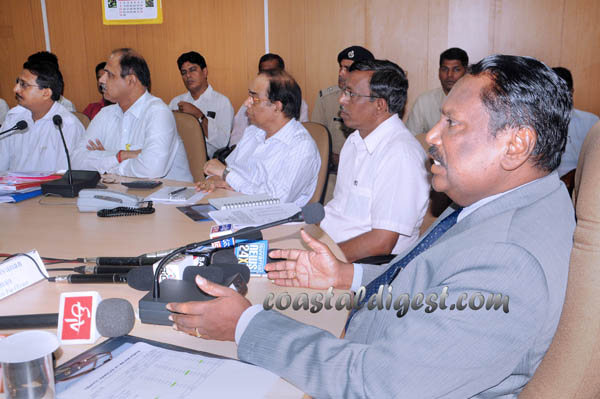
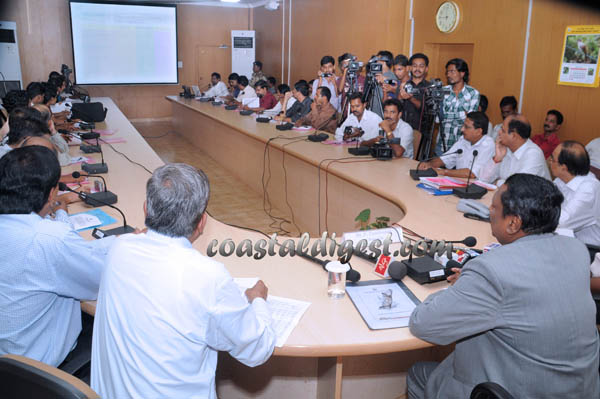
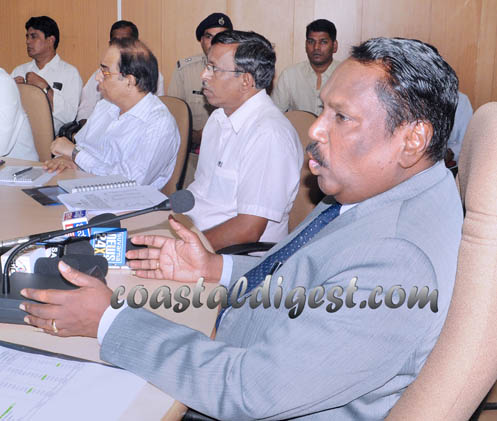
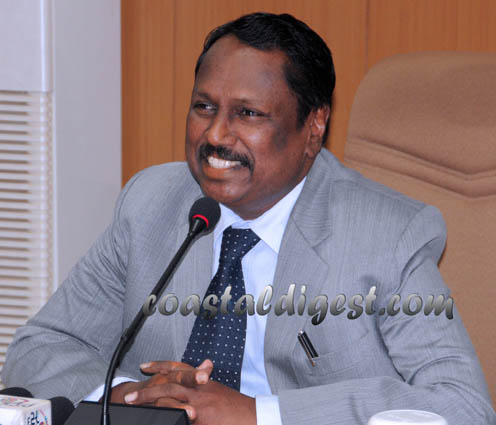
Revealing this at a press meet here on Tuesday, The Chairman of NMPT Tamilvanan said the The bright spot in cargo handling last fiscal came when NMP emerged as the largest LPG handling port among major ports in India by handling record quantity of 2.07 million tonnes, Tamilvanan said. Container traffic handled consistently increased by 12.08% by handling a record number of 45009 TEUs as against 40158 TEUs in 2010-11. Port also registered newer highs in handling coffee, raw cashew, wax candles, edible oil, and project cargo.

Mr Tamilvanan said the container traffic consistently increased by 12.08 per cent by handling a record number of 45,009 TEUs as against 40,158 TEUs in the previous year. The highest container traffic of 1512 twenty equity units (TEUs) in a single voyage on November 11, 2011. Container rakes started operation between Bangalore and Mangalore on December 18, 2011.

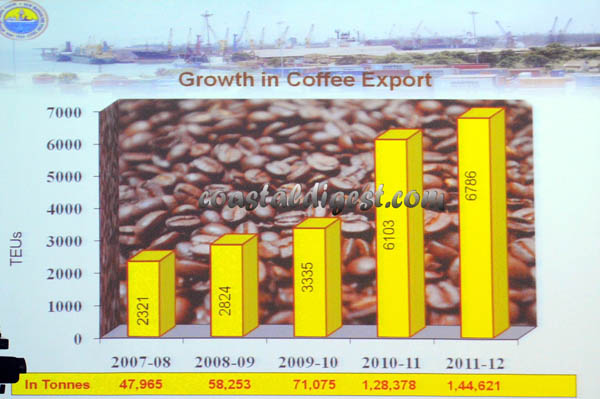
He said, highest quantity of 1,44,621 tonnes of coffee was exported. Highest quantity 1216 TEUs of wax candles was exported. Highest quantity 1,24,253 tonnes of raw cashed handled in 2011-12.

Record LPG traffic of 2.07 million tonnes handled in 2011-12 surpassing the earlier of 1.91 million tonnes in 2010-11 with the growth rate of 8.23 %. Record LPG traffic of 2 Lakh tonnes handled in July 2011 which is the highest quantity of LPG handled in a month surpassing the earlier record of 1.83 lakh tonnes in Dec 2011. Highest quantity of coal handled in 2011-12 surpassing earlier record of 2.85 million tonnes in 2010-11. Grab operation of timber logs commenced from Feb 2 ,2012. Highest quantity of 6.58 lakh tonnes of edible oil handled surpassing earlier record of 5.94 lakh tonnes in 2009-10.

Mr Tamilvanan said the mechanised handling of coal commenced in Nov 2011. Heaviest ODC cargo of 770 metric tonnes handled in 2011 -12. Highest quantity of 3.55 lakh tonnes of project cargo handled in Sep 2011. Highest number of 10,620 passengers in 17 cruise vessels were handled in 2011-12 as against 14 vessels with 5854 passengers in 2010-11.

The chairman said that for the consecutive fifth year, the Port revenue crossed Rs 300 crores mark. For the seventh consecutive year the Port's net surplus crossed Rs 100 crore (Rs 123 crores). The government loan of Rs 40.26 crores has been repaid. TAMP approved the revised scale of rates effective from April 1, 2012. For the first time TAMP also approved introduction of per ton levy in lieu of percentage basis levy and collection of wages w.e.f April 1, 2012.

He said, the construction of POL berth worth Rs 79 crore, coal handling facility for UPCL at Rs 230 crore, improvements to Port roads and development of storage yards, 3 ton forklift procured during March and additional 7 numbers of channel buoys deployed are some of the development works at NMPT. In an attempt to boost business NMPT in association with FKCCI held trade meets at Bangalore, Mysore, Madikeri, Hassan and Kannur emphasizing the updated developments in the port to stakeholders in the hinterland to augment accelerated movement of cargo, he added.

The chairman said, during the financial year 2011-12 the Port conducted several in-house training programmes for the officers and employees through NIPM/IIPM/NITK and Port faculty. A separate pollution control cell headed by qualified marine engineers is operating at the port whose main activity is to prevent and combat all types of pollutions and the cell conducts environmental studies with the help of NITK Suratkal and continuous inspection of harbour waters ensured to take prompt action to mitigate and combat pollution incidents.

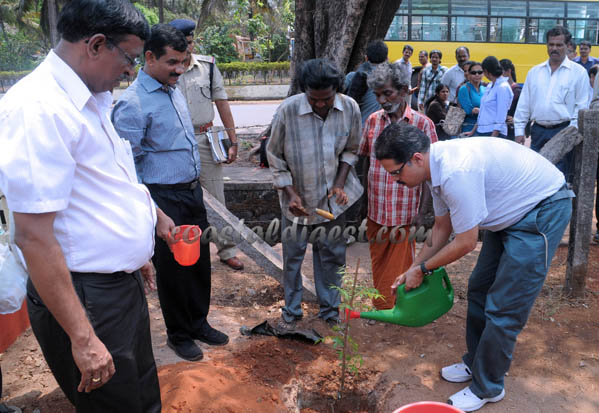
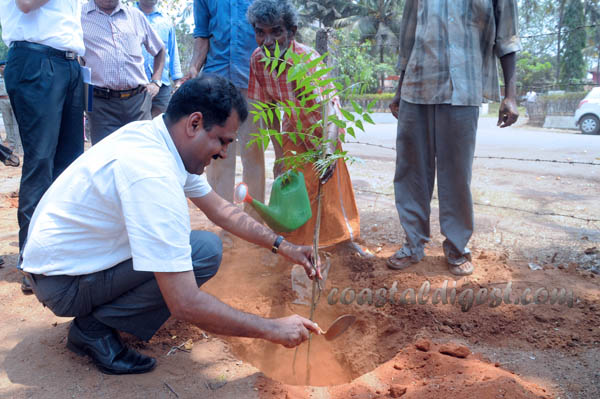
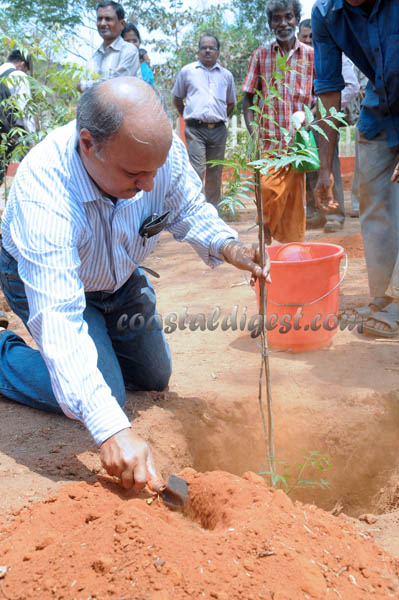
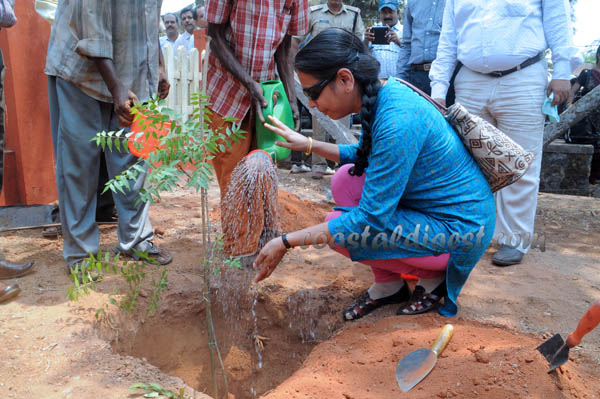
He said tree about 20,000 saplings were panted in the port area during the last two years. As part of its Corporate Social Responsibility it has contributed Rs 5 lakhs for a project which establishes protection of rare, endangered and threatened medicinal plants of Western Ghats at Pilikula Nisargadhama on the outskirts of Mangalore.
Nmpt3A_2

Nmpt3A_3

Nmpt3A_4

Nmpt3A_5

Nmpt3A_6

Nmpt3A_7

Nmpt3A_8

Nmpt3A_9

Nmpt3A_10

Comments

Add new comment

  • Coastaldigest.com reserves the right to delete or block any comments.
  • Coastaldigset.com is not responsible for its readers’ comments.
  • Comments that are abusive, incendiary or irrelevant are strictly prohibited.
  • Please use a genuine email ID and provide your name to avoid reject.
coastaldigest.com news network
February 5,2026

protestkerala.jpg

Mangaluru: The KSRTC Mangaluru division has rolled back the fare hike on buses operating on the Mangaluru–Kasaragod route following the suspension of toll collection at the Arikkady toll plaza near Kumbala in Kasaragod district.

The fare revision had been implemented after the National Highways Authority of India (NHAI) began toll collection at the Arikkady plaza on NH-66. As a result, fares for ordinary and Rajahamsa services were increased by ₹7 and ₹10, respectively, raising the bus fare from Mangaluru to Kasaragod from ₹81 to ₹88.

Senior Divisional Controller of KSRTC’s Mangaluru division, Rajesh Shetty, said the fares were reduced after toll collection at the Arikkady plaza was stopped. “The tollgate began operations on January 13, and the toll amount was deducted from the FASTag accounts of KSRTC buses operating on the route. Following an order from the central government to suspend toll collection, KSRTC has also withdrawn the additional fare with immediate effect,” he said.

At present, vehicles travelling on the Mangaluru–Kasaragod route pay toll only at the Talapady toll plaza. The toll for light motor vehicles (LMVs) at Talapady is ₹80 for a same-day return, while heavy vehicles, including buses, are charged ₹250. At Arikkady, the toll rates were ₹130 for LMVs (same-day return) and ₹450 for buses.

Protests against Arikkady toll plaza

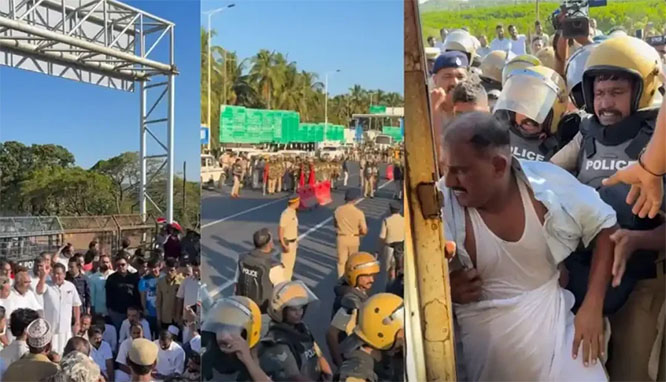
The Arikkady toll plaza witnessed widespread protests from January 12, the day toll collection commenced. On the second day, an action committee led by Manjeshwar MLA A K M Ashraf launched an indefinite protest at the site. Except for the BJP, leaders and workers of most major political parties participated in the agitation.

On the night of January 14, a large number of protesters gathered at the plaza and vandalised property, following which authorities temporarily suspended toll operations. The BJP later also expressed opposition to the toll plaza and criticised NHAI’s decision. 

Comments

Add new comment

  • Coastaldigest.com reserves the right to delete or block any comments.
  • Coastaldigset.com is not responsible for its readers’ comments.
  • Comments that are abusive, incendiary or irrelevant are strictly prohibited.
  • Please use a genuine email ID and provide your name to avoid reject.
News Network
February 1,2026

Bengaluru: The Karnataka High Court has refused to quash an investigation against a WhatsApp group administrator accused of allowing the circulation of obscene and offensive images depicting Hindutva politicians and idols in 2021.

Justice M Nagaprasanna observed that, prima facie, the ingredients of the offence under Section 295A of the Indian Penal Code were made out. “The offence under Section 295A of the IPC is met to every word of its ingredient, albeit prima facie,” the judge said.

The petitioner, Sirajuddin, a resident of Belthangady taluk in Dakshina Kannada district, had challenged the FIR registered against him at the CEN (Cyber, Economics and Narcotics) police station, Mangaluru, for offences under Section 295A of the IPC and Section 67 of the Information Technology Act. Section 295A relates to punishment for deliberate and malicious acts intended to outrage the religious feelings of any class of citizens.

According to the complaint filed by K Jayaraj Salian, also a resident of Belthangady taluk, he received a WhatsApp group link from an unknown source and was added to the group after accessing it. The group reportedly had six administrators and around 250 participants, where obscene and offensive images depicting Hindu deities and certain political figures were allegedly circulated repeatedly.

Sirajuddin was arrested in connection with the case and later released on bail on February 16, 2021. He argued before the court that he was being selectively targeted, while other administrators—including the creator of the group—were neither arrested nor investigated. He also contended that the Magistrate could not have taken cognisance of the offence under Section 295A without prior sanction under Section 196(1) of the CrPC.

Rejecting the argument, Justice Nagaprasanna held that prior sanction is required only at the stage of taking cognisance, and not at the stage of registration of the crime or during investigation.

The judge noted that the State had produced the entire investigation material before the court. “A perusal of the material reveals depictions of Hindu deities in an extraordinarily obscene, demeaning and profane manner. The content is such that its reproduction in a judicial order would itself be inappropriate,” the court said, adding that the material, on its face, had the tendency to outrage religious feelings and disturb communal harmony.

Observing that the case was still at the investigation stage, the court said it could not interdict the probe at this juncture. However, it expressed concern that the investigating officer appeared to have not proceeded uniformly against all administrators. The court clarified that if the investigation revealed the active involvement of any member in permitting the circulation of such content, they must also be proceeded against.

“At this investigative stage, any further observation by this Court would be unnecessary,” the order concluded.

Comments

Add new comment

  • Coastaldigest.com reserves the right to delete or block any comments.
  • Coastaldigset.com is not responsible for its readers’ comments.
  • Comments that are abusive, incendiary or irrelevant are strictly prohibited.
  • Please use a genuine email ID and provide your name to avoid reject.
News Network
January 23,2026

Karnataka Governor Thaawarchand Gehlot read only three lines from the 122-paragraph address prepared by the Congress-led state government while addressing the joint session of the Legislature on Thursday, effectively bypassing large sections critical of the BJP-led Union government.

The omitted portions of the customary Governor’s address outlined what the state government described as a “suppressive situation in economic and policy matters” under India’s federal framework. The speech also sharply criticised the Centre’s move to replace the Mahatma Gandhi National Rural Employment Guarantee Act (MGNREGA) with the Viksit Bharat–Guarantee for Rozgar and Ajeevika Mission (Gramin) Act, commonly referred to as the VB-GRAM (G) Act.

Governor Gehlot had earlier conveyed his objection to several paragraphs that were explicitly critical of the Union government. On Thursday, he confined himself to the opening lines — “I extend a warm welcome to all of you to the joint session of the State legislature. I am extremely pleased to address this august House” — before jumping directly to the concluding sentence of the final paragraph.

He ended the address by reading the last line of paragraph 122: “Overall, my government is firmly committed to doubling the pace of the State’s economic, social and physical development. Jai Hind — Jai Karnataka.”

According to the prepared speech, the Karnataka government demanded the scrapping of the VB-GRAM (G) Act, describing it as “contractor-centric” and detrimental to rural livelihoods, and called for the full restoration of MGNREGA. The state government argued that the new law undermines decentralisation, weakens labour protections, and centralises decision-making in violation of constitutional norms.

Key points from the unread sections of the speech:

•    Karnataka facing a “suppressive” economic and policy environment within the federal system

•    Repeal of MGNREGA described as a blow to rural livelihoods

•    VB-GRAM (G) Act accused of protecting corporate and contractor interests

•    New law alleged to weaken decentralised governance

•    Decision-making said to be imposed by the Centre without consulting states

•    Rights of Adivasis, women, backward classes and agrarian communities curtailed

•    Labourers allegedly placed under contractor control

•    States facing mounting fiscal stress due to central policies

•    VB-GRAM (G) Act accused of enabling large-scale corruption

Comments

Add new comment

  • Coastaldigest.com reserves the right to delete or block any comments.
  • Coastaldigset.com is not responsible for its readers’ comments.
  • Comments that are abusive, incendiary or irrelevant are strictly prohibited.
  • Please use a genuine email ID and provide your name to avoid reject.