Post-centenary silver jubilee of UFS Congregation held

April 12, 2012

PCSJC1

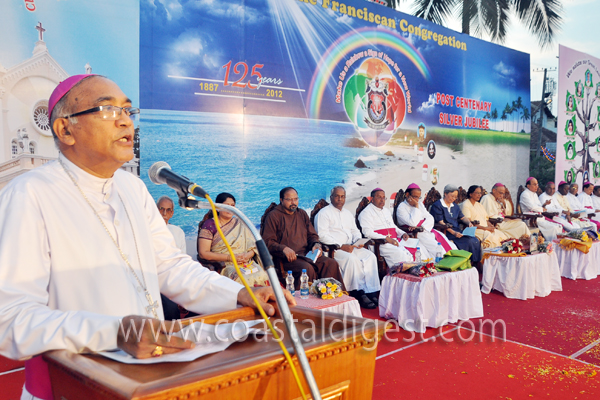
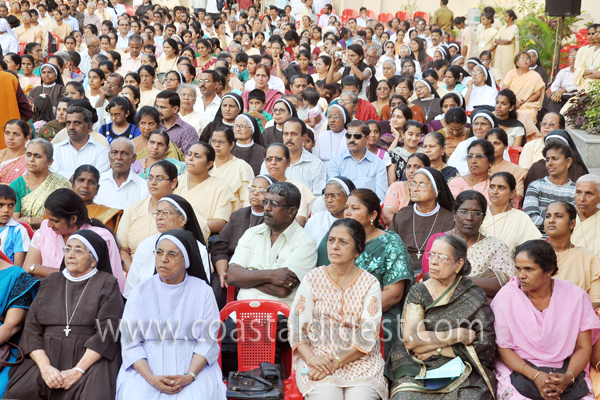
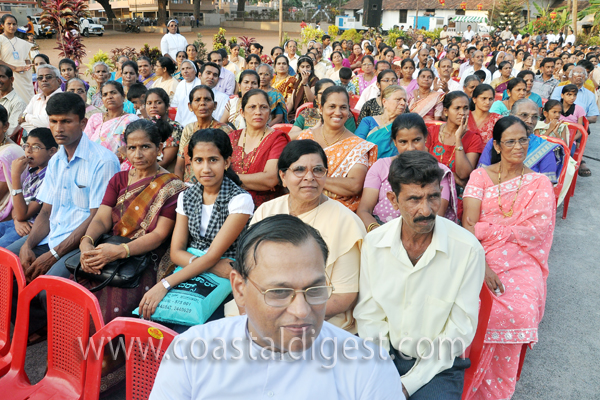
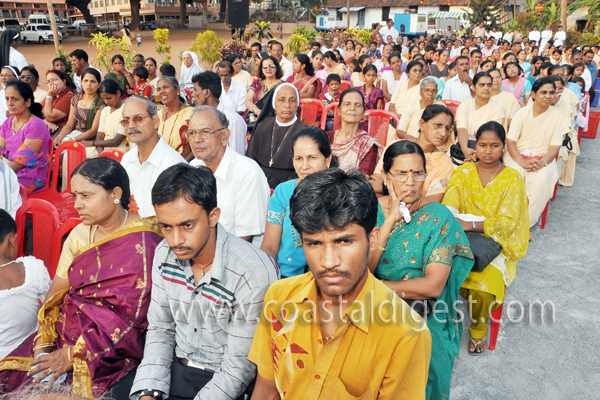
Mangalore, April 12: The Congregation of Ursuline Franciscan Sisters (UFS), which originated in Mangalore at Rosario Cathedral in 1887, celebrated its post-centenary silver jubilee on Thursday.

The congregation which started as a pious association has grown to pontifical height. Today there are more than 128 Convents with 1,100 members. They take up pastoral ministry and run educational, social and vocational centres, orphanages, hostels, homes for the elderly, medical support and so on through 33 dioceses, he said and added that the sisters have opened their houses in rural areas and helped the poorest of the poor.

Presiding over the programme, Archbishop of Bangalore Rev Dr Bernard Moras said that though the missionaries have served a lot in the region, they are treated like outsiders.

“This means we have failed some where to be part of the community, state and our country. This is the opportunity to be a part of the suffering of the society and work even more,” he said.

“To be relevant in turbulent times is a real challenge. Do not ask what the society and church can do for you. Instead think what you can do for the world. If an egg is broken from outside life dies, but if it breaks from within a new life begins,” he added.

Superior General of Roman Union of Ursuline Rev Sr Cecilia Wang appreciated the charitable work taken up by the congregation. “You have continued the work of St Angela Merici, St Francis of Assisi, St Ignatius of Loyola and St Ursula,” she said.

Five books, which are connected with the Ursuline Franciscan Congregation were released on the occasion. The 'Formation Manual' was released by Bishop Peter Machado, 'UFLA Hand book' by Leon from Tanzania, 'In the land of the living,' by Bishop Thomas Vazhapilly, 'Social Grace' by Bishop Aloysius Paul D'Souza, 'A purposeful Journey' by Bishop Rogath Kimario.

'Tobia Payana' a project to help children was inaugurated by the Congregation Superior General Rev Sr Doreen D'Souza.

A dance drama 'Kannada Nrithya Roopaka', Life Story of St Angela Merici the Founder of the Company of St Ursula in Italy was presented. It was followed by a song, dance and drama show 'Dhonu' (Rainbow) highlighting the frontline ministries of the Ursuline Franciscan Congregation and their future jubilee projects.

A short documentary 'Pilgrimage of Love' which showed the history, life and mission of the Ursuline Franciscan sisters was projected.

Fr Urban Stein motivated a few young ladies of Mangalore region to care for the suffering in the Old Bundar area. In the forefront was Nympha Fernandez, daughter of the Deputy Collector who became the first superior of the order. Initially the order was refereed to as “The company of St Ursula”.

This small dedicated band of local catholic maidens did exemplary work among the down trodden and were often called as the 'Angles of Bundar'.

On April 10,1887 the Association was formally formed and it obtained the seal of an integral religious congregation with its 'Canonical Erection' on May 13, 1934.


PCSJC2

PCSJC3

PCSJC4

PCSJC5

PCSJC6

PCSJC7

PCSJC8

PCSJC9

PCSJC10

PCSJC11

PCSJC12

PCSJC13

PCSJC14

PCSJC15

PCSJC16

PCSJC17

PCSJC18

PCSJC19

PCSJC20

Comments

Add new comment

  • Coastaldigest.com reserves the right to delete or block any comments.
  • Coastaldigset.com is not responsible for its readers’ comments.
  • Comments that are abusive, incendiary or irrelevant are strictly prohibited.
  • Please use a genuine email ID and provide your name to avoid reject.
News Network
February 3,2026

Bengaluru: Following reports of fresh Nipah virus (NiV) cases in West Bengal and heightened vigilance across parts of Southeast Asia, the Karnataka Health Department has placed the state on high alert and activated emergency preparedness protocols.

Health officials said enhanced surveillance measures have been initiated after two healthcare workers in Barasat, West Bengal, tested positive for the virus earlier this month. While no cases have been reported in Karnataka so far, authorities said the state’s past exposure to Nipah outbreaks and high inter-state mobility warranted preventive action.

Officials have directed district health teams to intensify monitoring, particularly at hospitals and points of entry, and to ensure early detection and isolation of suspected cases.

High Mortality Virus with Multiple Transmission Routes

Nipah virus is a zoonotic disease that can spread from animals to humans and has a reported fatality rate ranging between 60 and 75 per cent. Fruit bats, also known as flying foxes, are the natural reservoirs of the virus and can transmit it by contaminating food sources with saliva or urine.

Known modes of transmission include:

•    Contaminated food: Consumption of fruits partially eaten by bats or raw date-palm sap
•    Animal contact: Exposure to infected pigs or other animals
•    Human-to-human transmission: Close contact with body fluids of infected persons, particularly in healthcare settings

Symptoms and Disease Progression

The incubation period typically ranges from 4 to 14 days, though delayed onset has also been reported. Early symptoms often resemble common viral infections, making prompt clinical suspicion critical.

•    Initial symptoms: Fever, headache, body aches, fatigue, sore throat
•    Progressive symptoms: Drowsiness, disorientation, altered mental state
•    Severe stage: Seizures, neck stiffness and acute encephalitis, which can rapidly progress to coma

Public Health Advisory

The Health Department has issued precautionary guidelines urging the public to adopt risk-avoidance practices to prevent any local spillover.

Do’s
•    Wash fruits thoroughly before consumption
•    Drink boiled and cooled water
•    Use protective equipment while handling livestock
•    Maintain strict hand hygiene

Don’ts
•    Avoid fruits found on the ground or showing bite marks
•    Do not consume beverages made from raw tree sap, including toddy
•    Avoid areas with dense bat populations
•    Do not handle sick or dead animals

Preparedness Measures

Officials confirmed that isolation wards are being readied in major government hospitals and that medical staff are being sensitised to identify early warning signs.

“There is no cause for panic, but there is a need for heightened vigilance,” a senior health official said, adding that there is currently no approved vaccine or specific antiviral treatment for Nipah, and care remains largely supportive.

Comments

Add new comment

  • Coastaldigest.com reserves the right to delete or block any comments.
  • Coastaldigset.com is not responsible for its readers’ comments.
  • Comments that are abusive, incendiary or irrelevant are strictly prohibited.
  • Please use a genuine email ID and provide your name to avoid reject.
News Network
February 5,2026

Bengaluru: As air quality continues to worsen across several parts of the city, hospitals in Bengaluru are reporting a steady rise in patients suffering from respiratory illnesses such as asthma, bronchitis and Chronic Obstructive Pulmonary Disease (COPD), health officials and doctors said.

Data from the Suvarna Arogya Suraksha Trust (SAST) shows that 3,891 patients received treatment for respiratory ailments between April and November 2024. The figure rose to 4,187 during the same period in 2025.

Private hospitals, too, are witnessing a 10–15 per cent year-on-year increase in such cases.

While doctors caution that the rise cannot be attributed solely to air pollution, a significant number of patients are non-smokers with no prior history of respiratory disease.

“Nearly 70 per cent of the patients we see are non-smokers with no previous respiratory issues. When other causes are ruled out, air pollution emerges as the most likely factor,” said Dr Manjunath PH, consultant interventional pulmonologist at a hospital in Kengeri.

Doctors noted that patient footfall spikes during the winter months and around Deepavali, when air quality typically worsens.

“There is a clear correlation between poor air quality and the rise in cases. People commonly present with persistent cough, breathlessness and irritation of the respiratory tract, indicating the impact of polluted air on their health,” said Dr Sheetal Chaurasia, consultant in pulmonary medicine at a private hospital in Whitefield.

Dr Chaurasia added that respiratory tract infections are also on the rise.

“Poor air quality leads to chronic airway inflammation, making the airways more vulnerable to infections. We are seeing an increase in both upper and lower respiratory tract infections,” she said.

Patients with pre-existing respiratory conditions remain the worst affected.

“For those already diagnosed with respiratory illnesses, deteriorating air quality significantly worsens the condition. Both the frequency and severity of attacks increase sharply,” said Dr Vandana P, a pulmonologist at a hospital on Bannerghatta Road.

Doctors also flagged a worrying trend of rising respiratory problems among younger adults and children.

To reduce exposure, they advised people to wear masks while travelling on two-wheelers or autos and ensure adequate ventilation at home to minimise indoor air pollution.

Comments

Add new comment

  • Coastaldigest.com reserves the right to delete or block any comments.
  • Coastaldigset.com is not responsible for its readers’ comments.
  • Comments that are abusive, incendiary or irrelevant are strictly prohibited.
  • Please use a genuine email ID and provide your name to avoid reject.
News Network
January 23,2026

Mangaluru: The Karnataka Government Polytechnic (KPT), Mangaluru, has achieved autonomous status from the All India Council for Technical Education (AICTE), becoming the first government polytechnic in the country to receive such recognition in its 78-year history. The status was granted by AICTE, New Delhi, and subsequently approved by the Karnataka Board of Technical Education in October last year.

Officials said the autonomy was conferred a few months ago. Until recently, AICTE extended autonomous status only to engineering colleges, excluding diploma institutions. However, with a renewed national focus on skill development, several government polytechnics across India have now been granted autonomy.

KPT, the second-largest polytechnic in Karnataka, was established in 1946 with four branches and has since expanded to offer eight diploma programmes, including computer science and polymer technology. The institution is spread across a 19-acre campus.

Ravindra M Keni, the first dean of the institution, told The Times of India that AICTE had proposed autonomous status for polytechnic institutions that are over 25 years old. “Many colleges applied. In the first round, 100 institutions were shortlisted, which was further narrowed down to 15 in the second round. We have already completed one semester after becoming an autonomous institution,” he said. He added that nearly 500 students are admitted annually across eight three-year diploma courses.

Explaining the factors that helped KPT secure autonomy, Keni said the institution has consistently recorded 100 per cent admissions and placements for its graduates. He also noted its strong performance in sports, with the college emerging champions for 12 consecutive years, along with active student participation in NCC and NSS activities.

Autonomous status allows KPT to design industry-oriented curricula, conduct examinations, prepare question papers, and manage academic documentation independently. The institution can also directly collaborate with industries and receive priority funding from AICTE or the Ministry of Education. While academic autonomy has been granted, financial control will continue to rest with the state government.

“There will be separate committees for examinations, question paper setting, boards of studies, and boards of examiners. The institution will now have the freedom to conduct admissions without government notifications and issue its own marks cards,” Keni said, adding that new academic initiatives would be planned after a year of functioning under the autonomous framework.

Comments

Add new comment

  • Coastaldigest.com reserves the right to delete or block any comments.
  • Coastaldigset.com is not responsible for its readers’ comments.
  • Comments that are abusive, incendiary or irrelevant are strictly prohibited.
  • Please use a genuine email ID and provide your name to avoid reject.