



Lives, property at risk as flood situation looms large amid heavy rains in Karnataka

coastaldigest.com news network
August 6, 2020

Bengaluru/Mangaluru, Aug 6: Battered by torrential rains, several parts of Karnataka are facing a flood-like situation for the third consecutive year, putting lives and property at risk. 

Several districts of the state's coastal, Malnad and north interior regions are receiving heavy rains and the showers are expected to continue, while there are reports of landslides in hilly areas of Kodagu and Chikkamagaluru districts.

With flood-like situation in several parts of the state, Chief Minister B S Yediyurappa, who is currently undergoing treatment for COVID-19 infection at a private hospital here, has ordered immediate release of Rs 50 crore for emergency relief.

"In wake of heavy rains in several parts of the state, I have instructed the Chief Secretary to review the situation and issued instructions to DCs (Deputy Commissioners) to closely monitor the situation & take necessary measures. Also ordered immediate release of Rs 50 crores for emergency relief purposes," he tweeted last night.

A statement released by the CMO on Thursday said, Yediyurappa has directed the district in-charge Ministers to take precautionary measures in the wake of heavy rainfall across the state.

He instructed the ministers to remain in their constituencies and tour the damaged areas and also directed them to undertake relief distribution and other necessary measures.

"Rs 50 crore has already been released and if necessary more funds would be released. The ministers can take decisions regarding emergency works," he added.

Revenue Minister R Ashoka said he had spoken to Deputy Commissioners of all the districts and given them necessary instructions to respond immediately to the situation.

He has called for a meeting of the disaster management authority later today.

Home Minister Basavaraj Bommai said he will be holding a meeting with the State Disaster Response Force (SDRF) regarding relief and rescue measures to be taken.

Parts of districts in coastal and Malnad regions are currently under red alert and rains are likely to continue there.

Officials said, "... depending on the situation we will downgrade the alerts, it (rains) is likely to reduce during the next couple of days...wind speed is also high some parts, it may also reduce."

In Kodagu district along with widespread rains, landslides have also occurred.

There have been landslides at Brahmagiri, near Talacauvery, the origin of river Cauvery.

"At least four to five people- including the Talacauvery temple priest and family are currently missing... rescue teams have reached the spot," officials said, adding that sensing danger the priest had been asked to vacate the house earlier but he did not.

This is the third consecutive year that Kodagu is facing floods and landslides.

Several parts of north Karnataka, especially the border district of Belagavi are also facing flood situation as inflow has increased in Krishna river and its tributaries due to heavy rains in neighboring Maharashtra and also in the district.

With inflow increasing in Tungabhadra river, there is flood like situation in parts of Ballari district also.

There is a similar situation in Uttara Kannada district that is battered by rains and heavy winds.

The swollen Gangavali river has caused flood like situation in parts of the district.

Due to continuous rains in coastal and Malnad region several rivers including Netravati are swollen and gates of the dams have been opened.

There are also reports of heavy rains and wind causing destruction to crops in parts of Dharwad and Haveri among other districts.

The Karnataka government had recently said it has identified 1,989 villages and over 51 lakh people in 19 districts as flood prone.

As a temporary arrangement for those who will be affected by floods, as many as 1,747 relief centres have been identified- they are schools, anganwadi centres, community centres among others, Minister Ashoka had said recently.

In August 2019, Karnataka witnessed one of its worst natural calamities when heavy floods affected 103 taluks in 22 districts, killing more than 80 people and displacing nearly seven lakh people.

Comments

Add new comment

  • Coastaldigest.com reserves the right to delete or block any comments.
  • Coastaldigset.com is not responsible for its readers’ comments.
  • Comments that are abusive, incendiary or irrelevant are strictly prohibited.
  • Please use a genuine email ID and provide your name to avoid reject.
News Network
January 23,2026

Karnataka Governor Thaawarchand Gehlot read only three lines from the 122-paragraph address prepared by the Congress-led state government while addressing the joint session of the Legislature on Thursday, effectively bypassing large sections critical of the BJP-led Union government.

The omitted portions of the customary Governor’s address outlined what the state government described as a “suppressive situation in economic and policy matters” under India’s federal framework. The speech also sharply criticised the Centre’s move to replace the Mahatma Gandhi National Rural Employment Guarantee Act (MGNREGA) with the Viksit Bharat–Guarantee for Rozgar and Ajeevika Mission (Gramin) Act, commonly referred to as the VB-GRAM (G) Act.

Governor Gehlot had earlier conveyed his objection to several paragraphs that were explicitly critical of the Union government. On Thursday, he confined himself to the opening lines — “I extend a warm welcome to all of you to the joint session of the State legislature. I am extremely pleased to address this august House” — before jumping directly to the concluding sentence of the final paragraph.

He ended the address by reading the last line of paragraph 122: “Overall, my government is firmly committed to doubling the pace of the State’s economic, social and physical development. Jai Hind — Jai Karnataka.”

According to the prepared speech, the Karnataka government demanded the scrapping of the VB-GRAM (G) Act, describing it as “contractor-centric” and detrimental to rural livelihoods, and called for the full restoration of MGNREGA. The state government argued that the new law undermines decentralisation, weakens labour protections, and centralises decision-making in violation of constitutional norms.

Key points from the unread sections of the speech:

•    Karnataka facing a “suppressive” economic and policy environment within the federal system

•    Repeal of MGNREGA described as a blow to rural livelihoods

•    VB-GRAM (G) Act accused of protecting corporate and contractor interests

•    New law alleged to weaken decentralised governance

•    Decision-making said to be imposed by the Centre without consulting states

•    Rights of Adivasis, women, backward classes and agrarian communities curtailed

•    Labourers allegedly placed under contractor control

•    States facing mounting fiscal stress due to central policies

•    VB-GRAM (G) Act accused of enabling large-scale corruption

Comments

Add new comment

  • Coastaldigest.com reserves the right to delete or block any comments.
  • Coastaldigset.com is not responsible for its readers’ comments.
  • Comments that are abusive, incendiary or irrelevant are strictly prohibited.
  • Please use a genuine email ID and provide your name to avoid reject.
coastaldigest.com news network
February 5,2026

protestkerala.jpg

Mangaluru: The KSRTC Mangaluru division has rolled back the fare hike on buses operating on the Mangaluru–Kasaragod route following the suspension of toll collection at the Arikkady toll plaza near Kumbala in Kasaragod district.

The fare revision had been implemented after the National Highways Authority of India (NHAI) began toll collection at the Arikkady plaza on NH-66. As a result, fares for ordinary and Rajahamsa services were increased by ₹7 and ₹10, respectively, raising the bus fare from Mangaluru to Kasaragod from ₹81 to ₹88.

Senior Divisional Controller of KSRTC’s Mangaluru division, Rajesh Shetty, said the fares were reduced after toll collection at the Arikkady plaza was stopped. “The tollgate began operations on January 13, and the toll amount was deducted from the FASTag accounts of KSRTC buses operating on the route. Following an order from the central government to suspend toll collection, KSRTC has also withdrawn the additional fare with immediate effect,” he said.

At present, vehicles travelling on the Mangaluru–Kasaragod route pay toll only at the Talapady toll plaza. The toll for light motor vehicles (LMVs) at Talapady is ₹80 for a same-day return, while heavy vehicles, including buses, are charged ₹250. At Arikkady, the toll rates were ₹130 for LMVs (same-day return) and ₹450 for buses.

Protests against Arikkady toll plaza

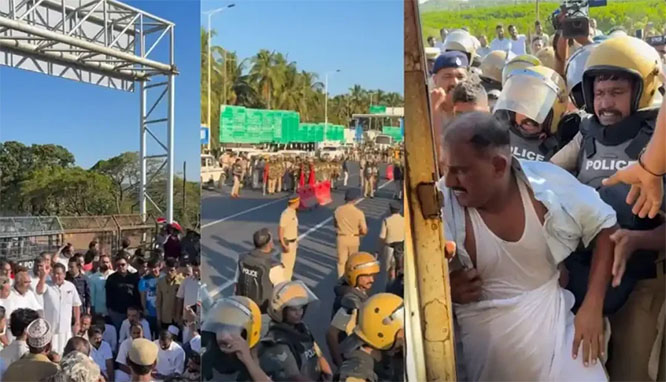
The Arikkady toll plaza witnessed widespread protests from January 12, the day toll collection commenced. On the second day, an action committee led by Manjeshwar MLA A K M Ashraf launched an indefinite protest at the site. Except for the BJP, leaders and workers of most major political parties participated in the agitation.

On the night of January 14, a large number of protesters gathered at the plaza and vandalised property, following which authorities temporarily suspended toll operations. The BJP later also expressed opposition to the toll plaza and criticised NHAI’s decision. 

Comments

Add new comment

  • Coastaldigest.com reserves the right to delete or block any comments.
  • Coastaldigset.com is not responsible for its readers’ comments.
  • Comments that are abusive, incendiary or irrelevant are strictly prohibited.
  • Please use a genuine email ID and provide your name to avoid reject.
News Network
February 5,2026

In an era where digital distractions are the primary rival to academic excellence, the Karnataka Education Department is taking the fight directly to the living room. As the SSLC (Class 10) annual examinations loom, officials have launched a localized "digital strike" to ensure students aren't losing their competitive edge to scrolling or soap operas.

The 7-to-9 Lockdown

The department has issued a formal directive urging—and in some cases, enforcing via home visits—a total blackout of mobile phones and television sets between 7:00 PM and 9:00 PM. This two-hour window is being designated as "sacred study time" across the state until the examinations conclude on April 2.

Key Pillars of the Initiative:

•    Doorstep Advocacy: Teachers are transitioning from classrooms to living rooms, meeting parents to explain the psychological benefits of a distraction-free environment.

•    Parental Accountability: The campaign shifts the burden of discipline from the student to the household, asking parents to lead by example and switch off their own devices.

•    The Timeline: The focus remains sharp on the upcoming exam block, scheduled from March 18 to April 2.

"The objective is simple: uninterrupted focus. We are reclaiming the evening hours for the students, ensuring their environment is as prepared as their minds," stated a senior department official.

Student vs. Reality

While the student community has largely welcomed the "forced focus"—with many admitting they lack the willpower to ignore notifications—the move has sparked a debate on enforceability. Without a "TV Police," the success of this initiative rests entirely on the shoulders of parents and the persuasive power of visiting educators.

Comments

Add new comment

  • Coastaldigest.com reserves the right to delete or block any comments.
  • Coastaldigset.com is not responsible for its readers’ comments.
  • Comments that are abusive, incendiary or irrelevant are strictly prohibited.
  • Please use a genuine email ID and provide your name to avoid reject.