



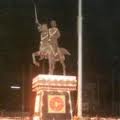
Ninth Abbakka Utsava from tomorrow

February 10, 2012

abbakka

Mangalore, February 10: The stage is set for the ninth edition of Veerarani Abbakka Utsava-2012 that gets underway at Uchila Bovi School ground at Sankolige, Someshwar near here, on Saturday.

While the seven editions were organized by Veerarani Abbakka Utsava Samiti with help and support from philanthropists and donors, the Utsava has received state support in the last two editions, including the current one with a funding of Rs 25 lakh. K Jayaram Shetty, former MLA and president of the reception committee, told reporters here that a grand folk procession from Kotekar Beeri to Utsava venue will mark the beginning of the two-day event.

Energy minister Shobha Karandlaje will inaugurate the festival. A seminar on 'Mathrroopi Samskruthi-Badalavaneya Nelegallu', chaired by Sulochana Narayan, will be held in the afternoon. Higher education minister V S Acharya will preside over 'Abbakka Utsava-Savi Samarambha' in evening.

N Yogish Bhat, deputy Speaker, will deliver the message of self-respect of Rani Abbakka. A 'chaturbasha kavighosti' featuring poets from Kannada, Tulu, Beary and Konkani languages will be held on February 12, which will be followed by seminar on 'DK district-facets of development' in the afternoon.Chief minister D V Sadananda Gowda will confer Rani Abbakka Awards on Lalitha Rai, writer, and Jayasheela, theatre artiste, at the valedictory. Mangalore MLA U T Khader, will preside, Rai said, adding the Samiti has urged the government.



Comments

Add new comment

  • Coastaldigest.com reserves the right to delete or block any comments.
  • Coastaldigset.com is not responsible for its readers’ comments.
  • Comments that are abusive, incendiary or irrelevant are strictly prohibited.
  • Please use a genuine email ID and provide your name to avoid reject.
News Network
January 23,2026

Mangaluru: The Karnataka Government Polytechnic (KPT), Mangaluru, has achieved autonomous status from the All India Council for Technical Education (AICTE), becoming the first government polytechnic in the country to receive such recognition in its 78-year history. The status was granted by AICTE, New Delhi, and subsequently approved by the Karnataka Board of Technical Education in October last year.

Officials said the autonomy was conferred a few months ago. Until recently, AICTE extended autonomous status only to engineering colleges, excluding diploma institutions. However, with a renewed national focus on skill development, several government polytechnics across India have now been granted autonomy.

KPT, the second-largest polytechnic in Karnataka, was established in 1946 with four branches and has since expanded to offer eight diploma programmes, including computer science and polymer technology. The institution is spread across a 19-acre campus.

Ravindra M Keni, the first dean of the institution, told The Times of India that AICTE had proposed autonomous status for polytechnic institutions that are over 25 years old. “Many colleges applied. In the first round, 100 institutions were shortlisted, which was further narrowed down to 15 in the second round. We have already completed one semester after becoming an autonomous institution,” he said. He added that nearly 500 students are admitted annually across eight three-year diploma courses.

Explaining the factors that helped KPT secure autonomy, Keni said the institution has consistently recorded 100 per cent admissions and placements for its graduates. He also noted its strong performance in sports, with the college emerging champions for 12 consecutive years, along with active student participation in NCC and NSS activities.

Autonomous status allows KPT to design industry-oriented curricula, conduct examinations, prepare question papers, and manage academic documentation independently. The institution can also directly collaborate with industries and receive priority funding from AICTE or the Ministry of Education. While academic autonomy has been granted, financial control will continue to rest with the state government.

“There will be separate committees for examinations, question paper setting, boards of studies, and boards of examiners. The institution will now have the freedom to conduct admissions without government notifications and issue its own marks cards,” Keni said, adding that new academic initiatives would be planned after a year of functioning under the autonomous framework.

Comments

Add new comment

  • Coastaldigest.com reserves the right to delete or block any comments.
  • Coastaldigset.com is not responsible for its readers’ comments.
  • Comments that are abusive, incendiary or irrelevant are strictly prohibited.
  • Please use a genuine email ID and provide your name to avoid reject.