



Pentagon gets authority to set troop levels in Afghanistan

Agencies
June 14, 2017

Washington, Jun 14: US President Donald Trump has given Defence Secretary Jim Mattis the authority to determine troop levels in Afghanistan, media reports said today, paving the way for sending more American forces to the war-torn country.
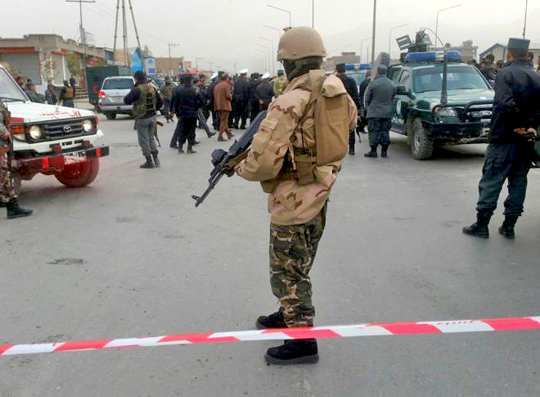
Pentagon

Such an authorisation was granted to Mattis by Trump yesterday.

Mattis, according to The New York Times, is believed to favour sending several thousands more troops to Afghanistan, but has not taken a final decision in this regard.

Neither the White House nor the Pentagon confirmed the news.

"I don't have anything I can comment on that right now. I would refer you to Secretary Mattis at this point," White House Deputy Press Secretary Sarah Sanders told reporters.

The US currently has some 8,400 troops in Afghanistan. Army General John Nicholson, the top US commander in Afghanistan, told Congress that he could use an infusion of US and allied troops to bolster support for the Afghan army.

Earlier this year, the Pentagon was considering a request for roughly 3,000 more troops, mainly for training and advising. That decision, however, has been stalled by the broader administration review of Afghan policy and a push for NATO to contribute more troops.

This sets the stage for US commanders to begin sending more forces to Afghanistan, after years of reductions made in the hope that Kabul could handle internal threats on its own.

Mattis, the former commander of all Middle East wars, said yesterday that the US is not winning the war in Afghanistan.

"We're not winning in Afghanistan right now," Mattis said, adding: "We'll correct this as soon as possible".

Mattis later described winning in Afghanistan as forming a central government that, with international help, "will be able to handle the violence."

The new admission from the retired Marine Corps four-star general comes as Congress grows increasingly impatient for a new strategy from the Trump administration for America's longest war as Taliban insurgents continue to regain ground and increase power, including launching coordinated attacks on American troops and journalists in recent weeks.

The Afghanistan war has been dragging on since October 2001 and the US-led coalition ended their combat mission against the Taliban in 2014 but they are increasingly involved in backing up Afghan forces on the battlefield.


Comments

Add new comment

  • Coastaldigest.com reserves the right to delete or block any comments.
  • Coastaldigset.com is not responsible for its readers’ comments.
  • Comments that are abusive, incendiary or irrelevant are strictly prohibited.
  • Please use a genuine email ID and provide your name to avoid reject.
News Network
December 7,2025

envoy.jpg

Since 1946, the United States has attempted 93 coups or “regime change” operations across the world — including two in Iran, US Special Envoy for Syria Tom Barrack has admitted.

Speaking to the UAE-based IMI Media Group, in remarks published by The National, Barrack said Washington tried twice to overthrow the Iranian government but failed both times. 

“For (Trump) then to be imputed with regime change — we had two regime changes in Iran already. Neither one worked. So I think wisely leave it to the region to solve,” said Barrack, who also serves as the US ambassador to Turkey.

His comments come six months after the US joined Israel in airstrikes against Iran during ongoing indirect nuclear negotiations between Tehran and Washington.

On June 13, Israel launched an attack on Iran that killed at least 1,064 people and hit civilian infrastructure. Days later, the United States targeted three nuclear facilities — Fordow, Natanz and Isfahan — in what Iran called a clear violation of international law. Iranian retaliation eventually forced a halt to the assault on June 24.

Barrack further claimed that US President Donald Trump and Foreign Secretary Marco Rubio are “not into regime change” and prefer a regional approach driven by Middle Eastern countries themselves. According to him, regional dialogue and non-interference by outside powers offer a more durable path forward.

He added that Washington is still open to an agreement with Tehran if Iranian authorities show “seriousness” and willingness to engage constructively.

However, Iran maintains the US has not shown readiness for meaningful talks. In an interview with Japan’s Kyodo News, Iranian Foreign Minister Abbas Araghchi said negotiations could advance only if Washington acknowledges Iran’s right to peaceful nuclear energy and lifts unilateral sanctions.

Comments

Add new comment

  • Coastaldigest.com reserves the right to delete or block any comments.
  • Coastaldigset.com is not responsible for its readers’ comments.
  • Comments that are abusive, incendiary or irrelevant are strictly prohibited.
  • Please use a genuine email ID and provide your name to avoid reject.