For PM Modi-Xi Meet After Tension, India And China Set Aside Formalities

Agencies
April 24, 2018

Apr 24: Prime Minister Narendra Modi will travel to meet Chinese President Xi Jinping this week, as the world's two most-populous countries seek to reduce tensions after a tense border dispute last year.

The "informal summit" between Xi Jinping and PM Modiwill be held Friday and Saturday in Wuhan, the capital of the central province of Hubei, Chinese Foreign Minister Wang Yi said Sunday at a news conference with India External Affairs Minister Sushma Swaraj.

The meeting is part of an intensifying dialogue between the two leaders whose countries comprise more than one-third of the world's population and 18 percent of global gross domestic product. It comes as both powers seek to reduce risk in their regional environments as China faces down U.S. President Donald Trump's threatened trade actions and PM Modi seeks to keep India's economy on track ahead of the 2019 election.

"It is very rare for two major countries like China and India to meet together so frequently," said Qian Feng, a researcher on international relations with Tsinghua University in Beijing. "For both sides, a peaceful border and a mutually beneficial trading partnership are obviously more in line with their interests. For this reason, the two sides are tacitly recovering bilateral relations rapidly."

Xi and PM Modi met last September and are scheduled to meet again in June for the Shanghai Cooperation Organization meeting in China's eastern port city of Qingdao. Both leaders have strong domestic reasons to put tensions aside.

"For China, the ongoing trade war with the U.S. prompted Beijing to adopt a more sensible attitude towards India," Qian Feng said, adding that PM Modi's economic and social reforms have slowed. "The turbulent global economic situation has increased economic risk in India."

The countries' foreign ministers emphasised the broader strategic context behind the meeting. Xi and PM Modi would have "communications of a strategic nature concerning big changes happening in the world," Mr Wang told reporters in Beijing. "They will also exchange views on overall, long-term and strategic matters concerning the future of China-India relations."

The two sides are setting aside formalities for the meeting in the hope of a breakthrough before border tensions resurface, according to Shailesh Kumar, political risk firm Eurasia Group's Asia director.

"The informal nature and timing of the summit indicates that first, both sides want to be able to discuss all topics in a free and cordial manner without the standard formalities," Kumar said. "Second, they want to meet before the summer, when many worry tensions between both armies in the mountain areas could rise again as the weather is less hostile."

The move toward rapprochement was facilitated by a meeting between Xi and PM Modi last September, when they held their first talks since defusing a border stand-off in remote region between India, Bhutan and China's Tibet region. Ms Swaraj, the Indian foreign minister, described peace and tranquility on the countries' border areas as an "essential prerequisite for the smooth development of bilateral relations."

The summit was good news in the short-term for investors in Asia, Mr Kumar said. "Priorities will be to build deeper ties to mitigate any security related disagreements while also establishing a framework to handle any issues as they arise," he said.

Longer term, though, differences between the two powers are likely to resurface. "Distrust is high and tensions will remain, particularly given China's financial involvement in Pakistan, which India sees as a strategic rather than economic engagement that can hurt India," Mr Kumar said.

Tensions have lingered since China defeated India in a brief border war in 1962. The residence of the Tibetan religious leader, the Dalai Lama, in the mountain town of Dharamsala in Northern India has also long angered Beijing.

They've been exacerbated by Beijing's rapid expansion of its political and economic ties in India's backyard through Xi's ambitious Belt and Road infrastructure initiative. Projects include railway building in Pakistan and port projects in Sri Lanka.

Against that backdrop, former Indian foreign secretary S. Jaishankar told India's Asian News International that the summit was "certainly a very bold step."

"The fact that they have agreed on an informal summit shows that the two leaders realise the importance of this relationship," he said. "They have taken on the responsibility themselves on putting it on a better course."

Comments

Add new comment

  • Coastaldigest.com reserves the right to delete or block any comments.
  • Coastaldigset.com is not responsible for its readers’ comments.
  • Comments that are abusive, incendiary or irrelevant are strictly prohibited.
  • Please use a genuine email ID and provide your name to avoid reject.
News Network
February 4,2026

gaming.jpg

Ghaziabad: In a tragic incident, three sisters aged 12, 14 and 16 died after jumping from the ninth floor of their apartment in Uttar Pradesh’s Ghaziabad in the early hours of Wednesday. The girls allegedly took the extreme step after becoming deeply obsessed with an online Korean task-based game.

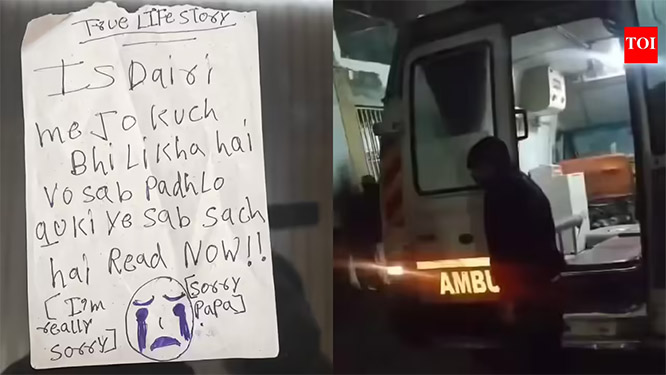
The incident occurred around 2.15 am at a high-rise apartment complex in Bharat City. Before jumping, the sisters — Pakhi (12), Prachi (14) and Vishika (16) — left behind a handwritten note that read, “Sorry, Papa.”

According to police, the girls went to the balcony, bolted the door from inside and jumped one after another. Their screams and the sound alerted their parents, neighbours and security guards. By the time the parents broke open the balcony door, all three had died.

“When we reached the spot, we confirmed that three minor girls, daughters of Chetan Kumar, had died after jumping from the building,” said Assistant Commissioner of Police Atul Kumar Singh.

Visuals from the scene on Wednesday morning showed the bodies lying on the ground, their mother wailing in grief, and stunned neighbours gathering at the complex.

Police said the sisters were heavily influenced by Korean culture and were addicted to an online “Korean love game”, though no specific game has been identified so far. Investigators are examining an eight-page suicide note written in a pocket diary, detailing the girls’ mobile and gaming activities.

“Read everything written in this diary because all of it is true. I’m really sorry. Sorry, Papa,” the note said, accompanied by a hand-drawn crying emoji.

Their father, Chetan Kumar, told police that the girls had even adopted Korean names and had gradually withdrawn from school and daily activities. “They used to say, ‘Korea is our life, Korea is our biggest love. We cannot give it up,’” he said, breaking down.

Police said the parents had recently restricted the girls’ mobile phone usage, which may have triggered distress. “The investigation has not revealed the name of any particular game, but it is evident that the girls were deeply influenced by Korean culture, as mentioned in the suicide note,” said senior police officer Nimish Patel.

The sisters reportedly did everything together, including eating and bathing. Their gaming addiction is believed to have begun during the COVID-19 pandemic, after which they became irregular at school and eventually stopped attending altogether.

Police also revealed that Chetan Kumar is married to two sisters and lives with both wives and their children, all daughters. Two of the deceased girls were daughters of one wife, while the third was their half-sister.

Further investigation is underway.

Comments

Add new comment

  • Coastaldigest.com reserves the right to delete or block any comments.
  • Coastaldigset.com is not responsible for its readers’ comments.
  • Comments that are abusive, incendiary or irrelevant are strictly prohibited.
  • Please use a genuine email ID and provide your name to avoid reject.
coastaldigest.com news network
February 5,2026

protestkerala.jpg

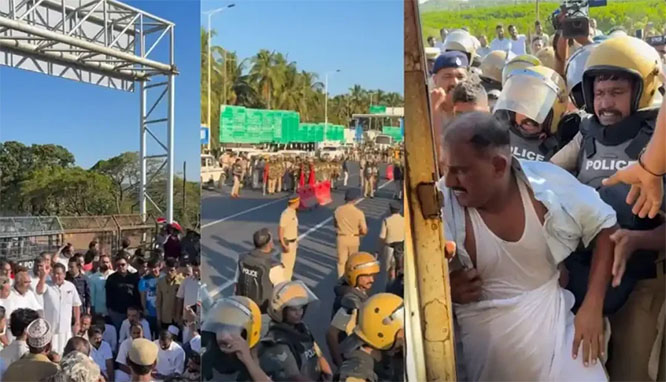
Mangaluru: The KSRTC Mangaluru division has rolled back the fare hike on buses operating on the Mangaluru–Kasaragod route following the suspension of toll collection at the Arikkady toll plaza near Kumbala in Kasaragod district.

The fare revision had been implemented after the National Highways Authority of India (NHAI) began toll collection at the Arikkady plaza on NH-66. As a result, fares for ordinary and Rajahamsa services were increased by ₹7 and ₹10, respectively, raising the bus fare from Mangaluru to Kasaragod from ₹81 to ₹88.

Senior Divisional Controller of KSRTC’s Mangaluru division, Rajesh Shetty, said the fares were reduced after toll collection at the Arikkady plaza was stopped. “The tollgate began operations on January 13, and the toll amount was deducted from the FASTag accounts of KSRTC buses operating on the route. Following an order from the central government to suspend toll collection, KSRTC has also withdrawn the additional fare with immediate effect,” he said.

At present, vehicles travelling on the Mangaluru–Kasaragod route pay toll only at the Talapady toll plaza. The toll for light motor vehicles (LMVs) at Talapady is ₹80 for a same-day return, while heavy vehicles, including buses, are charged ₹250. At Arikkady, the toll rates were ₹130 for LMVs (same-day return) and ₹450 for buses.

Protests against Arikkady toll plaza

The Arikkady toll plaza witnessed widespread protests from January 12, the day toll collection commenced. On the second day, an action committee led by Manjeshwar MLA A K M Ashraf launched an indefinite protest at the site. Except for the BJP, leaders and workers of most major political parties participated in the agitation.

On the night of January 14, a large number of protesters gathered at the plaza and vandalised property, following which authorities temporarily suspended toll operations. The BJP later also expressed opposition to the toll plaza and criticised NHAI’s decision. 

Comments

Add new comment

  • Coastaldigest.com reserves the right to delete or block any comments.
  • Coastaldigset.com is not responsible for its readers’ comments.
  • Comments that are abusive, incendiary or irrelevant are strictly prohibited.
  • Please use a genuine email ID and provide your name to avoid reject.
News Network
February 1,2026

Bengaluru, Feb 1: For travelers landing at Kempegowda International Airport (KIA), the sleek, wood-paneled curves of Terminal 2 promise a world-class welcome. But the famed “Garden City” charm quickly withers at the curb. As India’s aviation sector swells to record numbers—handling over 43 million passengers in Bengaluru alone this past year—the “last mile” has turned into a marathon of frustration.

The Bengaluru Logjam: Rules vs Reality

While the city awaits the 2027 completion of the Namma Metro Blue Line, the interim has been chaotic. Recent “decongestion” rules at Terminal 1 have pushed app-based cab pickups to distant parking zones, forcing weary passengers into a 20-minute walk with luggage.

“I landed after ten months away and felt like a stranger in my own city,” says Ruchitha Jain, a Koramangala resident. “My driver couldn’t find me, staff couldn’t guide me, and the so-called ‘Premium’ lane is just a fancy tax on convenience.”

•    The Cost of Distance: A 40-km cab ride can now easily cross ₹1,500, driven by demand pricing and airport surcharges.

•    The Bus Gap: While Vayu Vajra remains a lifeline, its ₹300–₹400 fare is often cited as the most expensive airport bus service in the country.

A National Pattern of Disconnect

The struggle is not unique to Karnataka. From Chennai’s coast to Hyderabad’s plateau, India’s airports tell a familiar story: brilliant runways, broken exits.

City:    Primary Issue   |    Recent Development

Bengaluru:    Cab pickup restrictions & distance  |    App-based taxis shifted to far parking zones; long walks and fare spikes reported

Chennai:    Multi-Level Parking (MLCP) hike  |    Passengers report 40-minute walks to reach cab pickup points

Hyderabad:    “Taxi mafia” & touting  |    Over 440 touting cases reported; security presence intensified

Mumbai:    Fare scams  |     Tourists charged ₹18,000 for just 400 metres, triggering police action

In Hyderabad, travelers continue to battle entrenched local groups that intimidate Uber and Ola drivers, pushing passengers toward overpriced private taxis. Chennai flyers, meanwhile, complain that reaching the designated pickup zones now takes longer than short-haul flights from cities like Coimbatore.

The ‘Budget Day’ Hope

As Finance Minister Nirmala Sitharaman presents the Union Budget 2026 today, the aviation sector is watching closely. With the government’s renewed emphasis on multimodal integration, there is cautious hope for funding toward seamless airport-metro-bus hubs.

The vision is clear: a future where planes, trains, and metros speak the same language. Until then, passengers at KIA—and airports across India—will continue to discover that the hardest part of flying isn’t the thousands of kilometres in the air, but the last few on the ground.

Comments

Add new comment

  • Coastaldigest.com reserves the right to delete or block any comments.
  • Coastaldigset.com is not responsible for its readers’ comments.
  • Comments that are abusive, incendiary or irrelevant are strictly prohibited.
  • Please use a genuine email ID and provide your name to avoid reject.