



Post Karnataka polls, regional parties ask Congress to be flexible

Agencies
May 20, 2018

New Delhi, May 20: The success of the Congress-JD(S) alliance in outpacing the BJP in Karnataka elections bodes well for opposition unity, with a chorus of regional voices hailing the Grand Old Partys decision to play second fiddle to a smaller outfit in the southern state.

Congratulatory messages poured in from the regions soon after BJP?s BS Yeddyurappa, unable to garner the numbers required for a simple majority in the state Assembly, bowed out as chief minister, paving the way for a JD(S)-Congress government.

The Congress partys decision to allow the Janata Dal (Secular) to take the lead in the state by installing its chief minister was applauded by many leaders, with NCP chief Sharad Pawar describing the role of the Congress as a ?sensible? one.

But while Pawar congratulated Congress president Rahul Gandhi for ousting the BJP, West Bengal Chief Minister Mamata Banerjee, among the first to call the developments a victory of the regional front, did not mention Gandhi in her message.

?Democracy wins. Congratulations Karnataka. Congratulations Deve Gowda ji, Kumaraswamy ji, Congress and others. Victory of the ?regional front?,? she said.

The sub-text was clear: some regional leaders would not allow the Congress take the lead in forming a broad platform of the opposition.

While an opposition leader felt the Congress would need to play a more ?gracious role? in a grand alliance before the 2019 Lok Sabha elections to keep the BJP and RSS out, senior CPI leader D Raja said the question of who would lead the front should be kept open.

Gandhi had ruffled some opposition feathers when, on the eve of the Karnataka elections, he had positioned himself as a prime ministerial candidate for the next LS polls if his party did well.

Raja, however, stressed the issue of who would be prime minister in 2019 should be discussed at a later stage.

"The instant focus should be defeating the BJP," he said.

What is clear is that the Congress understands the need to keep regional parties happy -- which explains why it agreed to be the junior partner in the Karnataka government led by HD Kumaraswamy of the JD(S).

In his statement after the fall of the BJP, Gandhi lauded JD(S) chief HD Deve Gowda for the coalitions victory.

"The opposition will unite and coordinate to defeat the BJP," Gandhi said.

But this may require more give and take than the Congress is used to.

"Congress President Rahul Gandhi is the most appropriate person to lead the country,? party communications head Randeep Surjewala told PTI, though he did not elaborate.

That said, the Karnataka developments sounded a clarion call for opposition unity.

From the DMKs MK Stalin and Loktantrik Janata Dals Sharad Yadav to TDPs N Chandrababu Naidu, RJDs Tejwaswi Yadav and TRSs K Chandrashekhar Rao, every regional leader urged non-BJP forces to align to defeat the BJP.

?May this herald the coming together of secular parties,? said Stalin.

Naidu, who worked to defeat the BJP in the Telugu-speaking belt of Karnataka, said, "It is a proud day for all of us.?

The May 12 election over and done with, all eyes are now on how the Congress plays its role as the central pole of opposition unity.

In Karnataka, the party acted strategically and swiftly to win over the JD(S) with the offer of the chief ministerial post, and sacrificed its own space for larger political gains.

But the move is also being seen as a sign of the partys decline in the state.

That its seats went down from 122 in 2013 to 78 could be read as Gandhis failure to steer the party to a majority, despite hectic campaigning and addressing 85 small and big rallies over three months.

This was the first state election after Gandhi became Congress president in mid-December, and the party wanted to pull out all the stops to form a government.

This explains the partys offer of unconditional support to the JD(S), which, with its 37 seats, clinched the deal for it.

Opposition leaders said Congress would have to show the same openness and flexibility going forward and ensure it gave space to other parties, even if it wanted to lead the front.

?Congress should give space to regional parties and there should be more give and take to help bring everyone together on one common platform," senior NCP leader Tariq Anwar, a former Congressman, said.

It should target a "consensual government" with regional parties based on a policy of give and take, he said.

"Then only will a good national alliance be formed to counter the BJP in 2019," Anwar told PTI.

The NCP leader, however, batted for the Congress retaining the top post saying past experiences of giving the post to regional players had not yielded results.

"A bigger party should be the centre of any coalition government and should take the number one position. This would be better," he said adding that the target should be to defeat the BJP.

But Raja of the CPI, while terming Karnataka a "positive development", stressed that the Congress had to be "realistic and flexible".

"This situation demands a broader coalition of all democratic forces. Congress party must be realistic and flexible in its approach to regional parties and democratic forces. It should be more accommodating," Raja said.

The equations are changing. How far the Congress goes in accommodating its allies may determine how far the BJP will go in 2019.

Comments

Add new comment

  • Coastaldigest.com reserves the right to delete or block any comments.
  • Coastaldigset.com is not responsible for its readers’ comments.
  • Comments that are abusive, incendiary or irrelevant are strictly prohibited.
  • Please use a genuine email ID and provide your name to avoid reject.
News Network
February 5,2026

In an era where digital distractions are the primary rival to academic excellence, the Karnataka Education Department is taking the fight directly to the living room. As the SSLC (Class 10) annual examinations loom, officials have launched a localized "digital strike" to ensure students aren't losing their competitive edge to scrolling or soap operas.

The 7-to-9 Lockdown

The department has issued a formal directive urging—and in some cases, enforcing via home visits—a total blackout of mobile phones and television sets between 7:00 PM and 9:00 PM. This two-hour window is being designated as "sacred study time" across the state until the examinations conclude on April 2.

Key Pillars of the Initiative:

•    Doorstep Advocacy: Teachers are transitioning from classrooms to living rooms, meeting parents to explain the psychological benefits of a distraction-free environment.

•    Parental Accountability: The campaign shifts the burden of discipline from the student to the household, asking parents to lead by example and switch off their own devices.

•    The Timeline: The focus remains sharp on the upcoming exam block, scheduled from March 18 to April 2.

"The objective is simple: uninterrupted focus. We are reclaiming the evening hours for the students, ensuring their environment is as prepared as their minds," stated a senior department official.

Student vs. Reality

While the student community has largely welcomed the "forced focus"—with many admitting they lack the willpower to ignore notifications—the move has sparked a debate on enforceability. Without a "TV Police," the success of this initiative rests entirely on the shoulders of parents and the persuasive power of visiting educators.

Comments

Add new comment

  • Coastaldigest.com reserves the right to delete or block any comments.
  • Coastaldigset.com is not responsible for its readers’ comments.
  • Comments that are abusive, incendiary or irrelevant are strictly prohibited.
  • Please use a genuine email ID and provide your name to avoid reject.
coastaldigest.com news network
February 5,2026

protestkerala.jpg

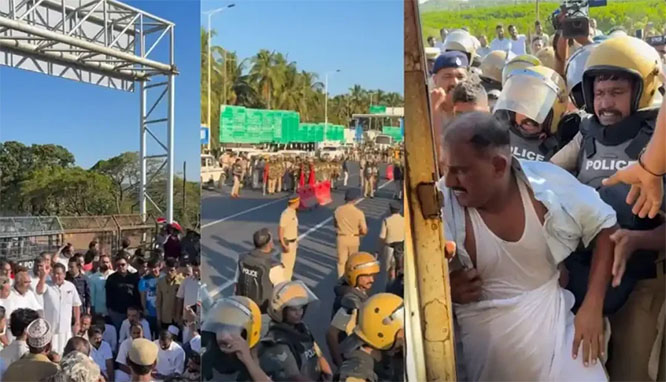
Mangaluru: The KSRTC Mangaluru division has rolled back the fare hike on buses operating on the Mangaluru–Kasaragod route following the suspension of toll collection at the Arikkady toll plaza near Kumbala in Kasaragod district.

The fare revision had been implemented after the National Highways Authority of India (NHAI) began toll collection at the Arikkady plaza on NH-66. As a result, fares for ordinary and Rajahamsa services were increased by ₹7 and ₹10, respectively, raising the bus fare from Mangaluru to Kasaragod from ₹81 to ₹88.

Senior Divisional Controller of KSRTC’s Mangaluru division, Rajesh Shetty, said the fares were reduced after toll collection at the Arikkady plaza was stopped. “The tollgate began operations on January 13, and the toll amount was deducted from the FASTag accounts of KSRTC buses operating on the route. Following an order from the central government to suspend toll collection, KSRTC has also withdrawn the additional fare with immediate effect,” he said.

At present, vehicles travelling on the Mangaluru–Kasaragod route pay toll only at the Talapady toll plaza. The toll for light motor vehicles (LMVs) at Talapady is ₹80 for a same-day return, while heavy vehicles, including buses, are charged ₹250. At Arikkady, the toll rates were ₹130 for LMVs (same-day return) and ₹450 for buses.

Protests against Arikkady toll plaza

The Arikkady toll plaza witnessed widespread protests from January 12, the day toll collection commenced. On the second day, an action committee led by Manjeshwar MLA A K M Ashraf launched an indefinite protest at the site. Except for the BJP, leaders and workers of most major political parties participated in the agitation.

On the night of January 14, a large number of protesters gathered at the plaza and vandalised property, following which authorities temporarily suspended toll operations. The BJP later also expressed opposition to the toll plaza and criticised NHAI’s decision. 

Comments

Add new comment

  • Coastaldigest.com reserves the right to delete or block any comments.
  • Coastaldigset.com is not responsible for its readers’ comments.
  • Comments that are abusive, incendiary or irrelevant are strictly prohibited.
  • Please use a genuine email ID and provide your name to avoid reject.
News Network
January 23,2026

Karnataka Governor Thaawarchand Gehlot read only three lines from the 122-paragraph address prepared by the Congress-led state government while addressing the joint session of the Legislature on Thursday, effectively bypassing large sections critical of the BJP-led Union government.

The omitted portions of the customary Governor’s address outlined what the state government described as a “suppressive situation in economic and policy matters” under India’s federal framework. The speech also sharply criticised the Centre’s move to replace the Mahatma Gandhi National Rural Employment Guarantee Act (MGNREGA) with the Viksit Bharat–Guarantee for Rozgar and Ajeevika Mission (Gramin) Act, commonly referred to as the VB-GRAM (G) Act.

Governor Gehlot had earlier conveyed his objection to several paragraphs that were explicitly critical of the Union government. On Thursday, he confined himself to the opening lines — “I extend a warm welcome to all of you to the joint session of the State legislature. I am extremely pleased to address this august House” — before jumping directly to the concluding sentence of the final paragraph.

He ended the address by reading the last line of paragraph 122: “Overall, my government is firmly committed to doubling the pace of the State’s economic, social and physical development. Jai Hind — Jai Karnataka.”

According to the prepared speech, the Karnataka government demanded the scrapping of the VB-GRAM (G) Act, describing it as “contractor-centric” and detrimental to rural livelihoods, and called for the full restoration of MGNREGA. The state government argued that the new law undermines decentralisation, weakens labour protections, and centralises decision-making in violation of constitutional norms.

Key points from the unread sections of the speech:

•    Karnataka facing a “suppressive” economic and policy environment within the federal system

•    Repeal of MGNREGA described as a blow to rural livelihoods

•    VB-GRAM (G) Act accused of protecting corporate and contractor interests

•    New law alleged to weaken decentralised governance

•    Decision-making said to be imposed by the Centre without consulting states

•    Rights of Adivasis, women, backward classes and agrarian communities curtailed

•    Labourers allegedly placed under contractor control

•    States facing mounting fiscal stress due to central policies

•    VB-GRAM (G) Act accused of enabling large-scale corruption

Comments

Add new comment

  • Coastaldigest.com reserves the right to delete or block any comments.
  • Coastaldigset.com is not responsible for its readers’ comments.
  • Comments that are abusive, incendiary or irrelevant are strictly prohibited.
  • Please use a genuine email ID and provide your name to avoid reject.