Secret meetings with Israel: UK’s Indian-origin minister Priti Patel quits

Agencies
November 9, 2017

London, Nov 9: Britain's senior-most Indian-origin minister Priti Patel resigned from her Cabinet post over her unauthorised secret meetings with Israeli politicians, after a meeting at Downing Street with Prime Minister Theresa May.

Patel's position as international development minister had become increasingly untenable after it emerged that she had two further meetings with Israeli officials that were not disclosed through the proper procedure.

In her resignation, Patel again apologised and said her actions "fell below the standards of transparency and openness that I have promoted and advocated".

It follows a week of controversies around a dozen undisclosed meetings she had with other Israelis, including Prime Minister Benjamin Netanyahu, for which she had been forced to apologise.

Her departure from the Cabinet marks an abrupt halt to the meteoric rise of the Gujarati-origin MP, often touted as a potential future leader of the Conservative party and a prime ministerial candidate.

The 45-year-old was elected as a Conservative MP for Witham in Essex in 2010 and gained prominence in the then David Cameron-led Tory government as his 'Indian Diaspora Champion'.

She went on to be appointed to junior ministerial posts, treasury minister in 2014 and then employment minister after the 2015 general election, before May promoted her to secretary of state in the department for international development (DfID) last year.

A longstanding Eurosceptic, Patel is among the most vocal supporters of Brexit and had steered the 'Vote Leave' campaign in the lead up to the June 2016 referendum in favour of Britain's exit from the European Union (EU).

She must have hoped that the storm around her undisclosed meetings in Israel would die down after a formal apology before she flew out to Africa for an official tour of Uganda and Ethiopia yesterday.

But she was unable to attend any of the scheduled meetings as she was ordered to abandon the visit and fly back to London today "at the request of the prime minister".

Earlier this week, Downing Street had said that May had accepted Patel's apology over a series of meetings while she was on holiday in Israel in August without reporting them to the Foreign Office.

But new revelations of further meetings with Israeli officials following that visit had made Patel's position within the Cabinet very precarious.

It is understood that she met Israel's public security minister Gilad Erdan in the UK Parliament complex in early September and an Israeli foreign ministry official Yuval Rotem in New York later that month.

The British premier was reportedly told about the unreported New York meeting during Patel's apology conversation at Downing Street on Monday but only learned about her unreported meeting with Erdan after the talks.

Ministers are required to tell the UK Foreign Office when they are conducting official business overseas, but it emerged that British diplomats in Israel were not informed about any of Patel's meetings - which included a meeting with Netanyahu and other political figures as well as charity organisations.

Opposition parties had been calling for Patel's resignation as minister in charge of DfID and the country's aid budget if it emerged that she had breached the ministerial code of conduct and failed to follow established protocol.

In a letter to May, Labour's shadow Cabinet Office minister Jon Trickett had called on the premier to either call in her independent adviser on ministerial standards to investigate, or "state publicly and explain your full reasons for why Priti Patel retains your confidence".

In her apology statement on Monday, Patel had attributed the unreported meetings to "enthusiasm".

"In hindsight, I can see how my enthusiasm to engage in this way could be misread, and how meetings were set up and reported in a way which did not accord with the usual procedures. I am sorry for this and I apologise for it," she said.

Her conduct had already led May to direct her Cabinet Office to look into tightening the ministerial code of conduct to avoid any such incidents in future.

Downing Street was also forced to deny that Patel's meetings in Israel had led to any change of political stance on the region after it emerged that in the wake of her visit in August, Patel had discussed potentially providing some of Britain's aid money to Israel's armed forces which run field hospitals in the disputed Golan Heights area.

Britain does not officially recognise Israeli occupation of the area, seized from Syria in the 1967 Six-Day War, and DfID was reportedly advised against any such move.

According to an Israeli media report, during her August visit to Israel, Patel also visited an Israeli military field hospital in the Golan Heights.

Manuel Hassassian, the Palestinian ambassador to the UK, said the offer to send aid money to the Israeli army made a mockery of the British government's claim to be "pushing for a two-state solution".

"It was shocking for me a Cabinet minister breaking the ministerial protocol and meeting 12 officials, high-ranking, including Netanyahu," he added.

Patel has been a longstanding supporter of Israel and also a former vice-chairman of the Conservative Friends of Israel group.

Meanwhile, it was also claimed that Patel deliberately avoided facing questions over the issue from MPs in the House of Commons today, by bringing forward her flight to Kenya.

It was left to her junior, DfID minister of state for the Middle East Alistair Burt, to defend his boss' actions in Parliament.

"The meetings were not particularly secret...If I had gone to Israel, I would have wanted a schedule like this," he told MPs.

It was widely believed that the delay in dismissing Patel was because the prime minister was more at ease keeping pro- Brexit MPs close at hand to prevent them doing too much damage as opponents of government decisions on the Tory backbenches.

But with her departure now, May has lost a second senior minister within a week, after Sir Michael Fallon stood down as defence minister amid allegations of inappropriate behaviour towards female journalists.

Another of her close Cabinet allies, first secretary of state Damian Green, is also under investigation over misconduct allegations and Foreign Secretary Boris Johnson has been under fire over his handling of a case involving a British Iranian jailed in Tehran.

The prime minister has been desperate not to shake up her already tenuous hold on Downing Street ever since her decision to call a snap general election in June backfired and lost the Conservative party its majority in Parliament.

But she has been increasingly seen as a weak leader trying to steady a very shaky regime.

Comments

Add new comment

  • Coastaldigest.com reserves the right to delete or block any comments.
  • Coastaldigset.com is not responsible for its readers’ comments.
  • Comments that are abusive, incendiary or irrelevant are strictly prohibited.
  • Please use a genuine email ID and provide your name to avoid reject.
News Network
January 23,2026

oscar.jpg

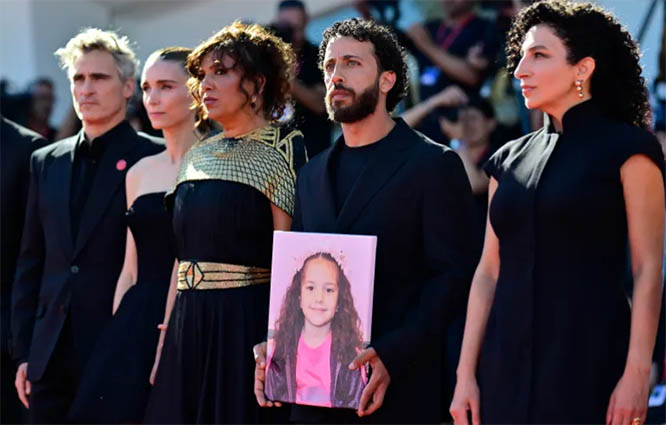
The Voice of Hind Rajab, inspired by the tragic final moments of a young Palestinian girl killed by Israeli fire in Gaza, has been nominated for an Academy Award in the Best International Feature Film category.

Directed by Tunisian filmmaker Kaouther Ben Hania, the film recounts the true story of five-year-old Hind Rajab, who lost her life in January 2024 while fleeing Israeli bombardment with her family.

The film features the real audio of Hind’s desperate call to the Palestinian Red Crescent Society, where she pleaded for help moments before the vehicle she was in was struck by 355 bullets.

The haunting narrative begins with a brief call made from the besieged Tel al-Hawa neighborhood of Gaza, where gunfire and armored vehicles drowned out every sound.

After witnessing the brutal killing of her family, she made a trembling call, her voice reduced to a whisper as she spoke of the massacre and her unbearable loneliness as the sole survivor.

Premiering at the Venice International Film Festival in September 2025, The Voice of Hind Rajab garnered widespread acclaim, receiving a record-setting 23-minute standing ovation and the Silver Lion Grand Jury Prize, the festival’s second-highest honor.

In her acceptance speech, Ben Hania dedicated the film to humanitarian workers and first responders in Gaza, emphasizing that Hind's voice symbolizes countless civilians affected by war.

She aims to give voice to victims often reduced to mere statistics, highlighting the broader suffering of civilians in war zones.

The film’s Oscar nomination underscores its powerful storytelling and ethical approach to depicting real-life tragedy, making it a crucial piece of contemporary cinema.

It serves not only as a narration of individual tragedy but also as an artistic and documentary response to the silence and censorship that often overshadow West Asian struggles and wars.

Using an innovative method she calls docufiction, Ben Hania bridges unvarnished reality and narrative structure, creating a work that is both artistically valuable and socially impactful.

Born in 1977 in Sidi Bouzid—later the epicenter of the Arab revolution—her background profoundly influenced her worldview and artistic approach.

She is a graduate of the Higher School of Audiovisual Arts of Tunis, Pantheon-Sorbonne University, and La Fémis in Paris, where her studies equipped her with the technical and theoretical tools needed to address complex subjects. 

Comments

Add new comment

  • Coastaldigest.com reserves the right to delete or block any comments.
  • Coastaldigset.com is not responsible for its readers’ comments.
  • Comments that are abusive, incendiary or irrelevant are strictly prohibited.
  • Please use a genuine email ID and provide your name to avoid reject.
News Network
January 23,2026

Karnataka Governor Thaawarchand Gehlot read only three lines from the 122-paragraph address prepared by the Congress-led state government while addressing the joint session of the Legislature on Thursday, effectively bypassing large sections critical of the BJP-led Union government.

The omitted portions of the customary Governor’s address outlined what the state government described as a “suppressive situation in economic and policy matters” under India’s federal framework. The speech also sharply criticised the Centre’s move to replace the Mahatma Gandhi National Rural Employment Guarantee Act (MGNREGA) with the Viksit Bharat–Guarantee for Rozgar and Ajeevika Mission (Gramin) Act, commonly referred to as the VB-GRAM (G) Act.

Governor Gehlot had earlier conveyed his objection to several paragraphs that were explicitly critical of the Union government. On Thursday, he confined himself to the opening lines — “I extend a warm welcome to all of you to the joint session of the State legislature. I am extremely pleased to address this august House” — before jumping directly to the concluding sentence of the final paragraph.

He ended the address by reading the last line of paragraph 122: “Overall, my government is firmly committed to doubling the pace of the State’s economic, social and physical development. Jai Hind — Jai Karnataka.”

According to the prepared speech, the Karnataka government demanded the scrapping of the VB-GRAM (G) Act, describing it as “contractor-centric” and detrimental to rural livelihoods, and called for the full restoration of MGNREGA. The state government argued that the new law undermines decentralisation, weakens labour protections, and centralises decision-making in violation of constitutional norms.

Key points from the unread sections of the speech:

•    Karnataka facing a “suppressive” economic and policy environment within the federal system

•    Repeal of MGNREGA described as a blow to rural livelihoods

•    VB-GRAM (G) Act accused of protecting corporate and contractor interests

•    New law alleged to weaken decentralised governance

•    Decision-making said to be imposed by the Centre without consulting states

•    Rights of Adivasis, women, backward classes and agrarian communities curtailed

•    Labourers allegedly placed under contractor control

•    States facing mounting fiscal stress due to central policies

•    VB-GRAM (G) Act accused of enabling large-scale corruption

Comments

Add new comment

  • Coastaldigest.com reserves the right to delete or block any comments.
  • Coastaldigset.com is not responsible for its readers’ comments.
  • Comments that are abusive, incendiary or irrelevant are strictly prohibited.
  • Please use a genuine email ID and provide your name to avoid reject.
coastaldigest.com news network
February 5,2026

protestkerala.jpg

Mangaluru: The KSRTC Mangaluru division has rolled back the fare hike on buses operating on the Mangaluru–Kasaragod route following the suspension of toll collection at the Arikkady toll plaza near Kumbala in Kasaragod district.

The fare revision had been implemented after the National Highways Authority of India (NHAI) began toll collection at the Arikkady plaza on NH-66. As a result, fares for ordinary and Rajahamsa services were increased by ₹7 and ₹10, respectively, raising the bus fare from Mangaluru to Kasaragod from ₹81 to ₹88.

Senior Divisional Controller of KSRTC’s Mangaluru division, Rajesh Shetty, said the fares were reduced after toll collection at the Arikkady plaza was stopped. “The tollgate began operations on January 13, and the toll amount was deducted from the FASTag accounts of KSRTC buses operating on the route. Following an order from the central government to suspend toll collection, KSRTC has also withdrawn the additional fare with immediate effect,” he said.

At present, vehicles travelling on the Mangaluru–Kasaragod route pay toll only at the Talapady toll plaza. The toll for light motor vehicles (LMVs) at Talapady is ₹80 for a same-day return, while heavy vehicles, including buses, are charged ₹250. At Arikkady, the toll rates were ₹130 for LMVs (same-day return) and ₹450 for buses.

Protests against Arikkady toll plaza

The Arikkady toll plaza witnessed widespread protests from January 12, the day toll collection commenced. On the second day, an action committee led by Manjeshwar MLA A K M Ashraf launched an indefinite protest at the site. Except for the BJP, leaders and workers of most major political parties participated in the agitation.

On the night of January 14, a large number of protesters gathered at the plaza and vandalised property, following which authorities temporarily suspended toll operations. The BJP later also expressed opposition to the toll plaza and criticised NHAI’s decision. 

Comments

Add new comment

  • Coastaldigest.com reserves the right to delete or block any comments.
  • Coastaldigset.com is not responsible for its readers’ comments.
  • Comments that are abusive, incendiary or irrelevant are strictly prohibited.
  • Please use a genuine email ID and provide your name to avoid reject.