Shahid Khaqan Abbasi elected Pakistan PM by National Assembly

Agencies
August 1, 2017

Islamabad, Aug 1: Shahid Khaqan Abbasi, a die-hard supporter of Nawaz Sharif, was today elected Prime Minister by Pakistan's National Assembly and put up a strong defence of the ousted leader saying that he may have been disqualified by the Supreme Court but remains the "people's premier".
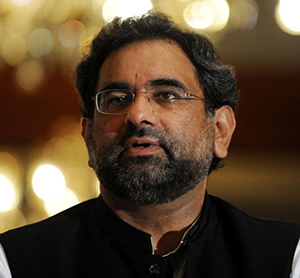
Abbasi, 58, was elected after getting 221 votes in the House of 342, defeating his three rivals emphatically.

Naveed Qamar of Pakistan Peoples Party (PPP) got 47 votes, Sheikh Rashid Ahmed, an Awami Muslim League leader who was Pakistan Tehreek-e-Insaf's candidate, got 33 votes, while Jamaat-e-Islami's Sahibzada Tariqullah managed just four votes.

Sharif's Pakistan Muslim League-Nawaz (PML-N) nominated Abbasi as interim Prime Minister until Sharif's brother Shehbaz is elected as a National Assembly member.

"Shahid Khaqan Abbasi has been declared as elected as Prime minister of Islamabad Republic of Pakistan," National Assembly Sardar Ayaz Sadiq announced amid sloganeering.

He then asked Abbasi to take the seat of the prime minister and address the House.

Abbasi, while addressing Parliament after the voting, said that his election was a victory for democracy.

He heavily criticised the Supreme Court judgement which disqualified Sharif.

"Sharif has been sent home but he is still people's premier," he said.

"Justice demands that 1,000 guilty are set free than one innocent is convicted," Abbasi said.
He also hailed his Pakistan Muslim League-Nawaz (PML-N) party for standing united after Sharif was disqualified.

Abbasi also promised that there would be no power shortage in the country after December.
After the voting and counting process, many of the PML-N National Assembly members entered the House with posters of Sharif. The National Assembly Speaker objected to this and asked them to put away the placards and posters.

Abbasi will be sworn-in in later at a special ceremony at the President's House, where President Mamnoon Hussain will administer the oath to him.

He is a true loyalist of Sharif and stood with him when his government was toppled in 1999 by Musharraf. Abbasi was imprisoned after the coup and was kept in jail for two years.

The Supreme Court on Friday disqualified 67-year-old Prime Minister Sharif for dishonesty and ruled that corruption cases be filed against him and his children over the Panama Papers scandal, forcing him to resign.

Abbasi will remain premier till Shehbaz is elected to the House to take over as prime minister and lead the government till next year when the general election will take place.

Pakistan has seen such arrangements in the past too.

During former military dictator Gen Pervez Musharraf's time, politician Chaudhry Shujaat Hussain was appointed as an interim prime minister until Shaukat Aziz, who was nominated by Musharraf, got elected by the ruling Pakistan Muslim League Quaid-e-Azam (PML-Q).

Earlier in the day, the opposition parties' meeting failed to result in agreement over a joint candidate.
Hours before the scheduled National Assembly session, Muttahida Qaumi Movement (MQM) announced to withdraw its candidate Kishwar Zehra in favour of Abbasi. The MQM's 24 MPs backed Abbasi.

Major political parties fielded their respective candidates for the premier's post.

The National Assembly's second biggest party in terms of numbers, the PPP, nominated Opposition Leader Khursheed Shah and Qamar. However, at the eleventh hour Shah withdrew from the election leaving Qamar as the sole PPP candidate.

Pakistan Tehreek-e-Insaf fielded Rashid as its nominee. Jamaat-e-Islami fielded Tariqullah as their candidate for the new prime minister.

The PML-N party holds 188 seats in the 342-member Parliament.

Comments

Add new comment

  • Coastaldigest.com reserves the right to delete or block any comments.
  • Coastaldigset.com is not responsible for its readers’ comments.
  • Comments that are abusive, incendiary or irrelevant are strictly prohibited.
  • Please use a genuine email ID and provide your name to avoid reject.
News Network
November 24,2025

israelsyra.jpg

Israeli forces have pushed over the Syrian frontier, erecting a checkpoint and stopping vehicles in the southwestern city of Quneitra, in yet another breach of the Arab country’s sovereignty.

The violation took place on Sunday, when the troops made their way across the border, setting up the outpost near the Ain al-Bayda junction in northern Quneitra, Syrian outlets reported.

According to the al-Ikhbariya paper, an Israeli detachment positioned itself at the junction, halting cars and conducting searches.

The Syrian Arab News Agency (SANA) reported that three Israeli military vehicles then moved further into the northern countryside, deploying between the town of Jubata al-Khashab and the villages of Ofaniya and Ain al-Bayda. The agency added that a separate Israeli unit mounted a new incursion in the central region, approaching the villages of Umm Batina and al-Ajraf.

Residents said such activities have surged in recent months, pointing to Israeli advances onto farmland, leveling of extensive forested areas, arrests, and spread of mobile checkpoints.

The Israeli regime began markedly increasing its military aggression against Syria last year.

The escalation coincided with increasingly ferocious onslaughts throughout the country by the so-called Hay'at Tahrir al-Sham (HTS) Takfiri terrorist group, which the government of President Bashar al-Assad had confined to northwestern Syria. The HTS, however, managed to overthrow the government as the Israeli attacks would pummel the country’s civilian and defensive infrastructure.

Various reports have shown that, during the escalation, the regime conducted more than 1,000 airstrikes on the Syrian territory and over 400 ground raids into the south.

Following the collapse of the Assad government, Tel Aviv also widened its grip over the occupied Golan Heights by taking control of a demilitarized buffer zone, in defiance of a 1974 Disengagement Agreement. Earlier this month, senior Israeli officials, including Prime Minister Benjamin Netanyahu, visited the buffer zone, prompting expressions of alarm on the part of the United Nations.

The United States, the regime’s biggest ally, has, meanwhile, been fraternizing the HTS head Abu Mohammed al-Jolani amid the widely reported prospect of rapprochement with Tel Aviv.

Comments

Add new comment

  • Coastaldigest.com reserves the right to delete or block any comments.
  • Coastaldigset.com is not responsible for its readers’ comments.
  • Comments that are abusive, incendiary or irrelevant are strictly prohibited.
  • Please use a genuine email ID and provide your name to avoid reject.
News Network
November 21,2025

Tejas.jpg

An Indian Air Force (IAF) Tejas fighter jet crashed on Friday, November 21, afternoon during its aerial demonstration at the Dubai Air Show, plunging to the ground at around 2:10 pm local time while performing a manoeuvre before thousands of spectators.

The IAF confirmed the incident, stating that a Tejas aircraft participating in the show had crashed and that further details were being gathered. An Air Force spokesperson said more information would be shared after initial assessments.

The crash sent thick black smoke billowing into the sky near the airport, causing panic among visitors, including families and children who had gathered to watch the display. Authorities have not yet confirmed whether the pilot managed to eject before the aircraft went down. Emergency response teams rushed to the scene, and officials have not released information on casualties or damage so far.

The Tejas is a 4.5-generation, multi-role fighter aircraft developed indigenously by Hindustan Aeronautics Limited (HAL). Designed for versatility, it is capable of offensive air support, close combat, ground attack missions and maritime operations. The aircraft family includes single-seat fighters and twin-seat trainers for both the Air Force and Navy.

HAL describes the latest version, the LCA Mk1A, as the most advanced in the series, featuring an AESA radar, an upgraded electronic warfare suite with radar-warning and self-protection jamming, smart multifunction displays, a digital map generator, a combined interrogator–transponder system and a modern radio altimeter. These enhancements significantly improve the aircraft’s combat capability and survivability.

Further updates from IAF and UAE authorities are awaited.

Comments

Add new comment

  • Coastaldigest.com reserves the right to delete or block any comments.
  • Coastaldigset.com is not responsible for its readers’ comments.
  • Comments that are abusive, incendiary or irrelevant are strictly prohibited.
  • Please use a genuine email ID and provide your name to avoid reject.
News Network
December 4,2025

Mangaluru: Chaos erupted at Mangaluru International Airport (MIA) after IndiGo flight 6E 5150, bound for Mumbai, was repeatedly delayed and ultimately cancelled, leaving around 100 passengers stranded overnight. The incident highlights the ongoing country-wide operational disruptions affecting the airline, largely due to the implementation of new Flight Duty Time Limitations (FDTL) norms for crew.

The flight was initially scheduled for 9:25 PM on Tuesday but was first postponed to 11:40 PM, then midnight, before being cancelled around 3:00 AM. Passengers expressed frustration over last-minute communication and the lack of clarity, with elderly and ailing travellers particularly affected. “Though the airline arranged food, there was no proper communication, leaving us confused,” said one family member.

An IndiGo executive at MIA cited the FDTL rules, designed to prevent pilot fatigue by limiting crew working hours, as the cause of the cancellation. While alternative arrangements, including hotel stays, were offered, about 100 passengers chose to remain at the airport, creating tension. A replacement flight was arranged but also faced delays due to the same constraints, finally departing for Mumbai around 1:45 PM on Wednesday. Passengers either flew, requested refunds, or postponed their travel.

The Mangaluru delay is part of a broader crisis for IndiGo. The airline has been forced to make “calibrated schedule adjustments”—a euphemism for widespread cancellations and delays—after stricter FDTL norms came into effect on November 1.

While an IndiGo spokesperson acknowledged unavoidable flight disruptions due to technology issues, operational requirements, and the updated crew rostering rules, the DGCA has intervened, summoning senior airline officials to explain the chaos and outline corrective measures.

The ripple effect has been felt across the country, with major hubs like Bengaluru and Mumbai reporting numerous cancellations. The Mangaluru incident underscores the systemic operational strain currently confronting India’s largest carrier, leaving passengers nationwide grappling with uncertainty and delays.

Comments

Add new comment

  • Coastaldigest.com reserves the right to delete or block any comments.
  • Coastaldigset.com is not responsible for its readers’ comments.
  • Comments that are abusive, incendiary or irrelevant are strictly prohibited.
  • Please use a genuine email ID and provide your name to avoid reject.