



2 silvers won, a bronze on hold: India’s remarkable day at Paralympics

News Network
August 29, 2021

silvers.jpg

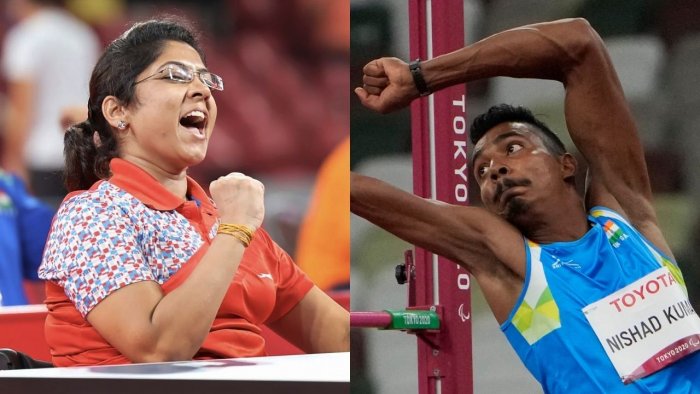
Bhavinaben Patel clinched a historic silver in table tennis to give India its first medal in Paralympics before high jumper Nishad Kumar also came second but the celebrations of a Super Sunday were somewhat muted after discus thrower Vinod Kumar's bronze-winning result was put on hold due to a protest over his disability classification.

Patel, who was diagnosed with polio when she was 12 months old, became only the second Indian woman to win a medal at the Paralympics after she signed off with a silver following a 0-3 loss to world number one Chinese paddler Ying Zhou in the women's singles table tennis class 4 final.

Nishad then clinched a silver with an Asian record before discus thrower Vinod fetched a bronze which was put on hold after a protest over his disability classification as India began collecting what is expected to be an unprecedented haul of athletics medals in the Games.

It somewhat marred the upbeat mood in the Indian camp on the National Sports Day, which is the birth anniversary of hockey wizard Major Dhyan Chand.

Vinod's classification in F52, which is for athletes with impaired muscle power, restricted range of movement, limb deficiency or leg length difference, was done on August 22 by the organisers.

It was not clear on what grounds the classification has been challenged.

"Results of this event are currently under review due to classification observation in competition. The Victory Ceremony has been postponed to the evening session of 30th August," read a statement from the Games organisers.

India's Chef de Mission Gursharan Singh told PTI that Vinod's medal stands for now till a decision on the matter by the technical officials likely to come on Monday.

But the day began brightly, with the 34-year-old Patel clinching a silver. She lost 7-11 5-11 6-11 loss to Zhou, a two-time gold medallist, in the women's singles summit clash which lasted 19 minutes.

Deepa Malik, who is the current president of Paralympic Committee of India (PCI), was the first Indian woman to win a medal in the Paralympic Games when she had claimed a silver in shotput at Rio five years back.

Patel, a wheelchair-bound player with an indomitable spirit, had suffered a loss to Zhou, one of the most decorated para-paddlers of China, in her first group stage match earlier in the week.

Patel started playing the sport 13 years ago at the Blind People's Association at Vastrapur area of Ahmedabad where she was a student of ITI for people with disabilities.

There, she saw visually impaired children playing table tennis and decided to take up the sport.

Patel hoped her success will help change the perception of people towards disability and create more opportunities.

"What I went through growing up, I don't want the next generation of people with disability to suffer," she said.

"Accessibility is a major issue and so is jobs and other opportunities. If my medal can somehow make the right noise and get people at the helm of affairs to be heard, I will be more than happy.

The 21-year-old Nishad, who is a farmer's son in Himachal Pradesh's Amb town, cleared 2.06m to win the silver in T47 class before 41-year-old BSF man Vinod, whose father fought in the 1971 Indo-Pakistan war, produced a best throw of 19.91m to clinch a bronze.

The 24-member Indian athletics team is hoping for a rich haul of medals -- at least 10 -- and the double success on Sunday gave the country enough reasons to smile on the National Sports Day.

Nishad, whose right hand got cut by a grass-cutting machine at his family's farm when he was an eight-year-old boy, cleared the same height of 2.06m with American Dallas Wise who was also awarded a silver.

Another American, Roderick Townsend, won the gold with a world record jump of 2.15m.

The second Indian in the fray, Ram Pal, finished fifth with a best jump of 1.94m.

T47 class is meant for athletes with a unilateral upper limb impairment resulting in some loss of function at the shoulder, elbow and wrist.

Nishad had also contracted Covid-19 earlier this year while training at the SAI Centre in Bengaluru.

Nishad had won a gold medal in the men's high jump T46/47 event at the Fazza World Para Athletics Grand Prix in Dubai earlier this year. He began competing in para athletics in 2009.

In Vinod's event, Piotr Kosewicz (20.02m) of Poland and Velimir Sandor (19.98m) of Croatia won the gold and silver respectively.

Vinod injured his legs while training after joining the BSF, falling off a cliff in Leh that left him bed-ridden for close to a decade during which he lost both his parents.

In archery, the Indian challenge ended in the compound mixed pair open section after the duo of Rakesh Kumar and Jyoti Baliyan made a quarterfinal exit.

The sixth seeded duo suffered a poor start mis-firing in the 6-ring in the first end that proved to be decisive as they lost to their Turkish opponents Oznur Cure and Bulent Korkmaz by 151-153 in an intriguing contest.

Earlier in the morning, the Indian duo stormed past Thailand's Anon Aungaphinan and Praphaporn Homjanthuek 147-141.

Indian challenge also ended in the women's compound open section where the lone challenger Jyoti lost to Kerrie-Louise Leonard of Ireland 141-137 in the first round.

The medal rush is expected to continue on Monday with star javelin thrower Devendra Jhajharia, gunning for his third gold, leading the charge.  

Comments

Add new comment

  • Coastaldigest.com reserves the right to delete or block any comments.
  • Coastaldigset.com is not responsible for its readers’ comments.
  • Comments that are abusive, incendiary or irrelevant are strictly prohibited.
  • Please use a genuine email ID and provide your name to avoid reject.
News Network
January 23,2026

Mangaluru: The Karnataka Government Polytechnic (KPT), Mangaluru, has achieved autonomous status from the All India Council for Technical Education (AICTE), becoming the first government polytechnic in the country to receive such recognition in its 78-year history. The status was granted by AICTE, New Delhi, and subsequently approved by the Karnataka Board of Technical Education in October last year.

Officials said the autonomy was conferred a few months ago. Until recently, AICTE extended autonomous status only to engineering colleges, excluding diploma institutions. However, with a renewed national focus on skill development, several government polytechnics across India have now been granted autonomy.

KPT, the second-largest polytechnic in Karnataka, was established in 1946 with four branches and has since expanded to offer eight diploma programmes, including computer science and polymer technology. The institution is spread across a 19-acre campus.

Ravindra M Keni, the first dean of the institution, told The Times of India that AICTE had proposed autonomous status for polytechnic institutions that are over 25 years old. “Many colleges applied. In the first round, 100 institutions were shortlisted, which was further narrowed down to 15 in the second round. We have already completed one semester after becoming an autonomous institution,” he said. He added that nearly 500 students are admitted annually across eight three-year diploma courses.

Explaining the factors that helped KPT secure autonomy, Keni said the institution has consistently recorded 100 per cent admissions and placements for its graduates. He also noted its strong performance in sports, with the college emerging champions for 12 consecutive years, along with active student participation in NCC and NSS activities.

Autonomous status allows KPT to design industry-oriented curricula, conduct examinations, prepare question papers, and manage academic documentation independently. The institution can also directly collaborate with industries and receive priority funding from AICTE or the Ministry of Education. While academic autonomy has been granted, financial control will continue to rest with the state government.

“There will be separate committees for examinations, question paper setting, boards of studies, and boards of examiners. The institution will now have the freedom to conduct admissions without government notifications and issue its own marks cards,” Keni said, adding that new academic initiatives would be planned after a year of functioning under the autonomous framework.

Comments

Add new comment

  • Coastaldigest.com reserves the right to delete or block any comments.
  • Coastaldigset.com is not responsible for its readers’ comments.
  • Comments that are abusive, incendiary or irrelevant are strictly prohibited.
  • Please use a genuine email ID and provide your name to avoid reject.
News Network
February 1,2026

Bengaluru, Feb 1: For travelers landing at Kempegowda International Airport (KIA), the sleek, wood-paneled curves of Terminal 2 promise a world-class welcome. But the famed “Garden City” charm quickly withers at the curb. As India’s aviation sector swells to record numbers—handling over 43 million passengers in Bengaluru alone this past year—the “last mile” has turned into a marathon of frustration.

The Bengaluru Logjam: Rules vs Reality

While the city awaits the 2027 completion of the Namma Metro Blue Line, the interim has been chaotic. Recent “decongestion” rules at Terminal 1 have pushed app-based cab pickups to distant parking zones, forcing weary passengers into a 20-minute walk with luggage.

“I landed after ten months away and felt like a stranger in my own city,” says Ruchitha Jain, a Koramangala resident. “My driver couldn’t find me, staff couldn’t guide me, and the so-called ‘Premium’ lane is just a fancy tax on convenience.”

•    The Cost of Distance: A 40-km cab ride can now easily cross ₹1,500, driven by demand pricing and airport surcharges.

•    The Bus Gap: While Vayu Vajra remains a lifeline, its ₹300–₹400 fare is often cited as the most expensive airport bus service in the country.

A National Pattern of Disconnect

The struggle is not unique to Karnataka. From Chennai’s coast to Hyderabad’s plateau, India’s airports tell a familiar story: brilliant runways, broken exits.

City:    Primary Issue   |    Recent Development

Bengaluru:    Cab pickup restrictions & distance  |    App-based taxis shifted to far parking zones; long walks and fare spikes reported

Chennai:    Multi-Level Parking (MLCP) hike  |    Passengers report 40-minute walks to reach cab pickup points

Hyderabad:    “Taxi mafia” & touting  |    Over 440 touting cases reported; security presence intensified

Mumbai:    Fare scams  |     Tourists charged ₹18,000 for just 400 metres, triggering police action

In Hyderabad, travelers continue to battle entrenched local groups that intimidate Uber and Ola drivers, pushing passengers toward overpriced private taxis. Chennai flyers, meanwhile, complain that reaching the designated pickup zones now takes longer than short-haul flights from cities like Coimbatore.

The ‘Budget Day’ Hope

As Finance Minister Nirmala Sitharaman presents the Union Budget 2026 today, the aviation sector is watching closely. With the government’s renewed emphasis on multimodal integration, there is cautious hope for funding toward seamless airport-metro-bus hubs.

The vision is clear: a future where planes, trains, and metros speak the same language. Until then, passengers at KIA—and airports across India—will continue to discover that the hardest part of flying isn’t the thousands of kilometres in the air, but the last few on the ground.

Comments

Add new comment

  • Coastaldigest.com reserves the right to delete or block any comments.
  • Coastaldigset.com is not responsible for its readers’ comments.
  • Comments that are abusive, incendiary or irrelevant are strictly prohibited.
  • Please use a genuine email ID and provide your name to avoid reject.
News Network
February 1,2026

Bengaluru: The Karnataka High Court has refused to quash an investigation against a WhatsApp group administrator accused of allowing the circulation of obscene and offensive images depicting Hindutva politicians and idols in 2021.

Justice M Nagaprasanna observed that, prima facie, the ingredients of the offence under Section 295A of the Indian Penal Code were made out. “The offence under Section 295A of the IPC is met to every word of its ingredient, albeit prima facie,” the judge said.

The petitioner, Sirajuddin, a resident of Belthangady taluk in Dakshina Kannada district, had challenged the FIR registered against him at the CEN (Cyber, Economics and Narcotics) police station, Mangaluru, for offences under Section 295A of the IPC and Section 67 of the Information Technology Act. Section 295A relates to punishment for deliberate and malicious acts intended to outrage the religious feelings of any class of citizens.

According to the complaint filed by K Jayaraj Salian, also a resident of Belthangady taluk, he received a WhatsApp group link from an unknown source and was added to the group after accessing it. The group reportedly had six administrators and around 250 participants, where obscene and offensive images depicting Hindu deities and certain political figures were allegedly circulated repeatedly.

Sirajuddin was arrested in connection with the case and later released on bail on February 16, 2021. He argued before the court that he was being selectively targeted, while other administrators—including the creator of the group—were neither arrested nor investigated. He also contended that the Magistrate could not have taken cognisance of the offence under Section 295A without prior sanction under Section 196(1) of the CrPC.

Rejecting the argument, Justice Nagaprasanna held that prior sanction is required only at the stage of taking cognisance, and not at the stage of registration of the crime or during investigation.

The judge noted that the State had produced the entire investigation material before the court. “A perusal of the material reveals depictions of Hindu deities in an extraordinarily obscene, demeaning and profane manner. The content is such that its reproduction in a judicial order would itself be inappropriate,” the court said, adding that the material, on its face, had the tendency to outrage religious feelings and disturb communal harmony.

Observing that the case was still at the investigation stage, the court said it could not interdict the probe at this juncture. However, it expressed concern that the investigating officer appeared to have not proceeded uniformly against all administrators. The court clarified that if the investigation revealed the active involvement of any member in permitting the circulation of such content, they must also be proceeded against.

“At this investigative stage, any further observation by this Court would be unnecessary,” the order concluded.

Comments

Add new comment

  • Coastaldigest.com reserves the right to delete or block any comments.
  • Coastaldigset.com is not responsible for its readers’ comments.
  • Comments that are abusive, incendiary or irrelevant are strictly prohibited.
  • Please use a genuine email ID and provide your name to avoid reject.