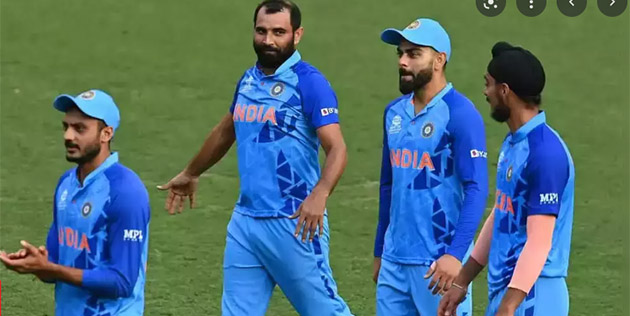
Mohammed Shami sizzles in 4-wicket over as India edge out Australia in T20 World Cup warm-up

News Network
October 17, 2022

shami.jpg

Mohammed Shami put the concerns over his fitness to rest with a sensational 20th over as India pulled off a six-run win over Australia in their first warm-up fixture of the T20 World Cup on Monday.

K L Rahul (57 off 33) and Suryakumar Yadav (50 off 33) smashed entertaining half-centuries to power India to 186 for seven after Australia opted to bowl at the Gabba.

Needing 16 runs off the last 12 balls with six wickets in hand, Australia were on course for a comfortable win before Shami, Harshal Patel and Virat Kohli the fielder scripted a turnaround for India.

Shami, who last played a competitive game in July and landed here after suffering a long bout of Covid-19, turned up to bowl the last over of the game and made a decisive impact on the game.

He landed yorker after yorker and ended up with three wickets in the over besides a run out. Shami was drafted into the squad as a replacement for the injured Jasprit Bumrah.

In the penultimate over, under-fire Harshal Patel delivered after being hammered early on, as he conceded only five runs in an over that also included a brilliant run out off a Kohli direct hit.

The star India batter had also plucked a stunning one-handed catch out of thin air at the boundary line to dismiss Pat Cummins.

However, concerns over India's bowling remains ahead of their tournament opener against Pakistan on October 23.

"There is room for improvement, but I want more consistency from the bowlers. You need to keep things simple and hit the deck hard. Overall a good game for us, they had a decent partnership and that put us under pressure," said skipper Rohit Sharma.

On Shami's match-winning effort, he said: "He is coming back after a long time, so we wanted to give him an over. Wanted to give him a challenge and let him bowl the final over, and you saw what he did."

Earlier, the Indian batters enjoyed the pace and bounce of the wicket, especially Rahul who scored the bulk of the runs in the powerplay, taking his team to 69 for no loss.

Rohit (15 off 14) was a mere spectator at the other end as Rahul came up with one classy hit after another.

During a 78-run stand between the openers, Rohit hardly got to bat and could open his account only in the fifth over.

Rahul, whose strike rate has been questioned in the past, looked like he was back to his best after coming back from an injury lay off.

His innings comprised delightful cover drivers off the pacers while his standout shots were the two sixes off Cummins, one was a crisp pull while the other was a whip off a good length ball, which sailed over deep midwicket.

Barring Hardik Pandya (2), who was outdone by a slower ball from Kane Richardson, all the Indian batters got to spend some valuable time in the middle.

The bigger boundaries in Australia are already making an impact with Kohli (19 off 13), Dinesh Karthik (20 off 14), Rohit and Rahul getting caught in the deep.

Karthik walked across the stumps to dispatch Kane Richardson over deep mid-wicket but was caught by Glenn Maxwell just inside the boundary ropes. It would have been a six at a ground in India.

Kohli was bounced out by Mitchell Starc to be caught at fine leg while Rohit's slog sweep landed in the safe hands of Maxwell.

After a high-quality knock, Rahul could not give a long hop from Maxwell due punishment and was caught at deep midwicket.

With the start India got, they should have reached 200 but could not do so.

There was also another fine knock from Suryakumar, who had also scored a fifty against Western Australia in Perth. He and Rahul also got the taste of the extra bounce as they both were hit on the helmet.

 

Comments

Add new comment

  • Coastaldigest.com reserves the right to delete or block any comments.
  • Coastaldigset.com is not responsible for its readers’ comments.
  • Comments that are abusive, incendiary or irrelevant are strictly prohibited.
  • Please use a genuine email ID and provide your name to avoid reject.
News Network
December 15,2025

Mangaluru, Dec 15: Air India Express has announced that it will resume direct flight services between Mangaluru and Muscat from March 2026, restoring an important international air link for passengers from the coastal region.

Airport authorities said the service will operate twice a week—on Sundays and Tuesdays—from March 1. The initial flights are scheduled on March 3, 8 and 10, followed by March 15 and 17, with the same operating pattern to continue thereafter. The flight duration is approximately three hours and 25 minutes.

The Mangaluru–Muscat route was earlier operated under the 2025 summer schedule, with services beginning on July 14. At that time, Air India Express had operated four flights a week before suspending the service.

Officials said the summer schedule will come into effect from March 29, after which changes in flight timings and departure schedules from Mangaluru are expected. Passengers have been advised to check the latest schedules while planning their travel.

The resumption of direct flights to Muscat is expected to significantly benefit expatriates, business travellers and others, further strengthening Mangaluru’s air connectivity with the Gulf region.

Comments

Add new comment

  • Coastaldigest.com reserves the right to delete or block any comments.
  • Coastaldigset.com is not responsible for its readers’ comments.
  • Comments that are abusive, incendiary or irrelevant are strictly prohibited.
  • Please use a genuine email ID and provide your name to avoid reject.
News Network
December 13,2025

New Delhi: School-going children are picking up drug and smoking habits and engaging in consumption of alcohol, with the average age of introduction to such harmful substances found to be around 13 years, suggesting a need for earlier interventions as early as primary school, a multi-city survey by AIIMS-Delhi said.

The findings also showed substance use increased in higher grades, with grade XI/XII students two times more likely to report use of substances when compared with grade VIII students. This emphasised the importance of continued prevention and intervention through middle and high school.

The study led by Dr Anju Dhawan of AIIMS's National Drug Dependence Treatment Centre, published in the National Medical Journal of India this month, looks at adolescent substance use across diverse regions.

The survey included 5,920 students from classes 8, 9, 11 and 12 in urban government, private and rural schools across 10 cities -- Bengaluru, Chandigarh, Delhi, Dibrugarh, Hyderabad, Imphal, Jammu, Lucknow, Mumbai, and Ranchi. The data were collected between May 2018 and June 2019.

The average age of initiation for any substance was 12.9 (2.8) years. It was lowest for inhalants (11.3 years) followed by heroin (12.3 years) and opioid pharmaceuticals (without prescription; 12.5 years).

Overall, 15.1 per cent of participants reported lifetime use, 10.3 per cent reported past year use, and 7.2 per cent reported use in the past month of any substance, the study found.

The most common substances used in the past year, after tobacco (4 per cent) and alcohol (3.8 per cent), were opioids (2.8 per cent), followed by cannabis (2 per cent) and inhalants (1.9 per cent). Use of non-prescribed pharmaceutical opioids was most common among opioid users (90.2 per cent).

On being asked, 'Do you think this substance is easily available for a person of your age' separately for each substance category, nearly half the students (46.3 per cent) endorsed that tobacco products and more than one-third of the students (36.5 per cent) agreed that a person of their age can easily procure alcohol products.

Similarly, for Bhang (21.9 per cent), ganja/charas (16.1 per cent), inhalants (15.2 per cent), sedatives (13.7 per cent), opium and heroin (10 per cent each), the students endorsed that these can be easily procured.

About 95 per cent of the children, irrespective of their grade, agreed with the statement that 'drug use is harmful'.

The rates of substance use (any) among boys were significantly higher than those of girls for substance use (ever), use in the past year and use in the past 30 days. Compared to grade VIII students, grade IX students were more likely, and grade XI/XII students were twice as likely to have used any substance (ever).

The likelihood of past-year use of any substance was also higher for grade IX students and for grade XI/XII students as compared to grade VIII students.

About 40 per cent of students mentioned that they had a family member who used tobacco or alcohol each. The use of cannabis (any product) and opioid (any product) by a family member was reported by 8.2 per cent and 3.9 per cent of students, respectively, while the use of other substances, such as inhalants/sedatives by family was 2-3 per cent, the study found.

A relatively smaller percentage of students reported use of tobacco or alcohol among peers as compared to among family members, while a higher percentage reported inhalants, sedatives, cannabis or opioid use among peers.

Children using substances (past year) compared to non-users reported significantly higher any substance use by their family members and peers.

There were 25.7 per cent students who replied 'yes' to the question 'conflicts/fights often occur in your family'. Most students also replied affirmatively to 'family members are aware of how their time is being spent' and 'damily members are aware of with whom they spend their time'.

Comments

Add new comment

  • Coastaldigest.com reserves the right to delete or block any comments.
  • Coastaldigset.com is not responsible for its readers’ comments.
  • Comments that are abusive, incendiary or irrelevant are strictly prohibited.
  • Please use a genuine email ID and provide your name to avoid reject.
News Network
December 6,2025

pilot.jpg

New Delhi: IndiGo, India’s largest airline, faced major operational turbulence this week after failing to prepare for new pilot-fatigue regulations issued by the Directorate General of Civil Aviation (DGCA). The stricter rules—designed to improve flight safety—took effect in phases through 2024, with the latest implementation on November 1. IndiGo has acknowledged that inadequate roster planning led to widespread cancellations and delays.

Below are the key DGCA rules that affected IndiGo’s operations:

1. Longer Mandatory Weekly Rest

Weekly rest for pilots has been increased from 36 hours to 48 hours.

The government says the extended break is essential to curb cumulative fatigue. This rule remains in force despite the current crisis.

2. Cap on Night Landings

Pilots can now perform only two night landings per week—a steep reduction from the earlier limit of six.

Night hours, defined as midnight to early morning, are considered the least alert period for pilots.

Given the disruptions, this rule has been temporarily relaxed for IndiGo until February 10.

3. Reduced Maximum Night Flight Duty

Flight duty that stretches into the night is now capped at 10 hours.

This measure has also been kept on hold for IndiGo until February 10 to stabilize operations.

4. Weekly Rest Cannot Be Replaced With Personal Leave

Airlines can no longer count a pilot’s personal leave as part of the mandatory 48-hour rest.

Pilots say this closes a loophole that previously reduced actual rest time.

Currently, all airlines are exempt from this rule to normalise travel.

5. Mandatory Fatigue Monitoring

Airlines must submit quarterly fatigue reports along with corrective actions to DGCA.

This system aims to create a transparent fatigue-tracking framework across the industry.

The DGCA has stressed that these rules were crafted to strengthen flight safety and align India with global fatigue-management standards. The temporary relaxations are expected to remain until February 2025, giving IndiGo time to stabilise its schedules and restore normal air travel.

Comments

Add new comment

  • Coastaldigest.com reserves the right to delete or block any comments.
  • Coastaldigset.com is not responsible for its readers’ comments.
  • Comments that are abusive, incendiary or irrelevant are strictly prohibited.
  • Please use a genuine email ID and provide your name to avoid reject.