Tokyo Olympics commences with a remote yet spectacular ceremony amid covid fears

News Network
July 23, 2021

Olymp.jpg

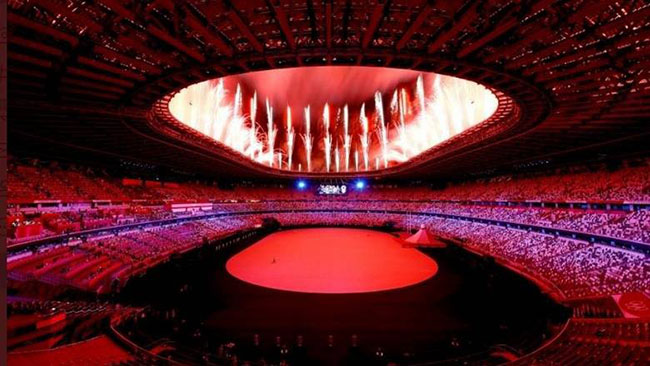
The opening ceremony of the Tokyo Olympics began on Friday in a nearly empty stadium after a year-long pandemic postponement and a build-up marred by scandal and controversy.

A video showing athletes training at home during the coronavirus pandemic started the show, with pink fireworks bursting into the air after a countdown.

The ceremony in the 68,000-capacity stadium is taking place before just a few hundred officials and dignitaries, including Japan's Emperor Naruhito, French President Emmanuel Macron and US First Lady Jill Biden.

The emperor will officially declare the Games open.

The Olympics have faced opposition in Japan over fears the global gathering of 11,000 athletes could trigger a super-spreader event.

Organisers have put strict virus measures in place, banning overseas fans for the first time ever, and keeping domestic spectators out of all but a handful of venues.

Athletes, support staff and media are subject to strict Covid-19 protocols, including regular testing and daily health checks.

Polls have consistently found a majority of Japanese are against the Games, with opinion ranging from weary indifference to outright hostility.

But there was plenty of enthusiasm outside the Olympic Stadium in the hours before the ceremony, as hundreds of people gathered hoping to soak up the atmosphere and watch the fireworks expected during the extravaganza.

Mako Fukuhara arrived six hours before the ceremony to grab a spot.

"Until now it didn't feel like the Olympics, but now we are by the stadium, it feels like the Olympics," she told AFP as people snapped selfies nearby.

'Determined'

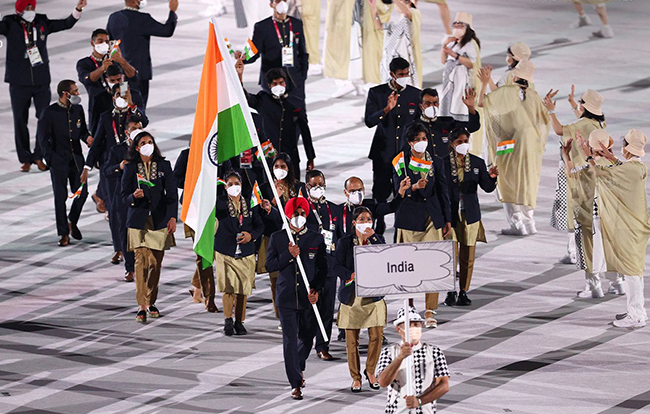
Traditionally a highlight of any Summer Games, featuring the parade of nations and the lighting of the Olympic cauldron, Tokyo's opening ceremony has been drastically pared back.

Fewer than 1,000 dignitaries and officials are present at the stadium, and in a sign of how divisive the Games remain, several top sponsors including Toyota and Panasonic are not attending.

A few hundred protestors demonstrated against the Games outside the stadium as the ceremony began.

Tokyo is battling a surge in virus cases, and is under emergency measures that means restaurants must shut by 8:00 pm and cannot sell alcohol.

Dogged by controversy

But Olympic officials have put a brave face on the unusual circumstances, with IOC chief Thomas Bach insisting cancellation was never on the table.

"Over the past 15 months we had to take many decisions on very uncertain grounds," he said this week. "We had doubts every day. There were sleepless nights.

"We can finally see at the end of the dark tunnel. Cancellation was never an option for us. The IOC never abandons the athletes... we did it for the athletes."

There are also hefty financial incentives in play. Insiders estimate the IOC would have been on the hook for around $1.5 billion in lost broadcasting revenues if the Games had been cancelled.

The pandemic has not been the only hiccup in preparations though, with scandals ranging from corruption during the bidding process to plagiarism allegations over the design of the Tokyo 2020 logo.

The controversies kept coming right up to the eve of the Games, with the opening ceremony's director sacked on Thursday for making a joke referencing the Holocaust in a video from 1998.

Back in the sporting arenas, a new generation of Olympic stars are looking to shine after a decade dominated by the likes of Usain Bolt and Michael Phelps.

US swimmer Caeleb Dressel could target seven gold medals, and in track and field, 400 metre hurdlers Karsten Warholm of Norway and the USA's Sydney McLaughlin are among those hoping to emerge as household names.

Gymnastics meanwhile will see Simone Biles attempt to crown her dazzling career by equalling Larisa Latynina's record of nine Olympic gold medals.

New Olympic sports will also be on display in Tokyo, with surfing, skateboarding, sport climbing and karate all making their debut.

Olympics.jpg

Comments

Add new comment

  • Coastaldigest.com reserves the right to delete or block any comments.
  • Coastaldigset.com is not responsible for its readers’ comments.
  • Comments that are abusive, incendiary or irrelevant are strictly prohibited.
  • Please use a genuine email ID and provide your name to avoid reject.
News Network
February 4,2026

Mangaluru: Urban local bodies and gram panchayats should make the use of Kannada on signboards mandatory while issuing trade licences to commercial establishments, Dakshina Kannada Deputy Commissioner Darshan HV said. He also called for regular inspections to ensure compliance.

Presiding over the District Kannada Awareness Committee meeting at the deputy commissioner’s office, Darshan said the city corporation would be directed to ensure that shops operating in malls prominently display their names in Kannada. “All commercial establishments, including shops, companies, offices and hotels, must mandatorily display their names in Kannada on signboards,” he said.

The deputy commissioner added that the National Highways Authority of India (NHAI) would be instructed to include Kannada on signboards along national highways. Banks, he said, would be directed through committee meetings to provide application forms in Kannada.

“Even if English-medium schools and colleges impart education in English, their signboards must display the institution’s name in Kannada. Steps will also be taken to ensure that private buses display place names in Kannada,” Darshan said.

During the meeting, committee members raised concerns over the closure of Kannada-medium schools in rural areas due to a shortage of teachers and stressed the need for immediate corrective measures. They also pointed out that several industries employ workers from other states while overlooking local candidates.

Members further demanded that nationalised banks provide deposit and withdrawal slips in Kannada. It was brought to the deputy commissioner’s notice that the presence of staff without knowledge of Kannada in rural branches of nationalised banks is causing hardship to local customers.

Meanwhile, MP Srinath, president of the District Kannada Sahitya Parishat, urged the district administration to allot land for the construction of a district Kannada Bhavana in Mangaluru.

Comments

Add new comment

  • Coastaldigest.com reserves the right to delete or block any comments.
  • Coastaldigset.com is not responsible for its readers’ comments.
  • Comments that are abusive, incendiary or irrelevant are strictly prohibited.
  • Please use a genuine email ID and provide your name to avoid reject.
News Network
January 23,2026

Karnataka Governor Thaawarchand Gehlot read only three lines from the 122-paragraph address prepared by the Congress-led state government while addressing the joint session of the Legislature on Thursday, effectively bypassing large sections critical of the BJP-led Union government.

The omitted portions of the customary Governor’s address outlined what the state government described as a “suppressive situation in economic and policy matters” under India’s federal framework. The speech also sharply criticised the Centre’s move to replace the Mahatma Gandhi National Rural Employment Guarantee Act (MGNREGA) with the Viksit Bharat–Guarantee for Rozgar and Ajeevika Mission (Gramin) Act, commonly referred to as the VB-GRAM (G) Act.

Governor Gehlot had earlier conveyed his objection to several paragraphs that were explicitly critical of the Union government. On Thursday, he confined himself to the opening lines — “I extend a warm welcome to all of you to the joint session of the State legislature. I am extremely pleased to address this august House” — before jumping directly to the concluding sentence of the final paragraph.

He ended the address by reading the last line of paragraph 122: “Overall, my government is firmly committed to doubling the pace of the State’s economic, social and physical development. Jai Hind — Jai Karnataka.”

According to the prepared speech, the Karnataka government demanded the scrapping of the VB-GRAM (G) Act, describing it as “contractor-centric” and detrimental to rural livelihoods, and called for the full restoration of MGNREGA. The state government argued that the new law undermines decentralisation, weakens labour protections, and centralises decision-making in violation of constitutional norms.

Key points from the unread sections of the speech:

•    Karnataka facing a “suppressive” economic and policy environment within the federal system

•    Repeal of MGNREGA described as a blow to rural livelihoods

•    VB-GRAM (G) Act accused of protecting corporate and contractor interests

•    New law alleged to weaken decentralised governance

•    Decision-making said to be imposed by the Centre without consulting states

•    Rights of Adivasis, women, backward classes and agrarian communities curtailed

•    Labourers allegedly placed under contractor control

•    States facing mounting fiscal stress due to central policies

•    VB-GRAM (G) Act accused of enabling large-scale corruption

Comments

Add new comment

  • Coastaldigest.com reserves the right to delete or block any comments.
  • Coastaldigset.com is not responsible for its readers’ comments.
  • Comments that are abusive, incendiary or irrelevant are strictly prohibited.
  • Please use a genuine email ID and provide your name to avoid reject.
News Network
February 4,2026

shettigar.jpg

An Indian resident who won the Dh20 million (approximately Rs 50 crore) jackpot in Abu Dhabi's Big Ticket draw has told of his joy at sharing his life-changing fortune with a friend.

Shanthanu Shettigar, a shop manager in Muscat, regularly buys tickets for the monthly grand prize draw with one of his closest friends – and the pair won on February 3.

Mr Shettigar, 33, who is from Udyavar in Udupi district of the southern state of Karnataka and has lived in the Omani capital for eight years, said he was left speechless after learning of his success.

“When I first moved to Muscat, many of my colleagues were purchasing Big Ticket, which encouraged me to give it a try,” he said.

“I started buying tickets on my own, and later began sharing tickets with a close friend. The ticket that brought me this win was one we purchased together.”

“Like most people, I receive a lot of spam calls, and I was fully absorbed in my work as well. I knew the live draw was taking place tonight, but I never imagined my name would be announced,” he said.

“When I realised it was real and that I had won, I was honestly speechless. It still hasn’t fully sunk in, but I’m extremely happy.”

Mr Shettigar is not sure how he will spend his share of the money, but encouraged others to take part.

“This win was completely unexpected, so I want to take some time to think things through before deciding what to do next,” he said.

“I would definitely encourage others to participate with Big Ticket, whether with family or friends – you never know when your moment might come.”

The Big Ticket was established in 1992 with an initial first prize of Dh1 million. It is one of the most popular monthly raffles in the UAE.

It has transformed the lives of many people across the Emirates and beyond.

Entry to the Big Ticket Millionaire is Dh500. Tickets can be bought online or at counters at Zayed International Airport and Al Ain Airport.

Comments

Add new comment

  • Coastaldigest.com reserves the right to delete or block any comments.
  • Coastaldigset.com is not responsible for its readers’ comments.
  • Comments that are abusive, incendiary or irrelevant are strictly prohibited.
  • Please use a genuine email ID and provide your name to avoid reject.