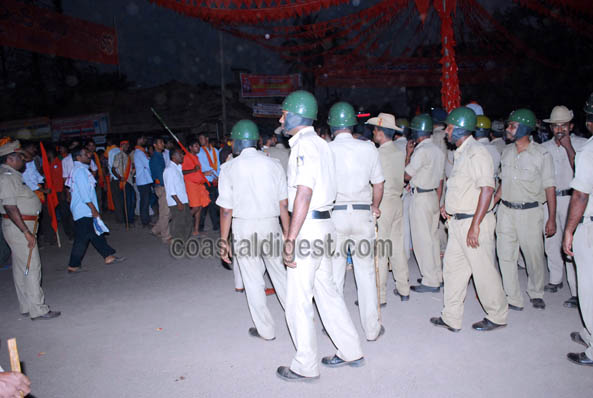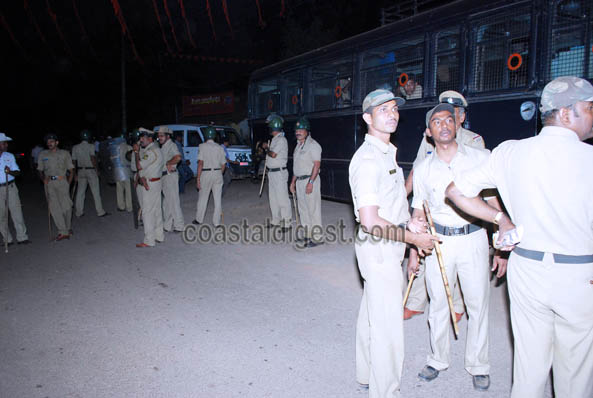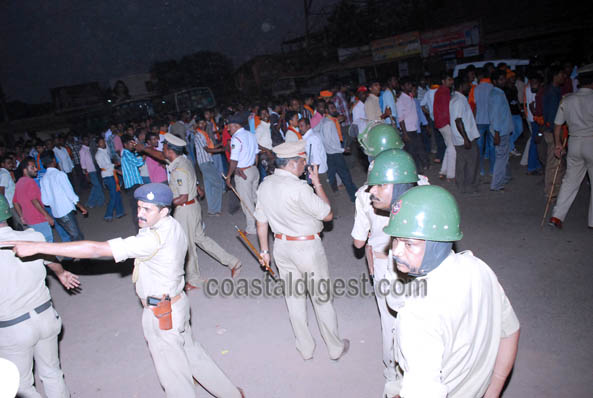
Tension grips Uppinangady following provocative speech; Stones pelted at mosques, 7 injured

[email protected] (CD Network)
January 22, 2012

uppi


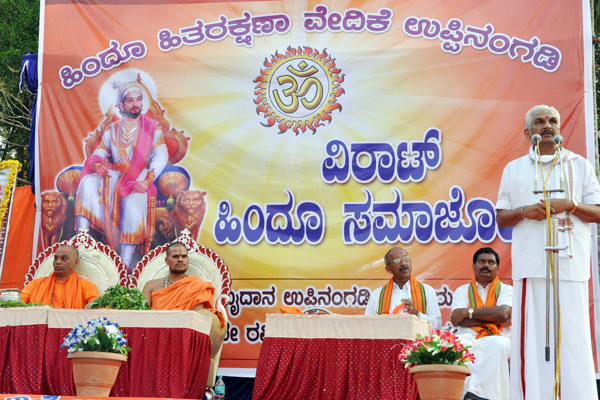
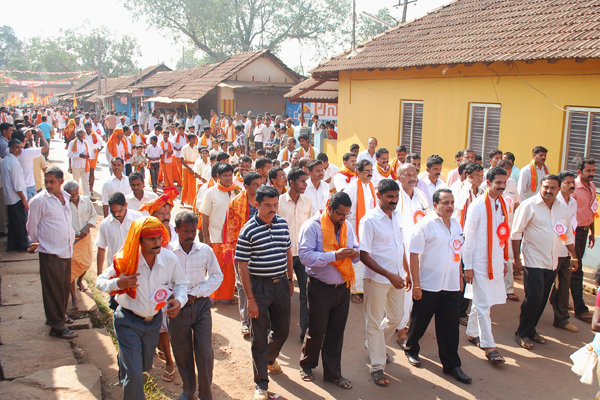
Mangalore, January 22: Tense atmosphere prevailed in Uppinangady following a provocative speech by Rashtriya Swayamsevak sangh leader Kalladka Prabhakar Bhat, who threatened to attack and shoot down the Muslim youths.

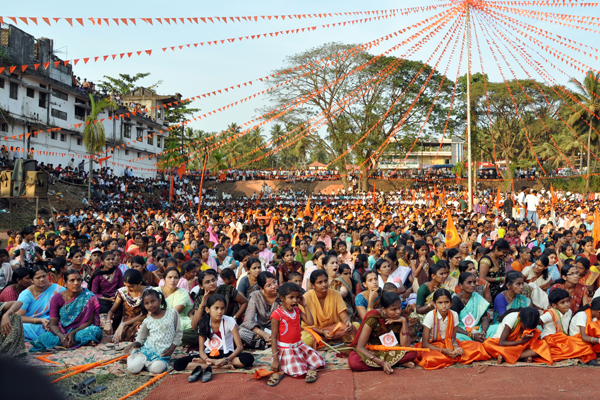
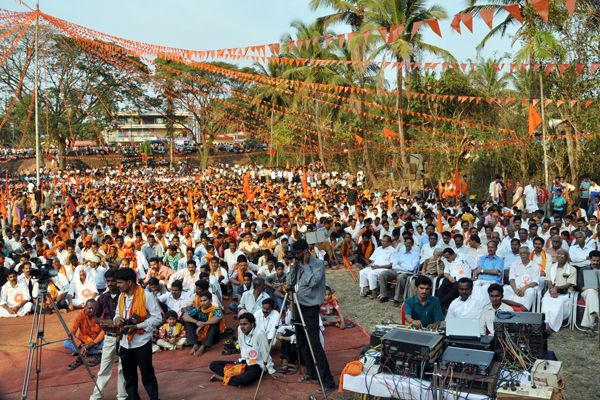
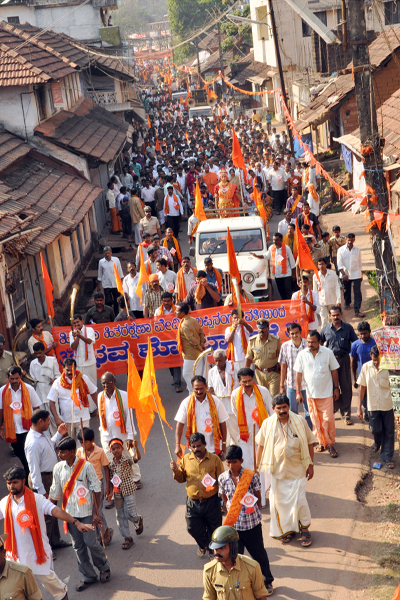
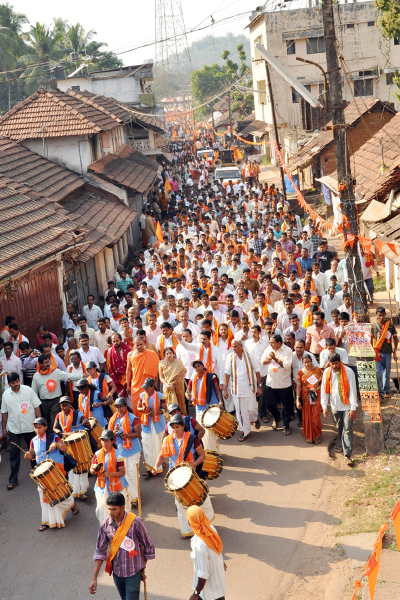
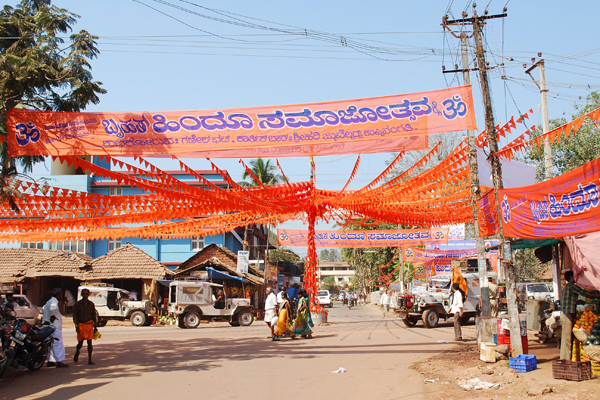
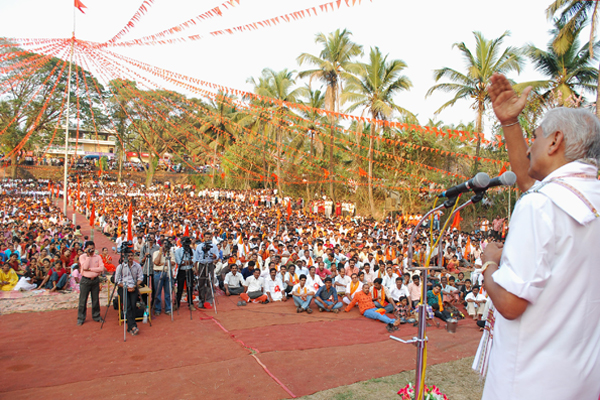
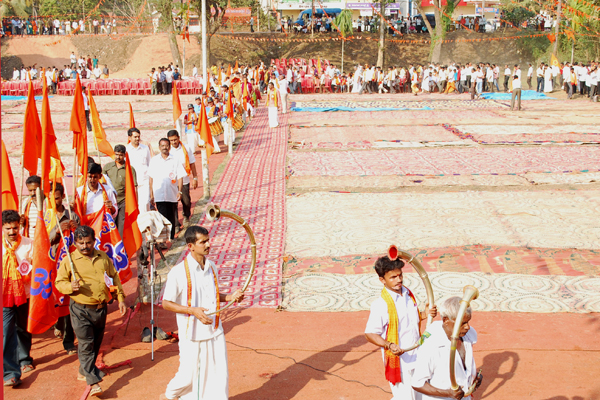
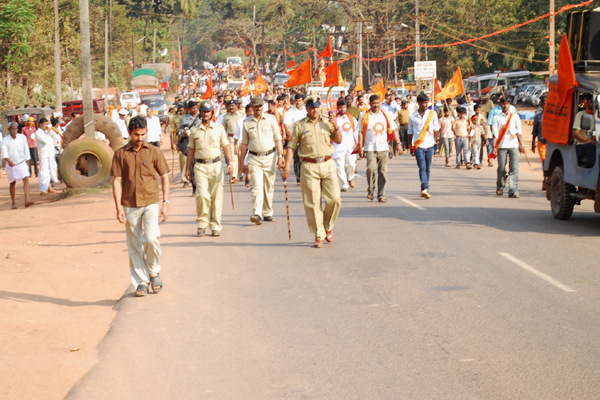
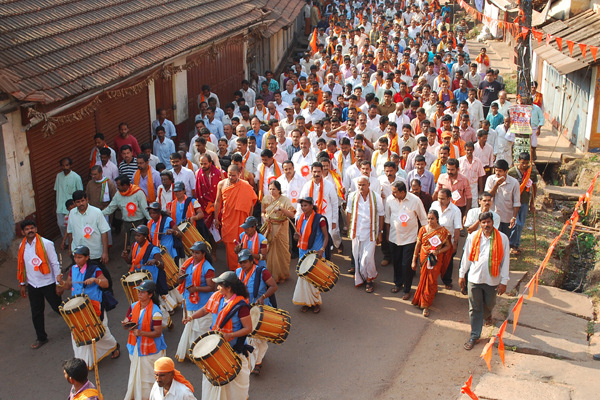
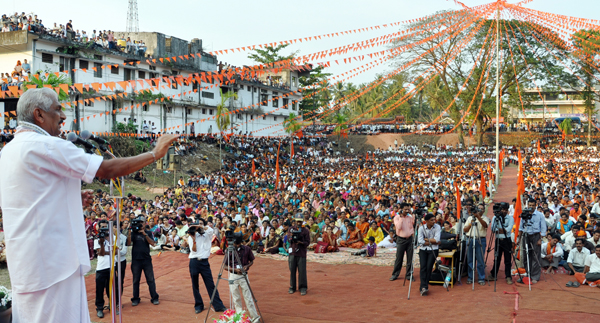
Mr Bhat was addressing hundreds of people who took part in Hindu Samajotsava at Chatrapati Shivaji Maidan. When the police allowed Mr Bhat to continue his speech, dozens of Muslim youth gathered at a junction near Uppinangady bus stand urged the police to stop the “fanatic terrorists”.

At this situation a verbal clash broke out between police and youths and the former resorted to mild baton charge. However, timely intervention of few Muslim leaders, who managed to send back the youths to their homes, brought the situation under control.

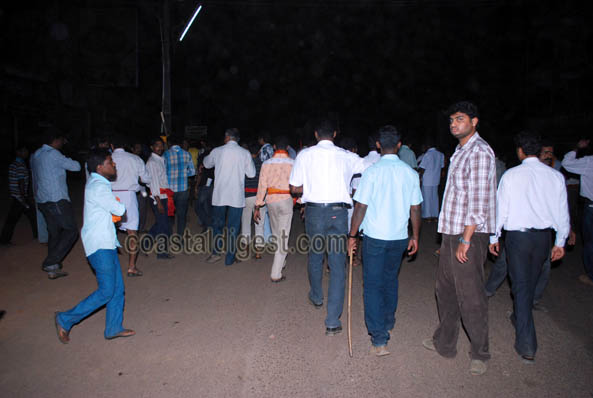
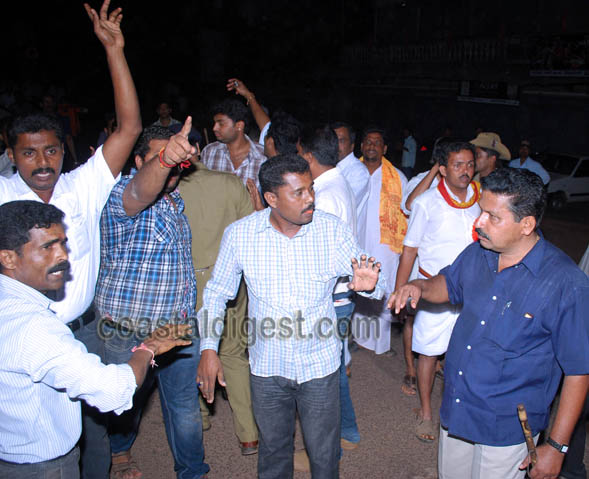
However, the situation turned worse, when the youths returning from Samajotsava began to shout provocative slogans near bus stand. The police, once again had to resort to baton charge to disperse the mob.

A few minutes later the youths from majority and minority communities confronted near Central Jum'a Masjid. However, police managed to disperse the mob.

Meanwhile, miscreants pelted stones at Juma Masjid situated behind the Government Hospital. The miscreants also threw stones at police, who rushed to the spot to disperse the mob. Subrahmanya police sub inspector Sunil Patil and two other constables got injured in the incident.

There were reports of damages from various places in and around the town. Stone were pelted at a cloth shop, a mobile centre and a fancy shop in Uppinangady.


A group of provoked youths, on their way back from Samajotsava, threw stones at Masjid building at Konthur near Kadaba. Another group was stopped by police while trying to attack an elderly Muslim man near Periyadka.


As per the latest reports, at least seven people have been injured in the aftermath of Samajotsava. A few among the injured have been admitted to a private hospital in Puttur.


Provocation

Mr Bhat, who was apparently trying to provoke the gathering throughout his speech, lashed out at Muslims and Christians, portraying them as traitors and enemies of Hindus.

“All the Muslims here are devils. Under the pretext of peace and friendship they wage 'love jehad' and convert Hindu girls into Islam and sell them to foreign countries”, he said. “We should not hesitate to teach them an unforgettable lesson to these devils”, he added.

He went on to claim that Muslim youths who convert Hindu girls through 'love jehad' would receive cash rewards. “Those Muslim youths who convert a Kashmiri girl will receive Rs 9 lakh. The reward for converting a Panjabi girl is Rs 7 lakh. Those who convert other Hindu girls will be paid Rs 5 lakh”, he said adding some vulgar jokes.

Mr Bhat also urged the Hindu youths to attack and torture their Muslim counterparts if the latter were seen talking with Hindu girls.

“If we hand them over to police, the latter will allow them to go home after receiving Rs 15,000 from them. Hence, we have decided to teach an unforgettable lesson to them without handing over to the police. We know how to punish them”, he said.

“We will shoot down such Muslim youths”, he shouted.

Mr Bhat also warned the Hindu parents against sending their children to the educational institutions run by Christians. “Christians have built schools and hospitals here only with the intention of conversion and not for any noble cause”, he said.

“Why do you send your children to such Christian schools instead of Hindu schools? Why should Hindu children call the Christian priests as Fathers?”, he questioned.

Mr Bhat's speech was audible across the town by fixing loud speakers in various places, in an apparent violation of a recent harmony-meet resolution to confine loud speakers only to the convention venue.
uppi2

uppi1

UP_22jan_1

UP_22jan_4

UP_22jan_6

HD_23Jan_1

HD_23Jan_2

HD_23Jan_3

HD_23Jan_4

HD_23Jan_5

HD_23Jan_6

HD_23Jan_8

HD_23Jan_9

HD_23Jan_10

HD_23Jan_12

HD_23Jan_13


Comments

Add new comment

  • Coastaldigest.com reserves the right to delete or block any comments.
  • Coastaldigset.com is not responsible for its readers’ comments.
  • Comments that are abusive, incendiary or irrelevant are strictly prohibited.
  • Please use a genuine email ID and provide your name to avoid reject.
News Network
February 1,2026

Bengaluru: Karnataka Deputy Chief Minister D K Shivakumar on Sunday criticised the Union Budget presented by Finance Minister Nirmala Sitharaman, claiming it offered no tangible benefit to the state.

Though he said he was yet to study the budget in detail, Shivakumar asserted that Karnataka had gained little from it. “There is no benefit for our state from the central budget. I was observing it. They have now named a programme after Mahatma Gandhi, after repealing the MGNREGA Act that was named after him,” he said.

Speaking to reporters here, the Deputy Chief Minister demanded the restoration of MGNREGA, and made it clear that the newly enacted rural employment scheme — VB-G RAM G — which proposes a 60:40 fund-sharing formula between the Centre and the states, would not be implemented in Karnataka.

“I don’t see any major share for our state in this budget,” he added.

Shivakumar, who also holds charge of Bengaluru development, said there were high expectations for the city from the Union Budget. “The Prime Minister calls Bengaluru a ‘global city’, but what has the Centre done for it?” he asked.

He also drew attention to the problems faced by sugar factories, particularly those in the cooperative sector, alleging a lack of timely decisions and support from the central government.

Noting that the Centre has the authority to fix the minimum support price (MSP) for agricultural produce, Shivakumar said the Union government must take concrete steps to protect farmers’ interests.

Comments

Add new comment

  • Coastaldigest.com reserves the right to delete or block any comments.
  • Coastaldigset.com is not responsible for its readers’ comments.
  • Comments that are abusive, incendiary or irrelevant are strictly prohibited.
  • Please use a genuine email ID and provide your name to avoid reject.
News Network
February 5,2026

In an era where digital distractions are the primary rival to academic excellence, the Karnataka Education Department is taking the fight directly to the living room. As the SSLC (Class 10) annual examinations loom, officials have launched a localized "digital strike" to ensure students aren't losing their competitive edge to scrolling or soap operas.

The 7-to-9 Lockdown

The department has issued a formal directive urging—and in some cases, enforcing via home visits—a total blackout of mobile phones and television sets between 7:00 PM and 9:00 PM. This two-hour window is being designated as "sacred study time" across the state until the examinations conclude on April 2.

Key Pillars of the Initiative:

•    Doorstep Advocacy: Teachers are transitioning from classrooms to living rooms, meeting parents to explain the psychological benefits of a distraction-free environment.

•    Parental Accountability: The campaign shifts the burden of discipline from the student to the household, asking parents to lead by example and switch off their own devices.

•    The Timeline: The focus remains sharp on the upcoming exam block, scheduled from March 18 to April 2.

"The objective is simple: uninterrupted focus. We are reclaiming the evening hours for the students, ensuring their environment is as prepared as their minds," stated a senior department official.

Student vs. Reality

While the student community has largely welcomed the "forced focus"—with many admitting they lack the willpower to ignore notifications—the move has sparked a debate on enforceability. Without a "TV Police," the success of this initiative rests entirely on the shoulders of parents and the persuasive power of visiting educators.

Comments

Add new comment

  • Coastaldigest.com reserves the right to delete or block any comments.
  • Coastaldigset.com is not responsible for its readers’ comments.
  • Comments that are abusive, incendiary or irrelevant are strictly prohibited.
  • Please use a genuine email ID and provide your name to avoid reject.
News Network
January 23,2026

Mangaluru: The Karnataka Government Polytechnic (KPT), Mangaluru, has achieved autonomous status from the All India Council for Technical Education (AICTE), becoming the first government polytechnic in the country to receive such recognition in its 78-year history. The status was granted by AICTE, New Delhi, and subsequently approved by the Karnataka Board of Technical Education in October last year.

Officials said the autonomy was conferred a few months ago. Until recently, AICTE extended autonomous status only to engineering colleges, excluding diploma institutions. However, with a renewed national focus on skill development, several government polytechnics across India have now been granted autonomy.

KPT, the second-largest polytechnic in Karnataka, was established in 1946 with four branches and has since expanded to offer eight diploma programmes, including computer science and polymer technology. The institution is spread across a 19-acre campus.

Ravindra M Keni, the first dean of the institution, told The Times of India that AICTE had proposed autonomous status for polytechnic institutions that are over 25 years old. “Many colleges applied. In the first round, 100 institutions were shortlisted, which was further narrowed down to 15 in the second round. We have already completed one semester after becoming an autonomous institution,” he said. He added that nearly 500 students are admitted annually across eight three-year diploma courses.

Explaining the factors that helped KPT secure autonomy, Keni said the institution has consistently recorded 100 per cent admissions and placements for its graduates. He also noted its strong performance in sports, with the college emerging champions for 12 consecutive years, along with active student participation in NCC and NSS activities.

Autonomous status allows KPT to design industry-oriented curricula, conduct examinations, prepare question papers, and manage academic documentation independently. The institution can also directly collaborate with industries and receive priority funding from AICTE or the Ministry of Education. While academic autonomy has been granted, financial control will continue to rest with the state government.

“There will be separate committees for examinations, question paper setting, boards of studies, and boards of examiners. The institution will now have the freedom to conduct admissions without government notifications and issue its own marks cards,” Keni said, adding that new academic initiatives would be planned after a year of functioning under the autonomous framework.

Comments

Add new comment

  • Coastaldigest.com reserves the right to delete or block any comments.
  • Coastaldigset.com is not responsible for its readers’ comments.
  • Comments that are abusive, incendiary or irrelevant are strictly prohibited.
  • Please use a genuine email ID and provide your name to avoid reject.