



Trump Announces 'Hard-hitting' Sanctions against Iran Aimed at Supreme Leader, Other Officials

Agencies
June 25, 2019

Washington, Jun 25: The United States on Monday imposed sanctions on Iran's supreme leader Ayatollah Ali Khamenei and a string of military chiefs, tightening pressure on the country that President Donald Trump threatened with "obliteration" if it seeks war.
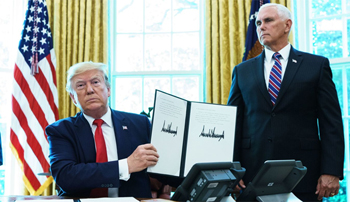
Trump signed the punitive financial measures against in the Oval Office, calling this a "strong and proportionate response to Iran's increasingly provocative actions."

Repeating that "never can Iran have a nuclear weapon," Trump said it was now up to Tehran to negotiate.

"We do not ask for conflict," he said, adding that depending on Iran's response the sanctions could end tomorrow -- or it "can also be years from now".

Expanding on the new measures, the Treasury said the US will blacklist Iran's Foreign Minister Mohammad Javad Zarif and block "billions" more in Iranian assets, with eight top commanders from Iran's Revolutionary Guards already added to the list.

Tensions are running high after Iran shot down a US spy drone last week and Trump considered, then cancelled, a retaliatory strike.

Iran, crippled by existing US sanctions that include the blocking of most of its crucial oil exports, sought to play down the US move.

"Are there really any sanctions left that the United States has not imposed on our country recently or in the past 40 years?" Iran's foreign ministry spokesman Abbas Mousavi said shortly before Trump signed his order.

"We... do not consider them to have any impact," he said.

Amid a flurry of diplomatic activity, the US, Britain, Saudi Arabia and the United Arab Emirates urged "diplomatic solutions" in the standoff, which is playing out in a region crucial to the global economy's oil supplies.

French President Emmanuel Macron said he would use a meeting with Trump at the G20 summit in Japan to urge "a constructive solution with the aim of ensuring collective regional security."

The Kremlin, which has longstanding links to Iran's government, earlier called Monday's sanctions "illegal."

‘US policy clear’

At home, Trump has taken criticism for sending mixed messages to Iran. However, the US president insists he has a clear strategy that breaks firmly with past US policy in the tinderbox Middle East.

In a pair of tweets on Monday, Trump said US aims regarding Iran boil down to "No Nuclear Weapons and No Further Sponsoring of Terror."

On Sunday, Trump told an NBC television interview that if it came to war, Iran would experience "obliteration like you've never seen before."

Iran insists that it does not have a nuclear weapons programme. It signed onto an international pact in 2015 meant to ensure that its nuclear industry sticks to civilian uses. Trump, however, pulled the US out of the deal in 2017, seeking its collapse.

But while some in Washington see the White House's ultimate goal as regime change in Tehran, Trump says he wants to avoid war and that he's open to negotiations with Iran's leaders.

He also insists that Washington's hands are freer than in the past because its own energy production frees it of dependence on Middle Eastern oil.

This means the US should no longer be seen as the guarantor of open sea lanes in the Gulf region, which saw two mysterious attacks in mid-June on non-US tankers that Washington claims were carried out by Tehran.

"All of these countries should be protecting their own ships," Trump tweeted on Monday. "We don't even need to be there."

So far, Trump's carrot-and-stick message does not seem to be getting through to Tehran.

"America's claim of readiness for unconditional negotiation is not acceptable with the continuation of threats and sanctions," Hesamodin Ashna, an advisor to Iran's President Hassan Rouhani, said Monday on Twitter.

International diplomacy

The dispute is bound up in a complex web of regional rivalries, with US allies Saudi Arabia and Israel long pushing Washington to act aggressively against Iran.

Israel's Prime Minister Benjamin Netanyahu warned his country, which is widely believed to have an undeclared nuclear arsenal, would do "everything" to stop Iran getting such a weapon.

In New York, the UN Security Council was to meet later on Monday at the request of the US to discuss the tensions.

US Secretary of State Mike Pompeo travelled on Monday to meet with Saudi leaders to build what he called a "global coalition" against the Islamic republic. Pompeo met Saudi King Salman and Crown Prince Mohammed bin Salman in the Red Sea city of Jeddah and was later due to hold talks in the UAE.

The sultanate of Oman, meanwhile, said reports that it had served as a back channel for the US to Iran in the aftermath of last week's drone shooting were "not true."

The foreign ministry called on Iran and the US via Twitter "to show self-control and to resolve the pending issues through dialogue."

Although Trump backed away from a bombing strike in retaliation for last week's drone downing, US media reports said a US cyber attack took place against Iranian missile control systems and a spy network.

On Monday, Iranian Telecommunications Minister Mohammad Javad Azari Jahromi said no cyber attack against his country had ever succeeded.

Comments

Add new comment

  • Coastaldigest.com reserves the right to delete or block any comments.
  • Coastaldigset.com is not responsible for its readers’ comments.
  • Comments that are abusive, incendiary or irrelevant are strictly prohibited.
  • Please use a genuine email ID and provide your name to avoid reject.
News Network
February 3,2026

Bengaluru: Following reports of fresh Nipah virus (NiV) cases in West Bengal and heightened vigilance across parts of Southeast Asia, the Karnataka Health Department has placed the state on high alert and activated emergency preparedness protocols.

Health officials said enhanced surveillance measures have been initiated after two healthcare workers in Barasat, West Bengal, tested positive for the virus earlier this month. While no cases have been reported in Karnataka so far, authorities said the state’s past exposure to Nipah outbreaks and high inter-state mobility warranted preventive action.

Officials have directed district health teams to intensify monitoring, particularly at hospitals and points of entry, and to ensure early detection and isolation of suspected cases.

High Mortality Virus with Multiple Transmission Routes

Nipah virus is a zoonotic disease that can spread from animals to humans and has a reported fatality rate ranging between 60 and 75 per cent. Fruit bats, also known as flying foxes, are the natural reservoirs of the virus and can transmit it by contaminating food sources with saliva or urine.

Known modes of transmission include:

•    Contaminated food: Consumption of fruits partially eaten by bats or raw date-palm sap
•    Animal contact: Exposure to infected pigs or other animals
•    Human-to-human transmission: Close contact with body fluids of infected persons, particularly in healthcare settings

Symptoms and Disease Progression

The incubation period typically ranges from 4 to 14 days, though delayed onset has also been reported. Early symptoms often resemble common viral infections, making prompt clinical suspicion critical.

•    Initial symptoms: Fever, headache, body aches, fatigue, sore throat
•    Progressive symptoms: Drowsiness, disorientation, altered mental state
•    Severe stage: Seizures, neck stiffness and acute encephalitis, which can rapidly progress to coma

Public Health Advisory

The Health Department has issued precautionary guidelines urging the public to adopt risk-avoidance practices to prevent any local spillover.

Do’s
•    Wash fruits thoroughly before consumption
•    Drink boiled and cooled water
•    Use protective equipment while handling livestock
•    Maintain strict hand hygiene

Don’ts
•    Avoid fruits found on the ground or showing bite marks
•    Do not consume beverages made from raw tree sap, including toddy
•    Avoid areas with dense bat populations
•    Do not handle sick or dead animals

Preparedness Measures

Officials confirmed that isolation wards are being readied in major government hospitals and that medical staff are being sensitised to identify early warning signs.

“There is no cause for panic, but there is a need for heightened vigilance,” a senior health official said, adding that there is currently no approved vaccine or specific antiviral treatment for Nipah, and care remains largely supportive.

Comments

Add new comment

  • Coastaldigest.com reserves the right to delete or block any comments.
  • Coastaldigset.com is not responsible for its readers’ comments.
  • Comments that are abusive, incendiary or irrelevant are strictly prohibited.
  • Please use a genuine email ID and provide your name to avoid reject.
News Network
January 23,2026

Karnataka Governor Thaawarchand Gehlot read only three lines from the 122-paragraph address prepared by the Congress-led state government while addressing the joint session of the Legislature on Thursday, effectively bypassing large sections critical of the BJP-led Union government.

The omitted portions of the customary Governor’s address outlined what the state government described as a “suppressive situation in economic and policy matters” under India’s federal framework. The speech also sharply criticised the Centre’s move to replace the Mahatma Gandhi National Rural Employment Guarantee Act (MGNREGA) with the Viksit Bharat–Guarantee for Rozgar and Ajeevika Mission (Gramin) Act, commonly referred to as the VB-GRAM (G) Act.

Governor Gehlot had earlier conveyed his objection to several paragraphs that were explicitly critical of the Union government. On Thursday, he confined himself to the opening lines — “I extend a warm welcome to all of you to the joint session of the State legislature. I am extremely pleased to address this august House” — before jumping directly to the concluding sentence of the final paragraph.

He ended the address by reading the last line of paragraph 122: “Overall, my government is firmly committed to doubling the pace of the State’s economic, social and physical development. Jai Hind — Jai Karnataka.”

According to the prepared speech, the Karnataka government demanded the scrapping of the VB-GRAM (G) Act, describing it as “contractor-centric” and detrimental to rural livelihoods, and called for the full restoration of MGNREGA. The state government argued that the new law undermines decentralisation, weakens labour protections, and centralises decision-making in violation of constitutional norms.

Key points from the unread sections of the speech:

•    Karnataka facing a “suppressive” economic and policy environment within the federal system

•    Repeal of MGNREGA described as a blow to rural livelihoods

•    VB-GRAM (G) Act accused of protecting corporate and contractor interests

•    New law alleged to weaken decentralised governance

•    Decision-making said to be imposed by the Centre without consulting states

•    Rights of Adivasis, women, backward classes and agrarian communities curtailed

•    Labourers allegedly placed under contractor control

•    States facing mounting fiscal stress due to central policies

•    VB-GRAM (G) Act accused of enabling large-scale corruption

Comments

Add new comment

  • Coastaldigest.com reserves the right to delete or block any comments.
  • Coastaldigset.com is not responsible for its readers’ comments.
  • Comments that are abusive, incendiary or irrelevant are strictly prohibited.
  • Please use a genuine email ID and provide your name to avoid reject.
News Network
January 20,2026

DGP.jpg

Karnataka DGP (Civil Rights Enforcement) K Ramachandra Rao was suspended with immediate effect, as per a state government order issued on Monday, 19 January. The order cited conduct unbecoming of a government servant and causing embarrassment to the state administration.

The Karnataka government suspended Rao after a purported video showed him in a compromising position with a woman inside his official chamber. The video went viral on social media. Rao rejected the videos outright, terming them "fabricated and false".

Who is K Ramachandra Rao?

Rao is a DGP-rank officer who was heading the Directorate of Civil Rights Enforcement until his suspension. He was promoted to DGP in September 2023 and assumed office in October 2023, the Sunday Guardian reported.

He also served as the Chairman and Managing Director of the Karnataka State Police Housing and Infrastructure Development Corporation Limited.

His stint as the Inspector General of Police (IGP) for the Southern Range was also marred by controversy. In 2014, during a cash seizure near Mysuru’s Yelwal, officials claimed the seized amount was ₹20 lakh, while the accused (Kerala-based merchants) claimed it was around ₹2.27 crore.

Rao, who was present during the seizure, denied all allegations. However, he was transferred soon after.

Allegations of collusion with a businessman surfaced, and a senior police officer was quoted by The Sunday Guardian as saying, “In Rao’s case, the CID has clearly mentioned that there was a great degree of lapse on the part of Rao and a deputy superintendent of police after it was brought to their notice that a few policemen, including a gunman attached to the IGP, were involved in the robbery.”

Rao had denied all wrongdoing in that incident. Despite past controversies, he rose to the state’s top police position, the Sunday Guardian reported.

Ranya Rao’s stepfather

Rao is the stepfather of Kannada actress Harshavardhini Ranya alias Ranya Rao, accused of orchestrating the illegal import of gold worth over ₹12.56 crore from Dubai to India along with two others — businessman Tarun Raju, and jewellery dealer Sahil Jain.

‘Obscene video’ controversy

A viral video showed Rao behaving inappropriately with a woman inside his office while in uniform.

The Karnataka government said in its Monday order that “vide videos and news reports widely broadcast on public news channels and media platforms, it is observed that Dr K Ramachandra Rao has acted in an obscene manner which is unbecoming of a Government Servant and also causing embarrassment to the Government.”

The order said the matter was examined by the state government, which found that the officer's conduct amounted to a violation of Rule 3 of the All India Services (Conduct) Rules, 1968.

The government said it is prima facie satisfied that "it is necessary to place Rao under suspension with immediate effect, pending inquiry".

During the suspension period, Rao will be entitled to subsistence allowance as per Rule 4 of the All India Services (Discipline and Appeal) Rules, 1969.

The order also places restrictions on his movement, stating that during the period of suspension, the officer must not leave headquarters under any circumstances without the written permission of the state government.

Comments

Add new comment

  • Coastaldigest.com reserves the right to delete or block any comments.
  • Coastaldigset.com is not responsible for its readers’ comments.
  • Comments that are abusive, incendiary or irrelevant are strictly prohibited.
  • Please use a genuine email ID and provide your name to avoid reject.