



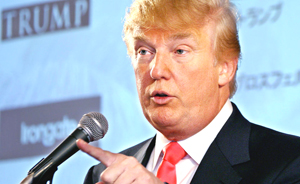
Washington, Jun 23: After five months without a U.S. number one in India, Donald Trump appears to have finally chosen the next ambassador to the subcontinent. Kenneth Juster, who serves as a top deputy at the National Economic Council in Trump's White House, will likely exert a steadying influence on U.S.-India relations if his nomination goes forward as expected.
Juster is a long-time India hand - he chaired the U.S.-India High Technology Cooperation Group and helped spearhead a major new bilateral initiative under the George W. Bush administration - and with his extensive diplomatic experience, he differs from some of Trump's other ambassadorial picks such as Terry Branstad, the former Iowa governor, or Callista Gingrich, his envoy to the Vatican.
That would be a balm for Indians ahead of Prime Minister Narendra Modi's first meeting with Trump on June 26 in Washington.
"If Ken Juster is named, the Indians will be pleased about that because he is a known quantity," said Tanvi Madan, director of the India Project at the Brookings Institution. "In a time of a lot of uncertainty, his appointment would be a reassurance."
"He's considered an experienced hand with a good relationship in the White House and other agencies that will make him an effective ambassador," said Ronak D. Desai, a U.S.-India relations expert at Harvard University and fellow at New America.
Rumors swirled in May that Juster was out as Trump's G7 chief negotiator amid personal tensions with other White House staff but was under consideration for India ambassador. Confirmation of his apparently likely nomination was reported in the Washington Post on June 21.
The State Department declined to comment.
If Juster is tapped for the post, he'll have to navigate some significant political minefields, in large part thanks to his former boss in the Oval Office. One key sticking point is climate change. Trump angered the entire world when he pulled out of the Paris climate agreement, and went out of his way to jab India in the process.
He falsely claimed India had only signed onto the agreement for billions of dollars in subsidies in a speech on June 1 announcing his withdrawal. "That rubbed India the wrong way," said Desai. India "invested a lot and went out on a ledge" to back the U.S.-brokered Paris climate agreement.
There's more irritants than just Paris. A spate of attacks on Indian-Americans since Trump came into office has also caused consternation in the subcontinent. And modifications to make it harder for highly-skilled workers overseas to get U.S. visas - part of the Trump White House's "America First" plan, which big tech companies don't like - could hit India hard.
But if anything has chafed Modi, he hasn't let it show publicly. "[India] has very studiously avoided criticizing Trump in a manner other world leaders have done in the past four to five months," said Desai.
Some blame the attacks on Indian-Americans on the racially-charged climate Trump churned up on the campaign trail - and he's been silent on the attacks ever since despite growing concerns among Indians and Indian-Americans.
"Given the very real fears of Indian-Americans and the crucial role of the Indian diaspora in U.S.-India relations, Modi can't afford not to bring up this matter," wrote the Wilson Center's Michael Kugelman.
But Trump's overall policy towards India has yet to take shape. Modi and former President Barack Obama enjoyed a strong personal rapport that boosted bilateral relations during his term. The litmus test for Modi's relationship with Trump comes Monday, when they meet for the first time in Washington.
The two leaders are expected to discuss terrorism, trade, and Indo-Pacific security issues, with an eye on China's growing assertiveness in the Indian Ocean, where the United States and India are cooperating more. Trump jarred the world with his rejection of multilateral free trade deals, excoriating China for what he called unfair trade practices that harm American workers.
India has so far avoided similar ire. Last year, trade between the two nations totalled almost $115 billion; the United States imported about $31 billion more from India than it exported. Commerce Secretary Wilbur Ross has previously signalled that the administration is open to discussing a free trade agreement with the world's sixth-largest economy, though there seems to be little momentum in that direction. (India was not a part of the Trans-Pacific Partnership, the 12-nation trade deal Trump pulled out of.)
But unlike China, Saudi Arabia, the Persian Gulf states, and Turkey, India is not a big player on issues like Syria or North Korea - the issues the Trump administration cares most about. That will make Modi work to capture Trump's interest.
"The question will be, what level of attention does India get?" said Madan.

Comments
Add new comment