



U.K. excludes India from relaxed student visa rules

Agencies
June 16, 2018

London, Jun 16: The U.K. government has caused outrage with its decision to exclude Indian students from a new list of countries considered low risk in order to facilitate an easier visa application process to U.K. universities.

In changes to its immigration policy tabled in Parliament on June 15, the U.K. Home Office announced a relaxation of the Tier 4 visa category for overseas students from around 25 countries.

On a list already covering countries like the U.S., Canada and New Zealand, the Home Office has added on the likes of China, Bahrain and Serbia as countries from where students would face reduced checks on educational, financial and English language skill requirements to study at British universities.

The changes, which come into effect on July 6, aim to make it easier for international students to come to study in the U.K.

However, India has been left out of this new expanded list, which means Indian students applying for similar courses will continue to face rigorous checks and documentary requirements.

'Kick in the teeth'
Lord Karan Bilimoria, Indian-origin entrepreneur and president of the U.K. Council for International Student Affairs (UKCISA), described the move as an insult to India and another example of Britain’s economically illiterate and hostile attitude to immigration.

“I consider this another kick in the teeth for India... This sends entirely the wrong message to India, to exclude it from these Tier 4 measures. The government has simply got it wrong, said “Mr. Bilimoria, while welcoming the overall visa relaxation measures introduced by U.K. Home Secretary Sajid Javid.

Mr. Bilimoria, the founder of Cobra Beer and founding-chair of U.K. India Business Council (U.K.IBC), added, “It is completely hypocritical that this is announced at the same time that Britain is talking about doing a post-Brexit Free Trade Agreement (FTA) with India. If this is the way they treat India, they can dream on about an FTA with India.”

“India has always been one of Britain’s closest allies and an emerging global economic superpower. Excluding India from this list is myopically short-sighted and is damaging what has always been a special relationship between our countries,” he said.

NISAU disappointed
The National Indian Students and Alumni Union (NISAU) U.K. also expressed disappointment at India’s exclusion from the list, which it said effectively categorises Indian students as high risk. The representative body for Indian students in the U.K. said it was unfair that Indian students should be treated differently from Chinese or other nationals on the list.

"It is important to note that June 16 announcement makes no change to the process of application for Indian students, but it is the perception of this message among Indian students that worries us. And, this raises another question — will China continue to get even more favourable actions while India gets the rhetoric," questioned Sanam Arora, president of NISAU U.K..

According to latest Office of National Statistics (ONS) data, India is among the top three countries from where overseas students come in to study at U.K. universities, after China and the U.S. While Indian students registered a hike of 30% to hit 15,171 Tier 4 visas last year, the numbers remain a far cry from around 30,000 six years ago.

The latest development will add to growing concern within Indian government circles, given that Ministers and diplomats have repeatedly highlighted the need for a more welcoming immigration regime for Indian students.

Last week, Indian High Commissioner to the U.K., Y.K. Sinha, held a meeting with the U.K.’s minister for universities, Sam Gyimah, during which he once again raised the issue of “smoother and greater student and faculty mobility between the two countries.”

“It is unfortunate that in the last six years we have seen a steep drop [in Indian student numbers]. What should be troubling universities here is that Indian students are now going in much greater numbers to the U.S., Australia — even France and Germany,” Mr. Sinha has said in the past.

Reduced documentation additional 11 countries
The U.K. Home Office said in order to make it easier for students to come and study in the U.K.’s world-leading education sector, it has expanded the list of countries from which students will be able to benefit from a streamlined application process.

Students from an additional 11 countries, including China, will be able to provide a reduced level of documentation when applying for their Tier 4 visa, the Home Office statement notes.

On being asked why India had been omitted from this expanded list, a spokesperson said, “We welcome Indian students who want to come to the U.K. to study at our world-leading educational institutions. We issue more visas to students from India than any other country except China and the USA.”

The Home Office stressed that 90% of Indian students who apply for a U.K. visa get one, a figure up from 86% in 2014 and 83% the year before that.

It added, “In addition, the proportion of Indian students coming to study in the U.K. at a university has increased from around 50% in 2010 to around 90% in 2016. Indian student visa applications are up 30% on last year. We continue to have regular discussions with the Indian government on a range of issues including on visas and U.K. immigration policy,” it said.

Comments

Add new comment

  • Coastaldigest.com reserves the right to delete or block any comments.
  • Coastaldigset.com is not responsible for its readers’ comments.
  • Comments that are abusive, incendiary or irrelevant are strictly prohibited.
  • Please use a genuine email ID and provide your name to avoid reject.
News Network
January 23,2026

modIKERALA.jpg

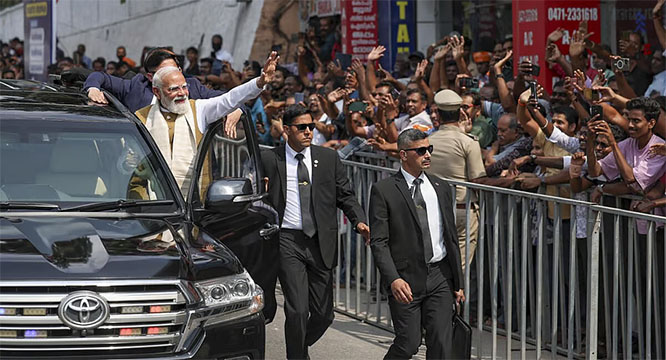
Prime Minister Narendra Modi, during his visit to Thiruvananthapuram on Friday, January 23, indicated that the Bharatiya Janata Party (BJP) is aiming to expand its political footprint in Kerala ahead of the Assembly elections scheduled in the coming months.

Speaking at a BJP-organised public meeting, Modi drew parallels between the party’s early electoral gains in Gujarat and its recent victory in the Thiruvananthapuram Municipal Corporation. The civic body win, which ended decades of Left control, was cited by the Prime Minister as a possible starting point for the party’s broader ambitions in the state.

Recalling BJP’s political trajectory in Gujarat, Modi said the party was largely insignificant before 1987 and received little media attention. He pointed out that the BJP’s first major breakthrough came with its victory in the Ahmedabad Municipal Corporation that year.

“Just as our journey in Gujarat began with one city, Kerala’s journey has also started with a single city,” Modi said, suggesting that the party’s municipal-level success could translate into wider electoral acceptance.

The Prime Minister alleged that successive governments led by the Left Democratic Front (LDF) and the United Democratic Front (UDF) had failed to adequately develop Thiruvananthapuram. He accused both fronts of corruption and neglect, claiming that basic infrastructure and facilities were denied to the capital city for decades.

According to Modi, the BJP’s control of the civic body represents a shift driven by public dissatisfaction with the existing political alternatives. He asserted that the BJP administration in Thiruvananthapuram had begun working towards development, though no specific details or timelines were outlined.

Addressing the gathering at Putharikandam Maidan, Modi said the BJP intended to project Thiruvananthapuram as a “model city,” reiterating his party’s commitment to governance-led change.

The Prime Minister’s visit to Kerala also included the inauguration of several development projects and the flagging off of new train services, as the BJP intensifies its political outreach in the poll-bound state.

Comments

Add new comment

  • Coastaldigest.com reserves the right to delete or block any comments.
  • Coastaldigset.com is not responsible for its readers’ comments.
  • Comments that are abusive, incendiary or irrelevant are strictly prohibited.
  • Please use a genuine email ID and provide your name to avoid reject.
News Network
January 23,2026

Karnataka Governor Thaawarchand Gehlot read only three lines from the 122-paragraph address prepared by the Congress-led state government while addressing the joint session of the Legislature on Thursday, effectively bypassing large sections critical of the BJP-led Union government.

The omitted portions of the customary Governor’s address outlined what the state government described as a “suppressive situation in economic and policy matters” under India’s federal framework. The speech also sharply criticised the Centre’s move to replace the Mahatma Gandhi National Rural Employment Guarantee Act (MGNREGA) with the Viksit Bharat–Guarantee for Rozgar and Ajeevika Mission (Gramin) Act, commonly referred to as the VB-GRAM (G) Act.

Governor Gehlot had earlier conveyed his objection to several paragraphs that were explicitly critical of the Union government. On Thursday, he confined himself to the opening lines — “I extend a warm welcome to all of you to the joint session of the State legislature. I am extremely pleased to address this august House” — before jumping directly to the concluding sentence of the final paragraph.

He ended the address by reading the last line of paragraph 122: “Overall, my government is firmly committed to doubling the pace of the State’s economic, social and physical development. Jai Hind — Jai Karnataka.”

According to the prepared speech, the Karnataka government demanded the scrapping of the VB-GRAM (G) Act, describing it as “contractor-centric” and detrimental to rural livelihoods, and called for the full restoration of MGNREGA. The state government argued that the new law undermines decentralisation, weakens labour protections, and centralises decision-making in violation of constitutional norms.

Key points from the unread sections of the speech:

•    Karnataka facing a “suppressive” economic and policy environment within the federal system

•    Repeal of MGNREGA described as a blow to rural livelihoods

•    VB-GRAM (G) Act accused of protecting corporate and contractor interests

•    New law alleged to weaken decentralised governance

•    Decision-making said to be imposed by the Centre without consulting states

•    Rights of Adivasis, women, backward classes and agrarian communities curtailed

•    Labourers allegedly placed under contractor control

•    States facing mounting fiscal stress due to central policies

•    VB-GRAM (G) Act accused of enabling large-scale corruption

Comments

Add new comment

  • Coastaldigest.com reserves the right to delete or block any comments.
  • Coastaldigset.com is not responsible for its readers’ comments.
  • Comments that are abusive, incendiary or irrelevant are strictly prohibited.
  • Please use a genuine email ID and provide your name to avoid reject.
News Network
February 1,2026

Bengaluru, Feb 1: For travelers landing at Kempegowda International Airport (KIA), the sleek, wood-paneled curves of Terminal 2 promise a world-class welcome. But the famed “Garden City” charm quickly withers at the curb. As India’s aviation sector swells to record numbers—handling over 43 million passengers in Bengaluru alone this past year—the “last mile” has turned into a marathon of frustration.

The Bengaluru Logjam: Rules vs Reality

While the city awaits the 2027 completion of the Namma Metro Blue Line, the interim has been chaotic. Recent “decongestion” rules at Terminal 1 have pushed app-based cab pickups to distant parking zones, forcing weary passengers into a 20-minute walk with luggage.

“I landed after ten months away and felt like a stranger in my own city,” says Ruchitha Jain, a Koramangala resident. “My driver couldn’t find me, staff couldn’t guide me, and the so-called ‘Premium’ lane is just a fancy tax on convenience.”

•    The Cost of Distance: A 40-km cab ride can now easily cross ₹1,500, driven by demand pricing and airport surcharges.

•    The Bus Gap: While Vayu Vajra remains a lifeline, its ₹300–₹400 fare is often cited as the most expensive airport bus service in the country.

A National Pattern of Disconnect

The struggle is not unique to Karnataka. From Chennai’s coast to Hyderabad’s plateau, India’s airports tell a familiar story: brilliant runways, broken exits.

City:    Primary Issue   |    Recent Development

Bengaluru:    Cab pickup restrictions & distance  |    App-based taxis shifted to far parking zones; long walks and fare spikes reported

Chennai:    Multi-Level Parking (MLCP) hike  |    Passengers report 40-minute walks to reach cab pickup points

Hyderabad:    “Taxi mafia” & touting  |    Over 440 touting cases reported; security presence intensified

Mumbai:    Fare scams  |     Tourists charged ₹18,000 for just 400 metres, triggering police action

In Hyderabad, travelers continue to battle entrenched local groups that intimidate Uber and Ola drivers, pushing passengers toward overpriced private taxis. Chennai flyers, meanwhile, complain that reaching the designated pickup zones now takes longer than short-haul flights from cities like Coimbatore.

The ‘Budget Day’ Hope

As Finance Minister Nirmala Sitharaman presents the Union Budget 2026 today, the aviation sector is watching closely. With the government’s renewed emphasis on multimodal integration, there is cautious hope for funding toward seamless airport-metro-bus hubs.

The vision is clear: a future where planes, trains, and metros speak the same language. Until then, passengers at KIA—and airports across India—will continue to discover that the hardest part of flying isn’t the thousands of kilometres in the air, but the last few on the ground.

Comments

Add new comment

  • Coastaldigest.com reserves the right to delete or block any comments.
  • Coastaldigset.com is not responsible for its readers’ comments.
  • Comments that are abusive, incendiary or irrelevant are strictly prohibited.
  • Please use a genuine email ID and provide your name to avoid reject.