



London, Aug 6: Non-EU visitors including Indians arriving in the UK will soon be no longer required to fill the "outdated" landing cards as part of the ongoing digital transformation of border controls, the Home Office has said.
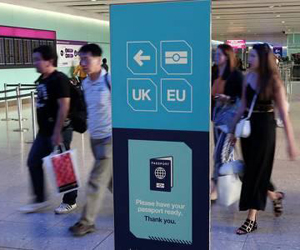
Landing cards are filled out by an estimated 16 million international visitors from outside the European Union (EU), including Indians, annually.
Under proposals published yesterday, the UK Home Office said the paper-based system, which costs the UK public around 3.6 million pounds (USD 4.6 million) each year, will be replaced as part of the UK Border Force's ongoing digital transformation of border controls.
"We are modernising border technology to ensure Border Force staff stop dealing with outdated paperwork and can continue to focus on security and protecting the public," said Immigration Minister Brandon Lewis.
"In addition, this change will improve the experience for arriving passengers so they get an even better welcome when they land in the UK," he said.
The withdrawal of landing cards, filled out by non-EU passengers since 1971, will not result in the loss of any data that is used for security checks, the Home Office said.
All passengers arriving from outside the EU will continue to be checked against the variety of police, security and immigration watch lists which are used to verify the identity and confirm the status of every passenger arriving at the British airports.
The Home Office has launched a four-week consultation with carriers/airlines, ports and those that use statistics gathered from landing card data before it comes into force later this year.
According to the department, the changes are expected to free up staff and enable Border Force to better deploy their resources.
At the same time, the changes will improve the experience for travellers as passengers will no longer need to fill out the paper cards while on board the flight or in queues at airports and ports.
The airports and ports, on the other hand, will no longer have to purchase and distribute them.
It is expected that queue lengths will be shortened and passenger flows improved at British airports, a move welcomed by Heathrow airport, the largest UK hub.
Heathrow CEO John Holland-Kaye said in a statement: "We warmly welcome this proposed change which would give visitors to Britain an improved experience, whilst maintaining a secure border into the UK".
"In post-Brexit Britain, it will be even more important to show we are open for business and make sure that we give investors, tourists and students a great welcome to our country.
"We look forward to continuing to work closely with the new Immigration Minister and Border Force over the coming years to keep improving the passenger experience at the UK's border," Holland-Kaye said.
The proposals have been characterised as part of the Home Office's ongoing transformation at the border which is enhancing Border Force's ability both to facilitate legitimate travel and ensure the security of the border.
"This programme of work has already seen the introduction of 232 e-gates at 21 ports and since June has seen more than a million passengers use them each week. This has enabled Border Force officers to work on other security and intelligence matters," the Home Office said.
The changes are in addition to the ongoing Digital Services at the Border (DSAB) programme, which is modernising technology at the border to improve intelligence gathering on goods and passengers and increase security.
The UK Border Force has also increased the use of Advance Passenger Information, with systems in place to receive data on 100 per cent of scheduled flights for all international journeys to and from the UK.

Comments
Add new comment