US, allies fire over 100 missiles at Syria, many intercepted

Agencies
April 14, 2018

The US and its allies fired more than 100 cruise missiles at Syria, a significant number of which were intercepted by Syrian air defences, the Russian defence ministry said Saturday.

"More than 100 cruise missiles and air-to-land missiles were fired by the US, Britain and France from the sea and air at Syrian military and civilian targets," the ministry said in a statement quoted by RIA Novosti news agency, adding that "a significant number" were shot down by Syrian air defences.

The United States, Britain and France carried out a wave of punitive strikes against Bashar al-Assad's Syrian regime on Saturday in response to alleged chemical weapons attacks that President Donald Trump branded the "crimes of a monster."

As Trump embarked on a White House address to announce the action - taken in defiance of Russia's threat to respond - explosions were heard in the Syrian capital Damascus, signalling a new chapter in a brutal seven-year-old civil war. 

AFP's correspondent in the city said several consecutive blasts were heard at 4:00 am (0100 GMT), followed by the sound of airplanes overhead. Smoke could be seen rising from the northern and eastern edges of the capital.

"A short time ago, I ordered the United States armed forces to launch precision strikes on targets associated with the chemical weapons capabilities of Syrian dictator Bashar al-Assad," Trump said, in a primetime address.

"A combined operation with the armed forces of France and the United Kingdom is now under way. We thank them both," Trump added.

"This massacre was a significant escalation in a pattern of chemical weapons use by that very terrible regime," he said of the suspected deadly gas attack a week ago on the rebel-held Damascus suburb of Douma 

"The evil and the despicable attack left mother and fathers, infants and children thrashing in pain and gasping for air. These are not the actions of a man. They are crimes of a monster instead."

General Joseph Dunford, Washington's top general, said the precision strikes hit three targets - a scientific research center near Damascus, a storage facility and command post also near the capital and a chemical weapons storage facility near Homs. 

He added that Syrian surface to air missile batteries had attempted to fire back, but there were no initial reports of any allied losses.

It was a marked escalation in force compared to a US strike launched a year ago, when only cruise missiles were used against a single airfield.

Dunford said Russia's forces in Syria had been warned through existing "deconfliction" channels that western planes would be in Syrian air space, but that Washington had not revealed the target sites or timing in advance.

Defense Secretary Jim Mattis said no additional strikes were planned unless Assad again uses chemical weapons.

"We were very precise and proportionate, but at the same time, it was a heavy strike," he said.

Trump also warned Russia and Iran not to stand by their ally in Damascus.

"Russia must decide if it will continue down this dark path or if it will join with civilized nations as a force for stability and peace," he argued.

The strikes had been expected since harrowing footage surfaced of the aftermath of the attack in Douma, which prompted a furious reaction from Trump.

Trump's anger and apparent determination was quickly matched by France's President Emmanuel Macron, who signed his country up for a joint response.

?We cannot tolerate the normalization of the use of chemical weapons," Macron said in a statement.

Britain's Prime Minister Theresa May was more cautious, but by the time the first precision cruise missile was launched, Trump had a mini-coalition.

"We cannot allow the use of chemical weapons to become normalized - within Syria, on the streets of the UK, or anywhere else in our world," May said, referring to a recent assassination attempt on a Russian double agent.

In the days between the attack in Douma and the US-led response, Washington and Moscow clashed repeatedly in duelling press statements and US debates.

Trump on Syria attack: 'Very soon or not so soon at all!'

Moscow denied its ally Assad had any role in the outrage, pushing a variety of alternative theories that peaked with a claim that Britain had staged the event.

More practically, at the United Nations, Russia's diplomats vetoed a US motion to re-establish an international investigation into chemical weapons use in Syria that could have established blame.

Washington, Paris and London have nevertheless insisted that their own secret intelligence points to Assad's guilt, and on Friday, a US spokeswoman said they had "proof."

The western leaders apparently found this convincing enough reason to launch a punitive strike, but other observers are concerned that the crisis could escalate.

The Russian military had vowed to respond to any attack, and Russian President Vladimir Putin's administration had repeatedly warned that Trump was taking America down a dangerous path.

After the strikes, Moscow's ambassador to the United States, Anatoly Antonov, said: "We warned that such actions would not be left without consequences."

United Nations Secretary-General Antonio Guterres on Friday had warned the rival camps against "full-blown military escalation" and stressed the need to "avoid the situation spiraling out of control."

Trump has long criticized his predecessor Barack Obama for failing to enforce a previous US "red line" in 2013 after earlier chemical attacks blamed on Assad's forces 

And he set his own precedent just over a year ago when he ordered a cruise missile strike on a Syrian air base after sarin was fired at civilians in the town of Khan Sheikhun.

Backed by his hawkish new national security adviser John Bolton, who took office on Monday, Trump has been meeting with advisors and generals all week to plan.

Mattis had reportedly been arguing for a cautious response that would minimize the risk of the US being dragged deeper into Syria's civil war.

But other advisors wanted to use the opportunity to convince Trump, who wants to pull US forces out of Syria once the Daesh group is defeated, to take a tough stance 

Comments

Add new comment

  • Coastaldigest.com reserves the right to delete or block any comments.
  • Coastaldigset.com is not responsible for its readers’ comments.
  • Comments that are abusive, incendiary or irrelevant are strictly prohibited.
  • Please use a genuine email ID and provide your name to avoid reject.
News Network
January 20,2026

DGP.jpg

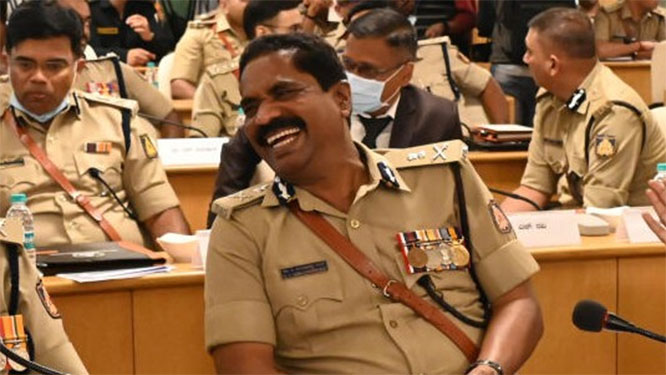
Karnataka DGP (Civil Rights Enforcement) K Ramachandra Rao was suspended with immediate effect, as per a state government order issued on Monday, 19 January. The order cited conduct unbecoming of a government servant and causing embarrassment to the state administration.

The Karnataka government suspended Rao after a purported video showed him in a compromising position with a woman inside his official chamber. The video went viral on social media. Rao rejected the videos outright, terming them "fabricated and false".

Who is K Ramachandra Rao?

Rao is a DGP-rank officer who was heading the Directorate of Civil Rights Enforcement until his suspension. He was promoted to DGP in September 2023 and assumed office in October 2023, the Sunday Guardian reported.

He also served as the Chairman and Managing Director of the Karnataka State Police Housing and Infrastructure Development Corporation Limited.

His stint as the Inspector General of Police (IGP) for the Southern Range was also marred by controversy. In 2014, during a cash seizure near Mysuru’s Yelwal, officials claimed the seized amount was ₹20 lakh, while the accused (Kerala-based merchants) claimed it was around ₹2.27 crore.

Rao, who was present during the seizure, denied all allegations. However, he was transferred soon after.

Allegations of collusion with a businessman surfaced, and a senior police officer was quoted by The Sunday Guardian as saying, “In Rao’s case, the CID has clearly mentioned that there was a great degree of lapse on the part of Rao and a deputy superintendent of police after it was brought to their notice that a few policemen, including a gunman attached to the IGP, were involved in the robbery.”

Rao had denied all wrongdoing in that incident. Despite past controversies, he rose to the state’s top police position, the Sunday Guardian reported.

Ranya Rao’s stepfather

Rao is the stepfather of Kannada actress Harshavardhini Ranya alias Ranya Rao, accused of orchestrating the illegal import of gold worth over ₹12.56 crore from Dubai to India along with two others — businessman Tarun Raju, and jewellery dealer Sahil Jain.

‘Obscene video’ controversy

A viral video showed Rao behaving inappropriately with a woman inside his office while in uniform.

The Karnataka government said in its Monday order that “vide videos and news reports widely broadcast on public news channels and media platforms, it is observed that Dr K Ramachandra Rao has acted in an obscene manner which is unbecoming of a Government Servant and also causing embarrassment to the Government.”

The order said the matter was examined by the state government, which found that the officer's conduct amounted to a violation of Rule 3 of the All India Services (Conduct) Rules, 1968.

The government said it is prima facie satisfied that "it is necessary to place Rao under suspension with immediate effect, pending inquiry".

During the suspension period, Rao will be entitled to subsistence allowance as per Rule 4 of the All India Services (Discipline and Appeal) Rules, 1969.

The order also places restrictions on his movement, stating that during the period of suspension, the officer must not leave headquarters under any circumstances without the written permission of the state government.

Comments

Add new comment

  • Coastaldigest.com reserves the right to delete or block any comments.
  • Coastaldigset.com is not responsible for its readers’ comments.
  • Comments that are abusive, incendiary or irrelevant are strictly prohibited.
  • Please use a genuine email ID and provide your name to avoid reject.
News Network
February 1,2026

US President Donald Trump on Saturday claimed that the government of India led by Prime Minister Narendra Modi has made a deal to buy Venezuelan oil, as opposed to purchasing it from Iran.

"We've already made that deal, the concept of the deal," he told reporters on Air Force One.

Trump had imposed 25% tariffs on countries buying Venezuelan oil, including India, in March 2025. He had also hit India with tariffs for buying Russian oil, saying it was "funding" President Vladimir Putin's war against Ukraine.

Trump has said that the US has taken control of the oil-rich Venezuela after capturing former President Nicolas Maduro in January.

A fleet of 18 ships loaded with crude oil bound for refineries in Texas, Louisiana, and Mississippi in January, the most since December 2024, according to a report by the news agency Bloomberg.

Combined crude deliveries to the US will reach about 2,75,000 barrels a day, more than doubling volumes seen in December last year. Shipments to China, which averaged 4,00,000 barrels a day last year, fell to zero in January.

PM Modi, Venezuelan President Agree To Expand Ties

Prime Minister Narendra Modi and Venezuela's acting President Delcy Rodriguez spoke on Friday and agreed to take the bilateral relations to "new heights" in the years ahead.

It was the first phone call between the two leaders since the capture of Maduro and his wife by the US on January 3.

"Spoke with Acting President of Venezuela, Ms. Delcy Rodriguez. We agreed to further deepen and expand our bilateral partnership in all areas, with a shared vision of taking India-Venezuela relations to new heights in the years ahead," PM Modi said in a post on X.

A statement from Prime Minister Modi's office said the two leaders agreed to further expand and deepen the India-Venezuela partnership in all areas, including trade and investment, energy, digital technology, health, agriculture, and people-to-people ties.

They exchanged views on various regional and global issues of mutual interest and underscored the importance of their close cooperation for the Global South, the statement said.

Rodriguez also said that they discussed partnerships in the fields of agriculture, science and technology, mining, and tourism, as well as the pharmaceutical and automotive industries.

Comments

Add new comment

  • Coastaldigest.com reserves the right to delete or block any comments.
  • Coastaldigset.com is not responsible for its readers’ comments.
  • Comments that are abusive, incendiary or irrelevant are strictly prohibited.
  • Please use a genuine email ID and provide your name to avoid reject.
News Network
January 23,2026

Mangaluru: The Karnataka Government Polytechnic (KPT), Mangaluru, has achieved autonomous status from the All India Council for Technical Education (AICTE), becoming the first government polytechnic in the country to receive such recognition in its 78-year history. The status was granted by AICTE, New Delhi, and subsequently approved by the Karnataka Board of Technical Education in October last year.

Officials said the autonomy was conferred a few months ago. Until recently, AICTE extended autonomous status only to engineering colleges, excluding diploma institutions. However, with a renewed national focus on skill development, several government polytechnics across India have now been granted autonomy.

KPT, the second-largest polytechnic in Karnataka, was established in 1946 with four branches and has since expanded to offer eight diploma programmes, including computer science and polymer technology. The institution is spread across a 19-acre campus.

Ravindra M Keni, the first dean of the institution, told The Times of India that AICTE had proposed autonomous status for polytechnic institutions that are over 25 years old. “Many colleges applied. In the first round, 100 institutions were shortlisted, which was further narrowed down to 15 in the second round. We have already completed one semester after becoming an autonomous institution,” he said. He added that nearly 500 students are admitted annually across eight three-year diploma courses.

Explaining the factors that helped KPT secure autonomy, Keni said the institution has consistently recorded 100 per cent admissions and placements for its graduates. He also noted its strong performance in sports, with the college emerging champions for 12 consecutive years, along with active student participation in NCC and NSS activities.

Autonomous status allows KPT to design industry-oriented curricula, conduct examinations, prepare question papers, and manage academic documentation independently. The institution can also directly collaborate with industries and receive priority funding from AICTE or the Ministry of Education. While academic autonomy has been granted, financial control will continue to rest with the state government.

“There will be separate committees for examinations, question paper setting, boards of studies, and boards of examiners. The institution will now have the freedom to conduct admissions without government notifications and issue its own marks cards,” Keni said, adding that new academic initiatives would be planned after a year of functioning under the autonomous framework.

Comments

Add new comment

  • Coastaldigest.com reserves the right to delete or block any comments.
  • Coastaldigset.com is not responsible for its readers’ comments.
  • Comments that are abusive, incendiary or irrelevant are strictly prohibited.
  • Please use a genuine email ID and provide your name to avoid reject.