



Seattle, Feb 4: A U.S. judge on Friday temporarily blocked President Donald Trump's ban on travelers and immigrants from seven predominantly Muslim countries, siding with two states that urged a nationwide hold on the executive order that has launched legal battles across the country.
“The state has met its burden in demonstrating immediate and irreparable injury,” Robart said.
Trump's order last week sparked protests nationwide and confusion at airports as some travelers were detained. The White House has argued that it will make the country safer.
It wasn't immediately clear what happens next for people who had waited years to receive visas to come to America. The Department of Homeland Security wouldn't comment, but the State Department had previously ordered visas from the seven countries revoked.
Washington became the first state to sue over the order that temporarily bans travel for people from Iran, Iraq, Syria, Sudan, Somalia, Libya and Yemen and suspends the U.S. refugee programme.
State Attorney General Bob Ferguson said the travel ban significantly harms residents and effectively mandates discrimination. Minnesota joined the lawsuit two days later.
After the ruling, Mr. Ferguson said people from the affected countries can now apply for entry to the U.S.
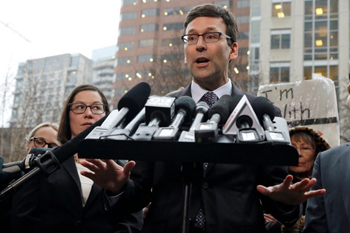
“Judge Robart's decision, effective immediately ... puts a halt to President Trump's unconstitutional and unlawful executive order,” Mr. Ferguson said. “The law is a powerful thing it has the ability to hold everybody accountable to it, and that includes the President of the United States.”
Gillian M. Christensen, a spokeswoman for the Department of Homeland Security, said the agency doesn't comment on pending litigation. The judge's ruling could be appealed the 9th U.S. Circuit Court of Appeals.
Federal attorneys had argued that Congress gave the President authority to make decisions on national security and immigrant entry.
The two states won a temporary restraining order while the court considers the lawsuit, which aims to permanently block Trump's order. Court challenges have been filed nationwide from states and advocacy groups.
In court, Washington Solicitor General Noah Purcell said the focus of the state's legal challenge was the way the President's order targeted Islam.
Mr. Trump has called for a ban on Muslims entering the country, and the travel ban was an effort to make good on that campaign promise, Ms. Purcell told the judge.
“Do you see a distinction between campaign statements and the executive order,” Judge Robart asked. “I think it's a bit of a reach to say the President is anti-Muslim based on what he said in New Hampshire in June.”
Ms. Purcell said there was an “overwhelming amount of evidence” to show that the order was directed at the Muslim religion, which is unconstitutional.
When the judge questioned the federal government's lawyer, Michelle Bennett, he repeatedly questioned the rationale behind the order.
Judge Robart, who was appointed the federal bench by President George W. Bush, asked if there had been any terrorist attacks by people from the seven counties listed in Mr. Trump's order since 9/11. Bennett said she didn't know.
“The answer is none,” Judge Robart said. “You're here arguing we have to protect from these individuals from these countries, and there's no support for that.”
Ms. Bennett argued that the states can't sue on behalf of citizens and the states have failed to show the order is causing irreparable harm.
Judge Robart disagreed.
“The state has met its burden of demonstrating immediate and irreparable injury,” he said. “I find the TRO is in the public interest.”
Up to 60,000 foreigners from the seven majority-Muslim countries had their visas canceled because of the executive order, the State Department said on Friday.
That figure contradicts a statement from a Justice Department lawyer on the same day during a court hearing in Virginia about the ban. The lawyer in that case said about 100,000 visas had been revoked.
The State Department clarified that the higher figure includes diplomatic and other visas that were actually exempted from the travel ban, as well as expired visas.
Mr. Ferguson, a Democrat, said the order is harming Washington residents, businesses and its education system.
Washington-based businesses Amazon, Expedia and Microsoft support the state's efforts to stop the order. They say it's hurting their operations, too.
Lawyers for Washington state said another hearing was expected in the next few weeks.

Comments
Add new comment