



Will not accept any modifications or changes in IWT: Pak

December 17, 2016

Islamabad, Dec 17: Pakistan has said it would not accept any modifications or changes in the Indus Waters Treaty after India strongly pitched for bilateral redressal of differences with it while implementing the 56-year-old accord.
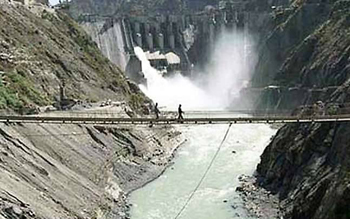
indus
"Pakistan will not accept any modifications or changes to the provisions of the Indus Waters Treaty (IWT). Our position is based on the principles enshrined in the treaty. And the treaty must be honoured in...letter and spirit," Special Assistant to Prime Minister Tariq Fatemi told Dawn News.

His remarks came after India strongly pitched for bilateral redressal of differences with Pakistan while implementing the Indus Waters Treaty. External Affairs Ministry Spokesperson Vikas Swarup had said on Thursday that given the will, there is no reason why the technical design parameters on which Pakistan has raised objections cannot be sorted out by experts from both sides on projects like Kishenganga.

India believes that these consultations should be given adequate time, Swarup had said. However, Dawn reported that India's request for more time alarmed Pakistan. "Islamabad argued that India used the same strategy on previous occasions, completing a project during the dispute and then insisting that since the project was already complete, it could not be modified," the report said.

The treaty, signed in 1960, gives India control over the three eastern rivers of the Indus basin -- the Beas, Ravi and Sutlej -- while Pakistan has the three western rivers -- the Indus, Chenab and Jhelum. The IWT also sets up a mechanism, the Permanent Indus Commission, which includes a commissioner from each country.

The current dispute revolves around the Kishenganga (330 megawatts) and Ratle (850 megawatts) hydroelectric plants. India is building the plants on the Kishanganga and Chenab rivers, which Pakistan claims violates the IWT.

Tensions over the water dispute increased late last month when Prime Minister Narendra Modi threatened to block the flow of waters into Pakistan, the daily said. Both sides had already completed the process proposed in the IWT and approached the World Bank only after the commission declared it "a dispute" as required, experts were quoted as saying.

"Dragging it through an already exhausted process will not help," an expert said. "Pakistan was seeking a court of arbitration because only the proposed court had the authority to consider both legal and technical aspects of the dispute. A neutral expert could only consider the technical aspects," the daily said.

Pakistan argues that the designs of the two Indian projects violate both legal and technical provisions of the treaty. India, however, has opposed Pakistan's efforts for setting up a court of arbitration.

Earlier this week, the World Bank announced pausing of the two separate processes initiated under the IWT to allow the two countries to consider alternative ways to resolve their disagreements.

Comments

Add new comment

  • Coastaldigest.com reserves the right to delete or block any comments.
  • Coastaldigset.com is not responsible for its readers’ comments.
  • Comments that are abusive, incendiary or irrelevant are strictly prohibited.
  • Please use a genuine email ID and provide your name to avoid reject.
Agencies
November 22,2025

indiapak.jpg

New York/Washington: US President Donald Trump has again claimed to have solved the conflict between India and Pakistan, repeating his assertion during a meeting with New York City Mayor-elect Zohran Mamdani in the Oval Office.

Mamdani flew to Washington DC for his first meeting with Trump in the White House on Friday. Trump said he “enjoyed” the meeting, which he described as “great.”

During remarks in the Oval Office, with Mamdani standing next to him, Trump repeated his claim that he solved the May conflict between India and Pakistan.

"I did eight peace deals of countries, including India and Pakistan,” he said.

On Wednesday, Trump had said he threatened to put 350 per cent tariffs on India and Pakistan if they did not end their conflict, repeating his claim that he solved the fighting between the nuclear-armed neighbours and that Prime Minister Narendra Modi had called him to say “we're not going to go to war.”

Since May 10, when Trump announced on social media that India and Pakistan had agreed to a “full and immediate” ceasefire after a “long night” of talks mediated by Washington, he has repeated his claim over 60 times that he “helped settle” the tensions between India and Pakistan.

India has consistently denied any third-party intervention. India launched Operation Sindoor on May 7, targeting terror infrastructure in Pakistan and Pakistan-occupied Kashmir in retaliation for the April 22 Pahalgam attack that killed 26 civilians. India and Pakistan reached an understanding on May 10 to end the conflict after four days of intense cross-border drone and missile strikes.

Mamdani emerged victorious in the closely-watched battle for New York City Mayor, becoming the first South Asian and Muslim to be elected to sit at the helm of the largest city in the US.

He had been the front-runner in the NYC Mayoral election for months and defeated Republican nominee Curtis Sliwa and political heavyweight former New York State Governor Andrew Cuomo, who ran as an independent candidate and was officially endorsed by Trump just hours before the elections.

Indian-descent Mamdani is the son of renowned filmmaker Mira Nair and Columbia University professor Mahmood Mamdani. He was born and raised in Kampala, Uganda and moved to New York City with his family when he was 7. Mamdani became a naturalised US citizen only recently, in 2018.

Comments

Add new comment

  • Coastaldigest.com reserves the right to delete or block any comments.
  • Coastaldigset.com is not responsible for its readers’ comments.
  • Comments that are abusive, incendiary or irrelevant are strictly prohibited.
  • Please use a genuine email ID and provide your name to avoid reject.