



Winnie Mandela, activist ex-wife of Nelson Mandela, dies

Agencies
April 3, 2018

Johannesburg, Apr 3: Winnie Mandela, the former wife of South African anti-apartheid icon Nelson Mandela, died on Monday aged 81, triggering an outpouring of tributes to one of the country's defining and most divisive figures.

The firebrand activist died in a Johannesburg hospital, her family said, adding that she had "fought valiantly against the Apartheid state" and that she was known "far and wide as the Mother of the Nation".

Winnie Mandela, who was married to Nelson Mandela for 38 years, played a high-profile role in the struggle to end white-minority rule, but her place in history was stained by controversy and accusations of violence.

Leading the tributes, Nobel laureate archbishop Desmond Tutu described her as "a defining symbol" of the battle against oppression.

"She refused to be bowed by the imprisonment of her husband, the perpetual harassment of her family by security forces, detentions, bannings and banishment," Tutu said.

"Her courageous defiance was deeply inspirational to me, and to generations of activists."

The statement from her family said that she passed away at the Netcare Milpark hospital in Johannesburg.

"She died after a long illness, for which she had been in and out of hospital since the start of the year. She succumbed peacefully in the early hours of Monday afternoon surrounded by her family and loved ones," it added.

In the ruling African National Congress (ANC), head of policy Jeff Radebe described her as "an icon of the revolutionary struggle".

Newly-appointed President Cyril Ramaphosa announced Tuesday evening that a "national official funeral" would be held on April 14, preceded by a public memorial service on April 11.

Most of Winnie's marriage to Nelson was spent apart, with Nelson imprisoned for 27 years, leaving her to raise their two daughters alone and to keep alive his political dream under the repressive white-minority regime.

But her reputation came under damaging scrutiny in the twilight years of apartheid rule.

In 1986, she was widely linked to "necklacing", when suspected traitors were burnt alive by a petrol-soaked car tyre being put over their head and set alight.

In 1990 the world watched when Nelson Mandela finally walked out of prison -- hand in hand with Winnie.

The following year, she was convicted of kidnapping and assault over the killing of Stompie Moeketsi, a 14-year-old boy.

In 1992, the Mandelas separated, and then divorced in 1996, after a legal wrangle that revealed she had an affair with a young bodyguard.

During her old age, she re-emerged as a respected elder who was feted as a living reminder of the late Mandela -- and of the long and much-storied struggle against apartheid.

Just last month, she was shown in television footage joking with Ramaphosa, who paid a courtesy call to her home in Soweto, the township where she lived for decades.

Dressed in full ANC colours of yellow, black and green, she asked Ramaphosa, who is known for his morning runs, "Why don't you get tired?"

"We can't get tired when you have given us work to do'" he told her.

After her death was announced, Ramaphosa described her as "a voice of defiance and resistance" who "was an abiding symbol of the desire of our people to be free".

"For many years, she bore the brunt of senseless brutality of the apartheid state with stoicism," he said.

"Despite the hardship she faced, she never doubted that the struggle for freedom and democracy would triumph and succeed."

Winnie Mandela often criticised the ANC, but she had expressed support for the current leadership of the party, which her husband led to power in the euphoric post-apartheid elections of 1994.

On Monday evening, Ramaphosa returned to her Soweto house as mourners gathered outside, singing struggle-era songs in tribute and praise.

"In African culture, we sing when we're hurt," ANC Women's League official Winnie Ngwenya, 64, told AFP.

African Commission chairman Moussa Faki Mahamat also paid tribute to Winnie Mandela, saying "the continent and beyond" were in grief at her passing.

She "will forever be remembered as a global icon, a fearless campaigner who sacrificed much of her life for freedom in South Africa and for women everywhere," he said on Twitter.

The SABC state broadcaster said she had attended church in Soweto on Easter Friday before being admitted to hospital complaining of flu. She had also suffered from diabetes for some years.

Suggestions that Winnie remained extremely close to Nelson Mandela in his final years were fuelled in a recent book by his doctor.

Vejay Ramlakan wrote that Winnie -- not Mandela's widow Graca Machel -- was with Mandela when he died in 2013. The book was withdrawn by its publishers under pressure from Mandela's family.

Comments

Add new comment

  • Coastaldigest.com reserves the right to delete or block any comments.
  • Coastaldigset.com is not responsible for its readers’ comments.
  • Comments that are abusive, incendiary or irrelevant are strictly prohibited.
  • Please use a genuine email ID and provide your name to avoid reject.
coastaldigest.com news network
February 5,2026

protestkerala.jpg

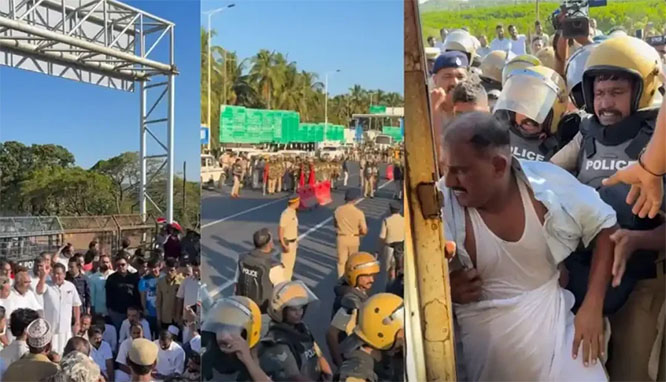
Mangaluru: The KSRTC Mangaluru division has rolled back the fare hike on buses operating on the Mangaluru–Kasaragod route following the suspension of toll collection at the Arikkady toll plaza near Kumbala in Kasaragod district.

The fare revision had been implemented after the National Highways Authority of India (NHAI) began toll collection at the Arikkady plaza on NH-66. As a result, fares for ordinary and Rajahamsa services were increased by ₹7 and ₹10, respectively, raising the bus fare from Mangaluru to Kasaragod from ₹81 to ₹88.

Senior Divisional Controller of KSRTC’s Mangaluru division, Rajesh Shetty, said the fares were reduced after toll collection at the Arikkady plaza was stopped. “The tollgate began operations on January 13, and the toll amount was deducted from the FASTag accounts of KSRTC buses operating on the route. Following an order from the central government to suspend toll collection, KSRTC has also withdrawn the additional fare with immediate effect,” he said.

At present, vehicles travelling on the Mangaluru–Kasaragod route pay toll only at the Talapady toll plaza. The toll for light motor vehicles (LMVs) at Talapady is ₹80 for a same-day return, while heavy vehicles, including buses, are charged ₹250. At Arikkady, the toll rates were ₹130 for LMVs (same-day return) and ₹450 for buses.

Protests against Arikkady toll plaza

The Arikkady toll plaza witnessed widespread protests from January 12, the day toll collection commenced. On the second day, an action committee led by Manjeshwar MLA A K M Ashraf launched an indefinite protest at the site. Except for the BJP, leaders and workers of most major political parties participated in the agitation.

On the night of January 14, a large number of protesters gathered at the plaza and vandalised property, following which authorities temporarily suspended toll operations. The BJP later also expressed opposition to the toll plaza and criticised NHAI’s decision. 

Comments

Add new comment

  • Coastaldigest.com reserves the right to delete or block any comments.
  • Coastaldigset.com is not responsible for its readers’ comments.
  • Comments that are abusive, incendiary or irrelevant are strictly prohibited.
  • Please use a genuine email ID and provide your name to avoid reject.
News Network
February 4,2026

Mangaluru: Urban local bodies and gram panchayats should make the use of Kannada on signboards mandatory while issuing trade licences to commercial establishments, Dakshina Kannada Deputy Commissioner Darshan HV said. He also called for regular inspections to ensure compliance.

Presiding over the District Kannada Awareness Committee meeting at the deputy commissioner’s office, Darshan said the city corporation would be directed to ensure that shops operating in malls prominently display their names in Kannada. “All commercial establishments, including shops, companies, offices and hotels, must mandatorily display their names in Kannada on signboards,” he said.

The deputy commissioner added that the National Highways Authority of India (NHAI) would be instructed to include Kannada on signboards along national highways. Banks, he said, would be directed through committee meetings to provide application forms in Kannada.

“Even if English-medium schools and colleges impart education in English, their signboards must display the institution’s name in Kannada. Steps will also be taken to ensure that private buses display place names in Kannada,” Darshan said.

During the meeting, committee members raised concerns over the closure of Kannada-medium schools in rural areas due to a shortage of teachers and stressed the need for immediate corrective measures. They also pointed out that several industries employ workers from other states while overlooking local candidates.

Members further demanded that nationalised banks provide deposit and withdrawal slips in Kannada. It was brought to the deputy commissioner’s notice that the presence of staff without knowledge of Kannada in rural branches of nationalised banks is causing hardship to local customers.

Meanwhile, MP Srinath, president of the District Kannada Sahitya Parishat, urged the district administration to allot land for the construction of a district Kannada Bhavana in Mangaluru.

Comments

Add new comment

  • Coastaldigest.com reserves the right to delete or block any comments.
  • Coastaldigset.com is not responsible for its readers’ comments.
  • Comments that are abusive, incendiary or irrelevant are strictly prohibited.
  • Please use a genuine email ID and provide your name to avoid reject.
News Network
February 1,2026

Bengaluru, Feb 1: For travelers landing at Kempegowda International Airport (KIA), the sleek, wood-paneled curves of Terminal 2 promise a world-class welcome. But the famed “Garden City” charm quickly withers at the curb. As India’s aviation sector swells to record numbers—handling over 43 million passengers in Bengaluru alone this past year—the “last mile” has turned into a marathon of frustration.

The Bengaluru Logjam: Rules vs Reality

While the city awaits the 2027 completion of the Namma Metro Blue Line, the interim has been chaotic. Recent “decongestion” rules at Terminal 1 have pushed app-based cab pickups to distant parking zones, forcing weary passengers into a 20-minute walk with luggage.

“I landed after ten months away and felt like a stranger in my own city,” says Ruchitha Jain, a Koramangala resident. “My driver couldn’t find me, staff couldn’t guide me, and the so-called ‘Premium’ lane is just a fancy tax on convenience.”

•    The Cost of Distance: A 40-km cab ride can now easily cross ₹1,500, driven by demand pricing and airport surcharges.

•    The Bus Gap: While Vayu Vajra remains a lifeline, its ₹300–₹400 fare is often cited as the most expensive airport bus service in the country.

A National Pattern of Disconnect

The struggle is not unique to Karnataka. From Chennai’s coast to Hyderabad’s plateau, India’s airports tell a familiar story: brilliant runways, broken exits.

City:    Primary Issue   |    Recent Development

Bengaluru:    Cab pickup restrictions & distance  |    App-based taxis shifted to far parking zones; long walks and fare spikes reported

Chennai:    Multi-Level Parking (MLCP) hike  |    Passengers report 40-minute walks to reach cab pickup points

Hyderabad:    “Taxi mafia” & touting  |    Over 440 touting cases reported; security presence intensified

Mumbai:    Fare scams  |     Tourists charged ₹18,000 for just 400 metres, triggering police action

In Hyderabad, travelers continue to battle entrenched local groups that intimidate Uber and Ola drivers, pushing passengers toward overpriced private taxis. Chennai flyers, meanwhile, complain that reaching the designated pickup zones now takes longer than short-haul flights from cities like Coimbatore.

The ‘Budget Day’ Hope

As Finance Minister Nirmala Sitharaman presents the Union Budget 2026 today, the aviation sector is watching closely. With the government’s renewed emphasis on multimodal integration, there is cautious hope for funding toward seamless airport-metro-bus hubs.

The vision is clear: a future where planes, trains, and metros speak the same language. Until then, passengers at KIA—and airports across India—will continue to discover that the hardest part of flying isn’t the thousands of kilometres in the air, but the last few on the ground.

Comments

Add new comment

  • Coastaldigest.com reserves the right to delete or block any comments.
  • Coastaldigset.com is not responsible for its readers’ comments.
  • Comments that are abusive, incendiary or irrelevant are strictly prohibited.
  • Please use a genuine email ID and provide your name to avoid reject.