Xi Jinping is president for life as China parliament ends term limits

Agencies
March 11, 2018

Beijing, Mar 11: China's Xi Jinping on Sunday secured a path to rule indefinitely as Parliament abolished presidential term limits, handing him almost total authority to pursue a vision of transforming the nation into an economic and military superpower.

The move reverses the era of "collective" leadership and orderly succession that was promoted by late paramount leader Deng Xiaoping to ensure stability following the turbulent one-man rule of Communist China's founder Mao Zedong.

The historic constitutional amendment breezed through the rubber-stamp Parliament with 2,958 in favour, two against and three abstentions despite an unusual bout of online criticism that censors have scrambled to extinguish.

Xi stood up first at the imposing Great Hall of the People in Beijing to cast his paper ballot in a red box, as delegates of the National People's Congress applauded after each vote on the constitutional amendment to lift the two five-year term limit for the presidency.

The first constitutional amendment in 14 years had been expected to breeze through the legislature, which has never rejected a Communist Party diktat in its half-century of existence.

"This is the urgent wish of the common people," said Ju Xiuqin, a delegate from northeastern Heilongjiang province, echoing party claims that the amendment had the unanimous support of "the masses".

Xi, 64, has consolidated power since 2012 when he was appointed to the country's top office: general secretary of the Communist Party.

While the position has no term limits, his two predecessors both gave it up after two terms as part of an orderly process established by Deng.

The country's presidency is a largely ceremonial office, but the constitutional limits meant Xi would have had to give it up in 2023.

But with the new amendments, he could now have a lifetime to push his goal of turning China into global economic powerhouse with a "world-class" military by mid-century.

His rise has been accompanied by tighter restrictions on civil society, with the detention of activists and lawyers, and stricter limits on the already heavily controlled internet.

At the same time, he gained a measure of popularity among Chinese people through a relentless crackdown on corruption that has punished more than a million party officials, and sidelined potential rivals.

While attention has focused on the term limits, the amendments also include major provisions that will engrave Xi's eponymous political mantra in the constitution and hand the Communist Party an even larger role in the country's affairs.

In a written report, the head of Parliament's Standing Committee, Zhang Dejiang, said the amendments "will ensure the constitution improves and develops in step with the times and provide a firm constitutional guarantee for upholding and developing socialism with Chinese characteristics in the new era".

The Communist Party says the move merely aligns the presidency with the limit-free titles of party secretary and military chief, claiming "the masses" unanimously called for the removal of term limits.

But the proposal was kept secret until it was revealed in a state media report on February 25, a week before the legislature's opening session.

The party later disclosed that Xi had presided over a meeting of the Politburo in September during which the leadership decided to revise the constitution.

The party then sought proposals and opinions, culminating in a decision in late January to introduce constitutional amendments at the NPC.

"Xi Jinping has presided over so many important projects such as economic reforms and the fight against corruption. There was a consensus that we supported him having more time to finish his work," said Dou Yanli, a delegate from eastern Shandong province.

The surprise move triggered a backlash online, prompting censors to block phrases and words such as "I disagree" and "emperor" and the image of Winnie the Pooh, the cartoon bear to which Xi has been compared.

Activists fear that removing term limits may lead to a further tightening of already strict controls on media, civil society and religion, as Xi tries to impose his highly ideological vision of socialism on every aspect of society.

Beijing-based activist Hu Jia, who says authorities forced him to leave the capital during the congress, called the amendment "illegal".

"Xi asked all people to obey the constitution, and then used the amendment to place himself above it. He used the constitution as the ultimate legal weapon that binds officials.

Comments

Add new comment

  • Coastaldigest.com reserves the right to delete or block any comments.
  • Coastaldigset.com is not responsible for its readers’ comments.
  • Comments that are abusive, incendiary or irrelevant are strictly prohibited.
  • Please use a genuine email ID and provide your name to avoid reject.
News Network
January 23,2026

Karnataka Governor Thaawarchand Gehlot read only three lines from the 122-paragraph address prepared by the Congress-led state government while addressing the joint session of the Legislature on Thursday, effectively bypassing large sections critical of the BJP-led Union government.

The omitted portions of the customary Governor’s address outlined what the state government described as a “suppressive situation in economic and policy matters” under India’s federal framework. The speech also sharply criticised the Centre’s move to replace the Mahatma Gandhi National Rural Employment Guarantee Act (MGNREGA) with the Viksit Bharat–Guarantee for Rozgar and Ajeevika Mission (Gramin) Act, commonly referred to as the VB-GRAM (G) Act.

Governor Gehlot had earlier conveyed his objection to several paragraphs that were explicitly critical of the Union government. On Thursday, he confined himself to the opening lines — “I extend a warm welcome to all of you to the joint session of the State legislature. I am extremely pleased to address this august House” — before jumping directly to the concluding sentence of the final paragraph.

He ended the address by reading the last line of paragraph 122: “Overall, my government is firmly committed to doubling the pace of the State’s economic, social and physical development. Jai Hind — Jai Karnataka.”

According to the prepared speech, the Karnataka government demanded the scrapping of the VB-GRAM (G) Act, describing it as “contractor-centric” and detrimental to rural livelihoods, and called for the full restoration of MGNREGA. The state government argued that the new law undermines decentralisation, weakens labour protections, and centralises decision-making in violation of constitutional norms.

Key points from the unread sections of the speech:

•    Karnataka facing a “suppressive” economic and policy environment within the federal system

•    Repeal of MGNREGA described as a blow to rural livelihoods

•    VB-GRAM (G) Act accused of protecting corporate and contractor interests

•    New law alleged to weaken decentralised governance

•    Decision-making said to be imposed by the Centre without consulting states

•    Rights of Adivasis, women, backward classes and agrarian communities curtailed

•    Labourers allegedly placed under contractor control

•    States facing mounting fiscal stress due to central policies

•    VB-GRAM (G) Act accused of enabling large-scale corruption

Comments

Add new comment

  • Coastaldigest.com reserves the right to delete or block any comments.
  • Coastaldigset.com is not responsible for its readers’ comments.
  • Comments that are abusive, incendiary or irrelevant are strictly prohibited.
  • Please use a genuine email ID and provide your name to avoid reject.
News Network
February 3,2026

wind.jpg

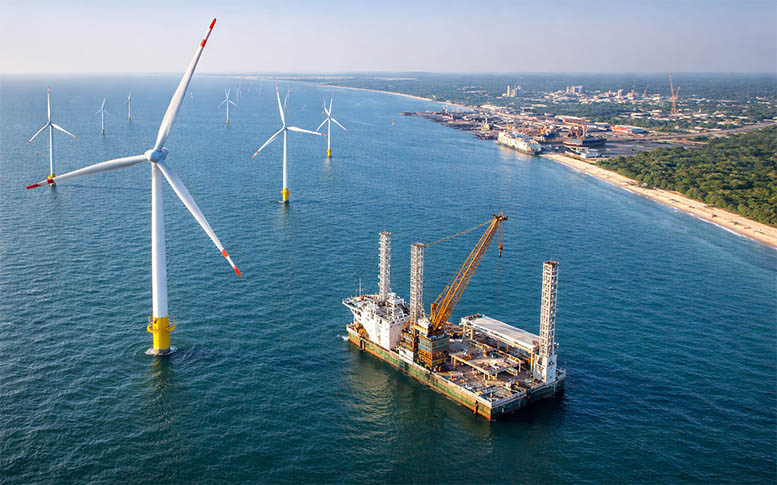
Dakshina Kannada MP Capt Brijesh Chowta has urged the Centre to give high priority to offshore wind energy generation along the Mangaluru coast, citing its strategic importance to India’s green energy and port-led development goals.

Raising the issue in the Lok Sabha under Rule 377, Chowta said studies by the National Institute of Oceanography have identified the Mangaluru coastline as part of India’s promising offshore wind ‘Zone-2’, covering nearly 6,490 sq km. He noted that the region’s relatively low exposure to cyclones and earthquakes makes it suitable for long-term offshore wind projects and called for its development as a dedicated offshore wind energy zone.

Highlighting the role of New Mangalore Port, Chowta said its modern infrastructure, multiple berths and heavy cargo-handling capacity position it well as a logistics hub for transporting and assembling large wind energy equipment.

He also pointed to the presence of major industrial units such as MRPL, OMPL, UPCL and the Mangaluru SEZ, which could serve as direct buyers of green power through power purchase agreements, improving project viability and speeding up execution.

With Karnataka’s peak power demand crossing 18,000 MW in early 2025, Chowta stressed the need to diversify renewable energy sources. He added that offshore wind projects in the Arabian Sea are strategically safer compared to the cyclone-prone Bay of Bengal.

Calling the project vital to India’s target of 500 GW of renewable energy by 2030, Chowta urged the Ministry of New and Renewable Energy to initiate resource assessments, pilot projects and stakeholder consultations at the earliest.

Comments

Add new comment

  • Coastaldigest.com reserves the right to delete or block any comments.
  • Coastaldigset.com is not responsible for its readers’ comments.
  • Comments that are abusive, incendiary or irrelevant are strictly prohibited.
  • Please use a genuine email ID and provide your name to avoid reject.
coastaldigest.com news network
February 5,2026

protestkerala.jpg

Mangaluru: The KSRTC Mangaluru division has rolled back the fare hike on buses operating on the Mangaluru–Kasaragod route following the suspension of toll collection at the Arikkady toll plaza near Kumbala in Kasaragod district.

The fare revision had been implemented after the National Highways Authority of India (NHAI) began toll collection at the Arikkady plaza on NH-66. As a result, fares for ordinary and Rajahamsa services were increased by ₹7 and ₹10, respectively, raising the bus fare from Mangaluru to Kasaragod from ₹81 to ₹88.

Senior Divisional Controller of KSRTC’s Mangaluru division, Rajesh Shetty, said the fares were reduced after toll collection at the Arikkady plaza was stopped. “The tollgate began operations on January 13, and the toll amount was deducted from the FASTag accounts of KSRTC buses operating on the route. Following an order from the central government to suspend toll collection, KSRTC has also withdrawn the additional fare with immediate effect,” he said.

At present, vehicles travelling on the Mangaluru–Kasaragod route pay toll only at the Talapady toll plaza. The toll for light motor vehicles (LMVs) at Talapady is ₹80 for a same-day return, while heavy vehicles, including buses, are charged ₹250. At Arikkady, the toll rates were ₹130 for LMVs (same-day return) and ₹450 for buses.

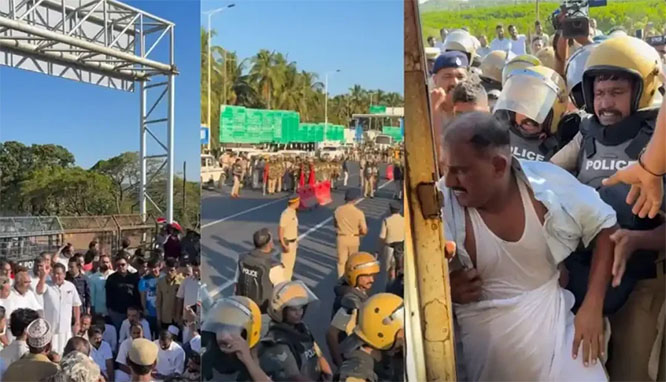
Protests against Arikkady toll plaza

The Arikkady toll plaza witnessed widespread protests from January 12, the day toll collection commenced. On the second day, an action committee led by Manjeshwar MLA A K M Ashraf launched an indefinite protest at the site. Except for the BJP, leaders and workers of most major political parties participated in the agitation.

On the night of January 14, a large number of protesters gathered at the plaza and vandalised property, following which authorities temporarily suspended toll operations. The BJP later also expressed opposition to the toll plaza and criticised NHAI’s decision. 

Comments

Add new comment

  • Coastaldigest.com reserves the right to delete or block any comments.
  • Coastaldigset.com is not responsible for its readers’ comments.
  • Comments that are abusive, incendiary or irrelevant are strictly prohibited.
  • Please use a genuine email ID and provide your name to avoid reject.