



Bulandshahr: Unraveling the anatomy of a riot

Ram Puniyani
December 21, 2018

The scene of violence in the name of emotive issues has been continuously throwing new patterns of instigating and orchestrating violence. In recent times we saw the major violence following the demolition of Babri Mosque (1992), Godhra train burning (Gujarat carnage 2002), murder of a Swami (Kandhamal 2008), on the pretext of love Jihad (Muzzafarnanger 2013) among others. The gross pattern seems to be to spread hatred against sections of society and unleash the hate, which gets converted in to violence. In last couple of years, what has dominated the scene of violence has been the accusations related to slaughter of cows, beginning with horrifying murder of Mohammad Akhlaq down to the killing of Junaid, Cow-beef have been used as a ‘weapon of hate’. In this very series follows the Bulandshahr killings of two men, one of them being a Hindu police officer.

This tragedy goes on to show the underbelly of communal violence, which in due course brings into its orbit not only the religious minorities but people from the majority religion also. As such the violence does not involve much killing of majority community, though they also suffer in small number. In this case, in Bulandshahr, we see the major victim is not only a Hindu but an officer of the state police. While full details are yet to come out with SIT probing, whatever can be gleaned from the media reports is frightening enough.

In beginning of December 2018 a large congregation of Muslims, Ijtema, took place in Bulandshahar. The congregation had participation of Muslims, by rough count of around fifty lakhs. These religious congregations do keep taking place in different parts of the country. Nearly seventy Kilometers away from the place of this congregation, in village Siyana of Bulandshahar, this incidence came to notice. It seems someone had thrown the remains of a slaughtered cow in an agricultural filed. The villagers noticed carcass, reported it to police, which planned to initiate the action as per law. As the carcass was being taken away in the tractor, some 40-50 youth from outside descended on the village and took charge of tractor. As per some reports the beef was thrown in the field by those belonging to Bharatiya Janta Morcha andBajrang dal. Reports by some journalists, report (video) shows that the whole incident was orchestrated by outsiders.

The youth took the tractor to the police station, lodged the FIR and created ruckus. Yogesh Raj, local Chief of Bajrang Dal, who lodged the FIR, was booked as the prime accused in the incident. Various versions are in the air. What followed led to the death of Inspector Subodh Singh in a brutal manner. Sudarshan TV’s, Suresh Chavanhke, the right wing channel close to RSS, tried to link up the violence to the Muslims-Itjema. As per Chavanke’s tweet the violence was indulged in by the Muslims participating in Itjema. This was countered by the police authorities who tweeted that the incident had nothing whatsoever to do with the Itjema, which was at a place far away and was a peaceful event.

Many other theories also started being thrown up. One being that one Jitendra Malik, who is part of Rashtriya Rifles posted in Kashmir, was present on the spot and was the culprit of the violence. His elder brother denied the charge and promised to prove the innocence of his brother. Malik was brought back from his duty in Kashmir, but nothing much seems to have been proven about his complicity. The usual question is who did it? Before that let’s see the very revealing facts related to the Inspector, SHO, who as per his sister was killed in a planned manner. Subodh Singh was the one who had investigated the Mohammad Akhlaq case leading to arrest of many culprits. It is said that it was he “who always took the right stand especially on Hindu-Muslim issues”. Probably he was not letting Hindutva groups to have their divisive ways. The local unit of BJP related organizations had written to the officials demanding transfer of Singh. The other highlights related to the incident are mixed, disturbing and appreciable both types. One is that many of those who had come to attend Ijtema were sheltered in the Shiva Temple. SHO Singh’s teenager son appealed for peace and harmony in the area. He said "I would appeal to the entire country, please stop Hindu-Muslim violence. People get violent at the slightest provocation. People should understand and think that they are bound by the law." In response the DSP in a moving face book post stated “I salute Abhishek who even after losing his father is not speaking the language of hatred and violence,”

 On the other side the Chief minister of UP, Mr. Adityanath, in the aftermath of this tragedy commented that incidents related to Cow slaughter are increasing and need to be curbed. This ‘Cow-Primacy’ got reflected in the statement of BJP MP who advised the investigating team to examine whether SHO came under attack as he failed to check the cow slaughters and cow smuggling! The murder of Singh a serving police official is relegated to second place in Yogi-BJP scheme of things. These are disturbing signs of times where the politics is being dictated by Modi-Yogi, in which emotive issues are taking precedence over human lives, which does not disturb them so far as these serve their political agenda of polarization!

Meanwhile the sense of insecurity is reigning supreme in the village, where the incident took place. The villagers who repeatedly affirmed that their village had braved all the communal incidents like Babri Demolition violence Muzzafarnagar violence, etc. is now fearing for their safety, feeling insecure in the places where they have been living in peace in decades.

In the trajectory of patterns of violence, Bulanshahr is yet another pattern of probably a planned violence, where the major victim can be from majority community itself; yet another victim of cow politics!

Comments

Add new comment

  • Coastaldigest.com reserves the right to delete or block any comments.
  • Coastaldigset.com is not responsible for its readers’ comments.
  • Comments that are abusive, incendiary or irrelevant are strictly prohibited.
  • Please use a genuine email ID and provide your name to avoid reject.
coastaldigest.com news network
January 19,2026

rizwanzameer.jpg

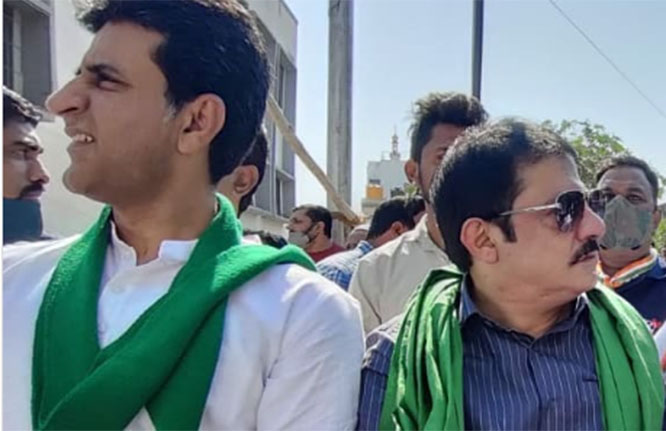
Bengaluru: As the dust settles on the recent legislative session, the corridors of Vidhana Soudha are buzzing with more than just policy talk. A high-stakes game of political musical chairs has begun, exposing a deepening rift within the Congress party’s Muslim leadership as a major Cabinet reshuffle looms.

With the party hierarchy signaling a "50% refresh" to gear up for the 2028 Assembly elections, the race to fill three projected Muslim ministerial berths has transformed from a strategic discussion into an all-out turf war.

The "Star Son" Spark

The internal friction turned public this week following provocative remarks by Zaid Khan, actor and son of Wakf Minister Zameer Ahmed Khan. Zaid’s claim—that his father "helped" secure a ticket for Shivajinagar MLA Rizwan Arshad in 2023—has acted as a lightning rod for resentment.

Rizwan’s camp was quick to fire back, dismissing the comment as a desperate attempt by Zameer to manufacture seniority. "Rizwan’s political pedigree was forged in the NSUI and Youth Congress long before Zameer even stepped into the party," a supporter noted, highlighting Rizwan’s tenure as an AICC secretary and his two-term presidency of the State Youth Congress.

A Tale of Two Loyalists

While both Zameer Ahmed Khan and Rizwan Arshad are staunch allies of Chief Minister Siddaramaiah and represent Bengaluru strongholds, their political DNA could not be more different:

•    Zameer Ahmed Khan: A four-time MLA who crossed over from JD(S) in 2018. Known for his "overzealous" and often polarizing outreach during communal flashpoints—from the DJ Halli riots to the recent Wakf land notice controversy—his style has frequently left the Congress high command in a state of "discomfort."

•    Rizwan Arshad: A homegrown organizational man. Seen as a "quiet performer," Arshad represents the sophisticated, moderate face of the party, preferred by those who find Zameer’s brand of politics too volatile.

The Outsiders Looking In

The bickering isn't limited to a duo. The "Beary" community, represented by leaders like N A Haris and Saleem Ahmed, is demanding its pound of flesh. Saleem Ahmed, the Chief Whip in the Legislative Council, has dropped the veil of diplomacy, openly declaring his ministerial aspirations.

"I was the only working president not included in the Cabinet last time," Saleem noted pointedly, signaling that the "loyalty quota" is no longer enough to keep the peace.

As Chief Minister Siddaramaiah prepares to finalize the list, he faces a delicate balancing act: rewarding the aggressive grassroots mobilization of Zameer’s camp without alienating the organizational stalwarts and minority sub-sects who feel increasingly sidelined by the "Chamarajpet-Shivajinagar" binary.

Comments

Add new comment

  • Coastaldigest.com reserves the right to delete or block any comments.
  • Coastaldigset.com is not responsible for its readers’ comments.
  • Comments that are abusive, incendiary or irrelevant are strictly prohibited.
  • Please use a genuine email ID and provide your name to avoid reject.
News Network
January 16,2026

Mangaluru: Mangaluru’s skyline is set for a high-end transformation as the coastal district of Dakshina Kannada prepares to shed its reputation for lacking premium hospitality. In a massive show of confidence, entrepreneurs have committed nearly ₹500 crores toward the construction of four new five-star hotels, a move experts say will finally plug the "luxury leak" to neighboring states.

For years, Mangaluru International Airport (MIA) has served as a gateway for high-net-worth travelers who, upon landing, promptly departed for Kerala or Kodagu due to a dearth of elite accommodation in the city. These new projects, three of which are backed by local visionary investors, aim to turn Mangaluru into a destination rather than just a transit point.

Mapping the Luxury Boom

The expansion is already in motion, with two major landmarks leading the charge:
•    Gurupura Property: Construction is already underway on a premier resort-style hotel.
•    Kuloor Hub: A sophisticated urban luxury hotel has been proposed for this strategic area.
•    Timeline: All four projects are slated for completion within the next 24 months, promising to fundamentally alter the region's tourism profile by 2028.

Why Now? The Investor Demand

The push for five-star infrastructure isn't just about tourism; it’s a direct response to the city’s industrial and academic evolution. Stakeholders from the IT and corporate sectors have long flagged the lack of premium suites as a hurdle for international business investments.

"Mangaluru is an powerhouse of mega-industries, medical excellence, and a burgeoning IT scene," noted a senior Tourism Department official. "It is an anomaly that a city with this much economic muscle has lacked a five-star anchor. By offering premium hospitality, we aren't just housing tourists; we are inviting global investors to stay, engage, and invest more deeply in our coast."

Strategic Retention

The "drain" of visitors to the neighboring state of Kerala has been a long-standing grievance for local businesses. With these new properties, the district administration expects a significant multiplier effect—benefiting local sightseeing, high-end retail, and the burgeoning medical tourism sector. As Mangaluru accelerates on its development trajectory, the message to the world is clear: the coast is finally ready to host you in style.

Comments

Add new comment

  • Coastaldigest.com reserves the right to delete or block any comments.
  • Coastaldigset.com is not responsible for its readers’ comments.
  • Comments that are abusive, incendiary or irrelevant are strictly prohibited.
  • Please use a genuine email ID and provide your name to avoid reject.