



China questions exclusion from Indo-Pacific group of India, US, Japan and Australia

Agencies
November 13, 2017

Beijing, Nov 13: Skirting any direct response to the first quadrilateral meeting of India, US, Japan and Australia, China on Monday questioned its exclusion from the group.

At the same time, it expressed hope that the new concept of 'Indo-Pacific' is not directed against it.

"The relevant proposals should be open and inclusive and should be conducive to win-win cooperation and avoid politicising or excluding the relevant parties," Chinese Foreign Ministry spokesman Geng Shuang said at a media briefing.

He was answering a spate of questions on the Indo-Pacific concept and the quadrilateral meeting held yesterday in Manila.

Asked whether he meant "exclusion of the relevant parties" referred to omission of China, Geng said China welcomes the development of friendly cooperation between relevant countries.

"We hope this kind of relations will not be directed at a third party and conducive to the regional peace and stability. This is the general concept and I think this kind of position applies to any proposal," he said, PTI reported.

Responding to a question about persistent references of Indo-Pacific by the US and Japan saying that they want to establish leaders' dialogue mechanism between India, US, Japan and Australia and Tokyo's willingness to conduct cooperation with China under the new concept, Geng said China has noted the Japanese statement in this regard.

"Promoting the stability and the development of the Asia Pacific region is the common responsibility of the regional countries. We hope the policies made and the action taken by the relevant parties can correspond with the trend of times featuring, peace, cooperation, friendship and development and can be conducive to upholding peace, prosperity and stability," he said.

Asked how China viewed the Indo-Pacific concept, Geng said peace and win-win cooperation is the trend of the times.

"It is also the trend of the world. The development of Any country, any region should correspond with the trend of the times and trend of the world," he said.

Officials from India, the US, Japan, and Australia on Sunday held extensive talks to pursue common interests in the strategically important Indo-Pacific region.

In the meeting, seen as the first major move in the formation of the quadrilateral security dialogue or 'quad', the officials deliberated on evolving security scenario in the Indo-Pacific region besides delving into effectively combating the threat of terrorism and other security challenges.

The Ministry of External Affairs (MEA) said in a statement that the consultations were held on issues of common interest in the Indo-Pacific region with a focus on cooperation based on converging vision and values for the promotion of peace, stability and prosperity in the area.

Following is the full statement by the MEA:

"Officials from India’s Ministry of External Affairs, Australia’s Department of Foreign Affairs, Japan’s Ministry of Foreign Affairs and United State’s Department of State met in Manila on November 12, 2017 for consultations on issues of common interest in the Indo-Pacific region. The discussions focused on cooperation based on their converging vision and values for promotion of peace, stability and prosperity in an increasingly inter-connected region that they share with each other and with other partners. They agreed that a free, open, prosperous and inclusive Indo-Pacific region serves the long-term interests of all countries in the region and of the world at large. The officials also exchanged views on addressing common challenges of terrorism and proliferation linkages impacting the region as well as on enhancing connectivity. The Indian side highlighted India’s Act East Policy as the cornerstone of its engagement in the Indo-Pacific region."

The move is seen as counter to China's aggressive behaviour in the area.

Meanwhile, a senior White House official had said earlier that "we have strong and growing ties with India. We talk about 'Indo- Pacific' in part because that phrase captures the importance of India's rise".

And the strategy is "certainly not" to contain China, he had added.

Indo-Pacific broadly refers to the Indian Ocean and Pacific Ocean regions, which also includes the disputed South China Sea where Vietnam, Malaysia, the Philippines, and Brunei question China's claims over almost the entire waterway.

The Indo-Pacific concept has figured prominently during the recent visit by President Donald Trump to the region including to Japan and China.

Comments

Add new comment

  • Coastaldigest.com reserves the right to delete or block any comments.
  • Coastaldigset.com is not responsible for its readers’ comments.
  • Comments that are abusive, incendiary or irrelevant are strictly prohibited.
  • Please use a genuine email ID and provide your name to avoid reject.
coastaldigest.com news network
February 5,2026

protestkerala.jpg

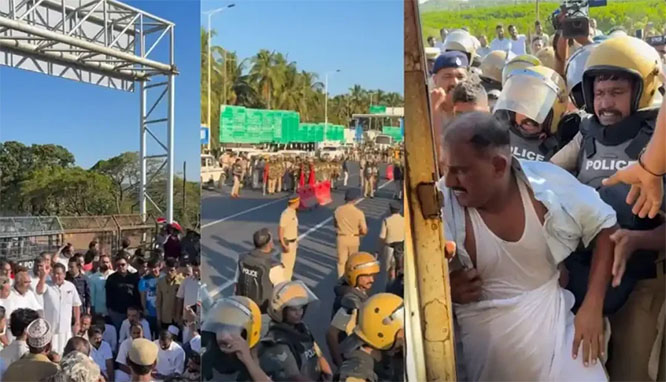
Mangaluru: The KSRTC Mangaluru division has rolled back the fare hike on buses operating on the Mangaluru–Kasaragod route following the suspension of toll collection at the Arikkady toll plaza near Kumbala in Kasaragod district.

The fare revision had been implemented after the National Highways Authority of India (NHAI) began toll collection at the Arikkady plaza on NH-66. As a result, fares for ordinary and Rajahamsa services were increased by ₹7 and ₹10, respectively, raising the bus fare from Mangaluru to Kasaragod from ₹81 to ₹88.

Senior Divisional Controller of KSRTC’s Mangaluru division, Rajesh Shetty, said the fares were reduced after toll collection at the Arikkady plaza was stopped. “The tollgate began operations on January 13, and the toll amount was deducted from the FASTag accounts of KSRTC buses operating on the route. Following an order from the central government to suspend toll collection, KSRTC has also withdrawn the additional fare with immediate effect,” he said.

At present, vehicles travelling on the Mangaluru–Kasaragod route pay toll only at the Talapady toll plaza. The toll for light motor vehicles (LMVs) at Talapady is ₹80 for a same-day return, while heavy vehicles, including buses, are charged ₹250. At Arikkady, the toll rates were ₹130 for LMVs (same-day return) and ₹450 for buses.

Protests against Arikkady toll plaza

The Arikkady toll plaza witnessed widespread protests from January 12, the day toll collection commenced. On the second day, an action committee led by Manjeshwar MLA A K M Ashraf launched an indefinite protest at the site. Except for the BJP, leaders and workers of most major political parties participated in the agitation.

On the night of January 14, a large number of protesters gathered at the plaza and vandalised property, following which authorities temporarily suspended toll operations. The BJP later also expressed opposition to the toll plaza and criticised NHAI’s decision. 

Comments

Add new comment

  • Coastaldigest.com reserves the right to delete or block any comments.
  • Coastaldigset.com is not responsible for its readers’ comments.
  • Comments that are abusive, incendiary or irrelevant are strictly prohibited.
  • Please use a genuine email ID and provide your name to avoid reject.
News Network
January 23,2026

Mangaluru: The Karnataka Government Polytechnic (KPT), Mangaluru, has achieved autonomous status from the All India Council for Technical Education (AICTE), becoming the first government polytechnic in the country to receive such recognition in its 78-year history. The status was granted by AICTE, New Delhi, and subsequently approved by the Karnataka Board of Technical Education in October last year.

Officials said the autonomy was conferred a few months ago. Until recently, AICTE extended autonomous status only to engineering colleges, excluding diploma institutions. However, with a renewed national focus on skill development, several government polytechnics across India have now been granted autonomy.

KPT, the second-largest polytechnic in Karnataka, was established in 1946 with four branches and has since expanded to offer eight diploma programmes, including computer science and polymer technology. The institution is spread across a 19-acre campus.

Ravindra M Keni, the first dean of the institution, told The Times of India that AICTE had proposed autonomous status for polytechnic institutions that are over 25 years old. “Many colleges applied. In the first round, 100 institutions were shortlisted, which was further narrowed down to 15 in the second round. We have already completed one semester after becoming an autonomous institution,” he said. He added that nearly 500 students are admitted annually across eight three-year diploma courses.

Explaining the factors that helped KPT secure autonomy, Keni said the institution has consistently recorded 100 per cent admissions and placements for its graduates. He also noted its strong performance in sports, with the college emerging champions for 12 consecutive years, along with active student participation in NCC and NSS activities.

Autonomous status allows KPT to design industry-oriented curricula, conduct examinations, prepare question papers, and manage academic documentation independently. The institution can also directly collaborate with industries and receive priority funding from AICTE or the Ministry of Education. While academic autonomy has been granted, financial control will continue to rest with the state government.

“There will be separate committees for examinations, question paper setting, boards of studies, and boards of examiners. The institution will now have the freedom to conduct admissions without government notifications and issue its own marks cards,” Keni said, adding that new academic initiatives would be planned after a year of functioning under the autonomous framework.

Comments

Add new comment

  • Coastaldigest.com reserves the right to delete or block any comments.
  • Coastaldigset.com is not responsible for its readers’ comments.
  • Comments that are abusive, incendiary or irrelevant are strictly prohibited.
  • Please use a genuine email ID and provide your name to avoid reject.
News Network
January 23,2026

Karnataka Governor Thaawarchand Gehlot read only three lines from the 122-paragraph address prepared by the Congress-led state government while addressing the joint session of the Legislature on Thursday, effectively bypassing large sections critical of the BJP-led Union government.

The omitted portions of the customary Governor’s address outlined what the state government described as a “suppressive situation in economic and policy matters” under India’s federal framework. The speech also sharply criticised the Centre’s move to replace the Mahatma Gandhi National Rural Employment Guarantee Act (MGNREGA) with the Viksit Bharat–Guarantee for Rozgar and Ajeevika Mission (Gramin) Act, commonly referred to as the VB-GRAM (G) Act.

Governor Gehlot had earlier conveyed his objection to several paragraphs that were explicitly critical of the Union government. On Thursday, he confined himself to the opening lines — “I extend a warm welcome to all of you to the joint session of the State legislature. I am extremely pleased to address this august House” — before jumping directly to the concluding sentence of the final paragraph.

He ended the address by reading the last line of paragraph 122: “Overall, my government is firmly committed to doubling the pace of the State’s economic, social and physical development. Jai Hind — Jai Karnataka.”

According to the prepared speech, the Karnataka government demanded the scrapping of the VB-GRAM (G) Act, describing it as “contractor-centric” and detrimental to rural livelihoods, and called for the full restoration of MGNREGA. The state government argued that the new law undermines decentralisation, weakens labour protections, and centralises decision-making in violation of constitutional norms.

Key points from the unread sections of the speech:

•    Karnataka facing a “suppressive” economic and policy environment within the federal system

•    Repeal of MGNREGA described as a blow to rural livelihoods

•    VB-GRAM (G) Act accused of protecting corporate and contractor interests

•    New law alleged to weaken decentralised governance

•    Decision-making said to be imposed by the Centre without consulting states

•    Rights of Adivasis, women, backward classes and agrarian communities curtailed

•    Labourers allegedly placed under contractor control

•    States facing mounting fiscal stress due to central policies

•    VB-GRAM (G) Act accused of enabling large-scale corruption

Comments

Add new comment

  • Coastaldigest.com reserves the right to delete or block any comments.
  • Coastaldigset.com is not responsible for its readers’ comments.
  • Comments that are abusive, incendiary or irrelevant are strictly prohibited.
  • Please use a genuine email ID and provide your name to avoid reject.