



India, China, Russia refrain from seeking East Jerusalem as Palestine capital

Agencies
December 12, 2017

New Delhi, Dec 12: India, Russia and China on Monday refrained from seeking East Jerusalem as the capital of Palestine after a meeting of foreign ministers from the three countries met in New Delhi.

External Affairs Minister Sushma Swaraj hosted her Russian and Chinese counterparts Sergey Lavrov and Wang Yi for the 15th annual meeting of the Russia-India-China (RIC) in New Delhi.

The joint statement issued after the meeting called for "negotiations aimed at creating an independent, viable, territorially contiguous Palestinian State living side by side in peace and security with Israel within mutually agreed and internationally recognised borders". It, however, did not have any reference to East Jerusalem.

The last RIC joint statement issued after the 14th meeting of the foreign ministers of the three nations in Moscow in April 2016 had categorically called for East Jerusalem to be the capital of the future state of Palestine.

The move by Russia, India and China to drop the reference to East Jerusalem as the capital of Palestine came just days after US President Donald Trump formally recognised the ancient holy city as the capital of Israel.

The US move evoked sharp criticism not only from Arab world, but also from Europe and many other nations. Trump also set in motion a plan to shift the US Embassy from Tel Aviv to Jerusalem.

Moscow has expressed concern over the US move. Russia's ambassador to Israel, Alexander Shein, however, was quoted saying that Moscow had recognised West Jerusalem as the capital of Israel in April this year. He, however, also said that Russia could consider shifting its embassy from Tel Aviv to West Jerusalem after the "Palestinians and the Israelis agree on all issues of the final status" of the territories of Palestine.

China, however, reiterated its support to establishment of an independent sovereign Palestine with East Jerusalem as its capital as recently as last week. "The status of Jerusalem must be determined through dialogue and negotiation on the basis of UN resolutions, and the two-state solution remains a viable, fundamental solution to the Palestinian issue," Wang said in Beijing after the US recognised the ancient city as the capital of Israel.

New Delhi declined to toe the US line on recognising Jerusalem as the capital of Israel and stated that its position on Palestine was "independent and consistent" and shaped by its "views and interests, and not determined by any third country". India, however, refrained from reiterating its long-held view that eastern part of the holy city should be the capital of Palestine.

India in fact stopped calling for East Jerusalem to be the capital of Palestine this year. Hosting Palestinian President Mahmoud Abbas in New Delhi in May, Prime Minister Narendra Modi did call for "a sovereign, independent, united and viable Palestine, co-existing peacefully with Israel", but avoided supporting the demand for East Jerusalem to be the capital of Palestine. He carefully avoided referring to it during his visit to Israel in July – the first by a Prime Minister of India, although the two countries had established formal diplomatic relations in 1992. His message on the occasion of International Day of Solidarity with Palestinian People on November 25 last or India's statement to UN General Assembly on November 29 last too did not refer to the call for East Jerusalem to be the capital of Palestine.

The leaders of BRICS (Brazil, Russia, India, China and South Africa) too refrained from calling for East Jerusalem the capital of Palestine when they issued a joint statement after the summit of the five-nation bloc at Xiamen in China in September. The statement issued after the BRICS summit in Goa in October 2016 had reiterated the call for East Jerusalem to be the capital of Palestine.

Comments

Add new comment

  • Coastaldigest.com reserves the right to delete or block any comments.
  • Coastaldigset.com is not responsible for its readers’ comments.
  • Comments that are abusive, incendiary or irrelevant are strictly prohibited.
  • Please use a genuine email ID and provide your name to avoid reject.
News Network
January 23,2026

modIKERALA.jpg

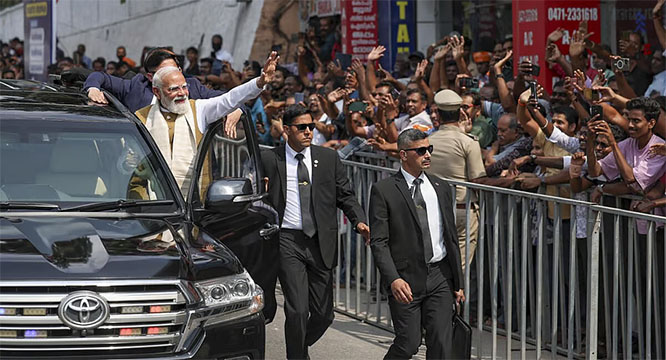
Prime Minister Narendra Modi, during his visit to Thiruvananthapuram on Friday, January 23, indicated that the Bharatiya Janata Party (BJP) is aiming to expand its political footprint in Kerala ahead of the Assembly elections scheduled in the coming months.

Speaking at a BJP-organised public meeting, Modi drew parallels between the party’s early electoral gains in Gujarat and its recent victory in the Thiruvananthapuram Municipal Corporation. The civic body win, which ended decades of Left control, was cited by the Prime Minister as a possible starting point for the party’s broader ambitions in the state.

Recalling BJP’s political trajectory in Gujarat, Modi said the party was largely insignificant before 1987 and received little media attention. He pointed out that the BJP’s first major breakthrough came with its victory in the Ahmedabad Municipal Corporation that year.

“Just as our journey in Gujarat began with one city, Kerala’s journey has also started with a single city,” Modi said, suggesting that the party’s municipal-level success could translate into wider electoral acceptance.

The Prime Minister alleged that successive governments led by the Left Democratic Front (LDF) and the United Democratic Front (UDF) had failed to adequately develop Thiruvananthapuram. He accused both fronts of corruption and neglect, claiming that basic infrastructure and facilities were denied to the capital city for decades.

According to Modi, the BJP’s control of the civic body represents a shift driven by public dissatisfaction with the existing political alternatives. He asserted that the BJP administration in Thiruvananthapuram had begun working towards development, though no specific details or timelines were outlined.

Addressing the gathering at Putharikandam Maidan, Modi said the BJP intended to project Thiruvananthapuram as a “model city,” reiterating his party’s commitment to governance-led change.

The Prime Minister’s visit to Kerala also included the inauguration of several development projects and the flagging off of new train services, as the BJP intensifies its political outreach in the poll-bound state.

Comments

Add new comment

  • Coastaldigest.com reserves the right to delete or block any comments.
  • Coastaldigset.com is not responsible for its readers’ comments.
  • Comments that are abusive, incendiary or irrelevant are strictly prohibited.
  • Please use a genuine email ID and provide your name to avoid reject.
News Network
February 5,2026

In an era where digital distractions are the primary rival to academic excellence, the Karnataka Education Department is taking the fight directly to the living room. As the SSLC (Class 10) annual examinations loom, officials have launched a localized "digital strike" to ensure students aren't losing their competitive edge to scrolling or soap operas.

The 7-to-9 Lockdown

The department has issued a formal directive urging—and in some cases, enforcing via home visits—a total blackout of mobile phones and television sets between 7:00 PM and 9:00 PM. This two-hour window is being designated as "sacred study time" across the state until the examinations conclude on April 2.

Key Pillars of the Initiative:

•    Doorstep Advocacy: Teachers are transitioning from classrooms to living rooms, meeting parents to explain the psychological benefits of a distraction-free environment.

•    Parental Accountability: The campaign shifts the burden of discipline from the student to the household, asking parents to lead by example and switch off their own devices.

•    The Timeline: The focus remains sharp on the upcoming exam block, scheduled from March 18 to April 2.

"The objective is simple: uninterrupted focus. We are reclaiming the evening hours for the students, ensuring their environment is as prepared as their minds," stated a senior department official.

Student vs. Reality

While the student community has largely welcomed the "forced focus"—with many admitting they lack the willpower to ignore notifications—the move has sparked a debate on enforceability. Without a "TV Police," the success of this initiative rests entirely on the shoulders of parents and the persuasive power of visiting educators.

Comments

Add new comment

  • Coastaldigest.com reserves the right to delete or block any comments.
  • Coastaldigset.com is not responsible for its readers’ comments.
  • Comments that are abusive, incendiary or irrelevant are strictly prohibited.
  • Please use a genuine email ID and provide your name to avoid reject.
News Network
January 23,2026

oscar.jpg

The Voice of Hind Rajab, inspired by the tragic final moments of a young Palestinian girl killed by Israeli fire in Gaza, has been nominated for an Academy Award in the Best International Feature Film category.

Directed by Tunisian filmmaker Kaouther Ben Hania, the film recounts the true story of five-year-old Hind Rajab, who lost her life in January 2024 while fleeing Israeli bombardment with her family.

The film features the real audio of Hind’s desperate call to the Palestinian Red Crescent Society, where she pleaded for help moments before the vehicle she was in was struck by 355 bullets.

The haunting narrative begins with a brief call made from the besieged Tel al-Hawa neighborhood of Gaza, where gunfire and armored vehicles drowned out every sound.

After witnessing the brutal killing of her family, she made a trembling call, her voice reduced to a whisper as she spoke of the massacre and her unbearable loneliness as the sole survivor.

Premiering at the Venice International Film Festival in September 2025, The Voice of Hind Rajab garnered widespread acclaim, receiving a record-setting 23-minute standing ovation and the Silver Lion Grand Jury Prize, the festival’s second-highest honor.

In her acceptance speech, Ben Hania dedicated the film to humanitarian workers and first responders in Gaza, emphasizing that Hind's voice symbolizes countless civilians affected by war.

She aims to give voice to victims often reduced to mere statistics, highlighting the broader suffering of civilians in war zones.

The film’s Oscar nomination underscores its powerful storytelling and ethical approach to depicting real-life tragedy, making it a crucial piece of contemporary cinema.

It serves not only as a narration of individual tragedy but also as an artistic and documentary response to the silence and censorship that often overshadow West Asian struggles and wars.

Using an innovative method she calls docufiction, Ben Hania bridges unvarnished reality and narrative structure, creating a work that is both artistically valuable and socially impactful.

Born in 1977 in Sidi Bouzid—later the epicenter of the Arab revolution—her background profoundly influenced her worldview and artistic approach.

She is a graduate of the Higher School of Audiovisual Arts of Tunis, Pantheon-Sorbonne University, and La Fémis in Paris, where her studies equipped her with the technical and theoretical tools needed to address complex subjects. 

Comments

Add new comment

  • Coastaldigest.com reserves the right to delete or block any comments.
  • Coastaldigset.com is not responsible for its readers’ comments.
  • Comments that are abusive, incendiary or irrelevant are strictly prohibited.
  • Please use a genuine email ID and provide your name to avoid reject.