



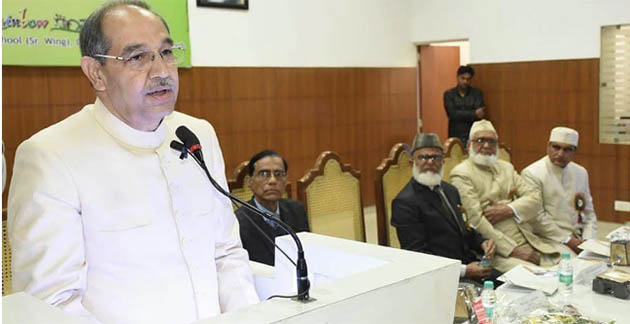
Aligarh Muslim University’s ex Vice-chancellor Tariq Mansoor is BJP’s new Vice President

News Network
July 29, 2023

mansoor.jpg

New Delhi, July 29: In an attempt to strengthen its ongoing outreach among Muslim Pasmanda communities, the BJP on Sunday appointed former Aligarh Muslim University vice-chancellor Tariq Mansoor as one of its vice presidents.

Mr Mansoor was instrumental in steering the AMU, one of the hotbeds of anti-NRC and CAA protests, on a "middle path", and later closely working with the RSS on its project to promote the teachings of Mughal prince Dara Shikoh on peaceful Hindu-Muslim coexistence that was in contradiction to his brother Mughal emperor Aurangzeb's way of working.

The appointment came on a day when Home Minister Amit Shah was in Rameshwaram in Tamil Nadu to launch a book on former president APJ Abdul Kalam, also one of the icons of the party's Pasmanda outreach.

BJP has been continuously reaching out to a section of the Muslim population through Minority Morcha meetings, mostly focused on Pasmanda Muslims, who are from Dalit and other backward class communities. Mr Mansoor was elected to the Uttar Pradesh Legislative Council, the fourth Muslim picked by the BJP for the post in the last few years.

Tariq Mansoor is from Aligarh in Uttar Pradesh, where Muslims constitute roughly 19% of the state's electorate, and have a sizeable presence in at least 30 Lok Sabha seats, out of which they play a major role in deciding the outcome in 15 to 20 constituencies. 

According to an RSS functionary, Mr Mansoor had impressed the sangh's leadership by his work on the Dara Shikoh project, by effectively using the AMU's Persian department to translate much of Shikoh's work on inter-faith dialogue and project him as an ideal for the Muslim community. He organised seminars and conferences on the same.

Mr Mansoor, a surgeon, has been associated with AMU since the 1970s when he completed his MBBS degree in surgery from the university's JN Medical College. He then went on to do his Master of Surgery (MS) degree in 1982 from the same college. Apart from the BJP's focus on the Pasmanda Muslims, which is important in terms of influence, the RSS has been specifically reaching out to Muslim academics, and people of the community from professions such as medicine, law, and bureaucracy, to make a difference in the minority discourse.

Jamal Siddiqui, head of the BJP's Minority Morcha said Mr Mansoor was a "nationalist Muslim" who has always promoted the ideal of "nation first." "His understanding of the fault lines in the Muslim community is as deep as his knowledge about the country and its history. He has led the students of AMU on the right path and prevented them from being misled. His appointment will help the party to expand better."

He was the fourth person from the Muslim community to be promoted to the Legislative Council by the party in UP since 2017, after Bukkal Nawab, Mohsin Raza, and Danish Azad Ansari.

Mr Mansoor was the AMU Vice Chancellor when it witnessed protests against the Citizenship Amendment Act (CAA) and the proposed National Register of Citizens (NRC) in 2020. He was then criticised for "not standing up for students" when policemen allegedly barged into the university, as opposed to the VC of Jamia Millia Islamia in Delhi, who stood by the students. Mr Mansoor has, however, always said he did his best, and talked about the importance of welfare and socio-economic justice over identity issues.

"Mansoor belongs to Aligarh, the hub of Muslim politics, and comes from an educated, middle class family. His family has doctors and lawyers. This is the kind of Muslims we want to work with to take the nation forward," a BJP functionary from UP said.

Khalid Anis Ansari, associate professor from Azim Premji University, who has been actively raising issues pertaining to the community for many years, has often pointed out that Indian Muslims too are victims of caste-based stratification, and are divided into three main classes, and hundreds of biradaris.

The 'Ashraf' Muslims, or native upper caste converts, for instance Syed, Sheikh, Mughal, Pathan, etc are at the top, and the Syed biradari is highly revered. The movements against the Ashraf dominance have been led by the 'lower' ones - Ajlaf (backward Muslims) and Arzal (Dalit Muslims), and these are known as Pasmandas, the community the BJP has been trying to woo. Only 15 percent of the community come from these upper caste communities, while the rest are largely Pasmanda Muslims. The BJP has planned a massive Sneh Yatra to reach out to these Pasmanda Muslims in the coming days.

Muslim intellectuals and opposition parties have, however, said this was an attempt by the BJP to create a divide among the Muslim community, and that often the Muslim victims of hate crimes or economic boycott were Pasmanda themselves.

Comments

Add new comment

  • Coastaldigest.com reserves the right to delete or block any comments.
  • Coastaldigset.com is not responsible for its readers’ comments.
  • Comments that are abusive, incendiary or irrelevant are strictly prohibited.
  • Please use a genuine email ID and provide your name to avoid reject.
News Network
February 1,2026

US President Donald Trump on Saturday claimed that the government of India led by Prime Minister Narendra Modi has made a deal to buy Venezuelan oil, as opposed to purchasing it from Iran.

"We've already made that deal, the concept of the deal," he told reporters on Air Force One.

Trump had imposed 25% tariffs on countries buying Venezuelan oil, including India, in March 2025. He had also hit India with tariffs for buying Russian oil, saying it was "funding" President Vladimir Putin's war against Ukraine.

Trump has said that the US has taken control of the oil-rich Venezuela after capturing former President Nicolas Maduro in January.

A fleet of 18 ships loaded with crude oil bound for refineries in Texas, Louisiana, and Mississippi in January, the most since December 2024, according to a report by the news agency Bloomberg.

Combined crude deliveries to the US will reach about 2,75,000 barrels a day, more than doubling volumes seen in December last year. Shipments to China, which averaged 4,00,000 barrels a day last year, fell to zero in January.

PM Modi, Venezuelan President Agree To Expand Ties

Prime Minister Narendra Modi and Venezuela's acting President Delcy Rodriguez spoke on Friday and agreed to take the bilateral relations to "new heights" in the years ahead.

It was the first phone call between the two leaders since the capture of Maduro and his wife by the US on January 3.

"Spoke with Acting President of Venezuela, Ms. Delcy Rodriguez. We agreed to further deepen and expand our bilateral partnership in all areas, with a shared vision of taking India-Venezuela relations to new heights in the years ahead," PM Modi said in a post on X.

A statement from Prime Minister Modi's office said the two leaders agreed to further expand and deepen the India-Venezuela partnership in all areas, including trade and investment, energy, digital technology, health, agriculture, and people-to-people ties.

They exchanged views on various regional and global issues of mutual interest and underscored the importance of their close cooperation for the Global South, the statement said.

Rodriguez also said that they discussed partnerships in the fields of agriculture, science and technology, mining, and tourism, as well as the pharmaceutical and automotive industries.

Comments

Add new comment

  • Coastaldigest.com reserves the right to delete or block any comments.
  • Coastaldigset.com is not responsible for its readers’ comments.
  • Comments that are abusive, incendiary or irrelevant are strictly prohibited.
  • Please use a genuine email ID and provide your name to avoid reject.
News Network
February 1,2026

Bengaluru, Feb 1: For travelers landing at Kempegowda International Airport (KIA), the sleek, wood-paneled curves of Terminal 2 promise a world-class welcome. But the famed “Garden City” charm quickly withers at the curb. As India’s aviation sector swells to record numbers—handling over 43 million passengers in Bengaluru alone this past year—the “last mile” has turned into a marathon of frustration.

The Bengaluru Logjam: Rules vs Reality

While the city awaits the 2027 completion of the Namma Metro Blue Line, the interim has been chaotic. Recent “decongestion” rules at Terminal 1 have pushed app-based cab pickups to distant parking zones, forcing weary passengers into a 20-minute walk with luggage.

“I landed after ten months away and felt like a stranger in my own city,” says Ruchitha Jain, a Koramangala resident. “My driver couldn’t find me, staff couldn’t guide me, and the so-called ‘Premium’ lane is just a fancy tax on convenience.”

•    The Cost of Distance: A 40-km cab ride can now easily cross ₹1,500, driven by demand pricing and airport surcharges.

•    The Bus Gap: While Vayu Vajra remains a lifeline, its ₹300–₹400 fare is often cited as the most expensive airport bus service in the country.

A National Pattern of Disconnect

The struggle is not unique to Karnataka. From Chennai’s coast to Hyderabad’s plateau, India’s airports tell a familiar story: brilliant runways, broken exits.

City:    Primary Issue   |    Recent Development

Bengaluru:    Cab pickup restrictions & distance  |    App-based taxis shifted to far parking zones; long walks and fare spikes reported

Chennai:    Multi-Level Parking (MLCP) hike  |    Passengers report 40-minute walks to reach cab pickup points

Hyderabad:    “Taxi mafia” & touting  |    Over 440 touting cases reported; security presence intensified

Mumbai:    Fare scams  |     Tourists charged ₹18,000 for just 400 metres, triggering police action

In Hyderabad, travelers continue to battle entrenched local groups that intimidate Uber and Ola drivers, pushing passengers toward overpriced private taxis. Chennai flyers, meanwhile, complain that reaching the designated pickup zones now takes longer than short-haul flights from cities like Coimbatore.

The ‘Budget Day’ Hope

As Finance Minister Nirmala Sitharaman presents the Union Budget 2026 today, the aviation sector is watching closely. With the government’s renewed emphasis on multimodal integration, there is cautious hope for funding toward seamless airport-metro-bus hubs.

The vision is clear: a future where planes, trains, and metros speak the same language. Until then, passengers at KIA—and airports across India—will continue to discover that the hardest part of flying isn’t the thousands of kilometres in the air, but the last few on the ground.

Comments

Add new comment

  • Coastaldigest.com reserves the right to delete or block any comments.
  • Coastaldigset.com is not responsible for its readers’ comments.
  • Comments that are abusive, incendiary or irrelevant are strictly prohibited.
  • Please use a genuine email ID and provide your name to avoid reject.
News Network
February 5,2026

Bengaluru: As air quality continues to worsen across several parts of the city, hospitals in Bengaluru are reporting a steady rise in patients suffering from respiratory illnesses such as asthma, bronchitis and Chronic Obstructive Pulmonary Disease (COPD), health officials and doctors said.

Data from the Suvarna Arogya Suraksha Trust (SAST) shows that 3,891 patients received treatment for respiratory ailments between April and November 2024. The figure rose to 4,187 during the same period in 2025.

Private hospitals, too, are witnessing a 10–15 per cent year-on-year increase in such cases.

While doctors caution that the rise cannot be attributed solely to air pollution, a significant number of patients are non-smokers with no prior history of respiratory disease.

“Nearly 70 per cent of the patients we see are non-smokers with no previous respiratory issues. When other causes are ruled out, air pollution emerges as the most likely factor,” said Dr Manjunath PH, consultant interventional pulmonologist at a hospital in Kengeri.

Doctors noted that patient footfall spikes during the winter months and around Deepavali, when air quality typically worsens.

“There is a clear correlation between poor air quality and the rise in cases. People commonly present with persistent cough, breathlessness and irritation of the respiratory tract, indicating the impact of polluted air on their health,” said Dr Sheetal Chaurasia, consultant in pulmonary medicine at a private hospital in Whitefield.

Dr Chaurasia added that respiratory tract infections are also on the rise.

“Poor air quality leads to chronic airway inflammation, making the airways more vulnerable to infections. We are seeing an increase in both upper and lower respiratory tract infections,” she said.

Patients with pre-existing respiratory conditions remain the worst affected.

“For those already diagnosed with respiratory illnesses, deteriorating air quality significantly worsens the condition. Both the frequency and severity of attacks increase sharply,” said Dr Vandana P, a pulmonologist at a hospital on Bannerghatta Road.

Doctors also flagged a worrying trend of rising respiratory problems among younger adults and children.

To reduce exposure, they advised people to wear masks while travelling on two-wheelers or autos and ensure adequate ventilation at home to minimise indoor air pollution.

Comments

Add new comment

  • Coastaldigest.com reserves the right to delete or block any comments.
  • Coastaldigset.com is not responsible for its readers’ comments.
  • Comments that are abusive, incendiary or irrelevant are strictly prohibited.
  • Please use a genuine email ID and provide your name to avoid reject.