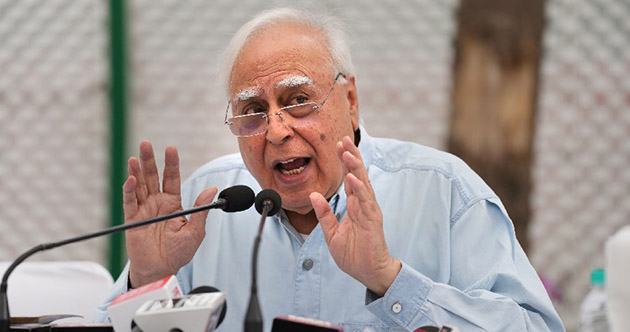
Congress must lead coalition against BJP in 2024: Kapil Sibal

News Network
April 9, 2023

kapilsibal.jpg

The Congress has to be at the centre of any coalition that would take on the BJP in the 2024 general elections and all Opposition parties should be more mindful of sensitivities as well as be circumspect in criticising each other's ideologies in order to build a strong alliance, Rajya Sabha MP Kapil Sibal said on Sunday.

Sibal, a prominent voice in the Opposition ranks, gave a clarion call to all political parties opposed to the BJP-led government to first find a common platform which, he said, could also be his newly-launched 'Insaaf' platform for fighting injustice.

In an interview with PTI, the former Union minister said the leadership question of an Opposition coalition for 2024 need not be answered at this stage and also cited the example of 2004 when the incumbent Atal Bihari Vajpayee government was voted out of power despite the Opposition not having a declared face.

He asserted that the Congress certainly has to be the fulcrum and at the centre of any coalition of Opposition parties that will take on the BJP in 2024.

Asked if the Nationalist Congress Party (NCP) supremo Sharad Pawar's statement backing the Adani Group which is facing allegations jolted Opposition unity, Sibal said, "If you narrow down issues then you will have differences among political parties. If you have a broad collaborative platform which does not deal with narrow issues, the possibility of consensus is much greater."

"If Rahul Gandhi has a point of view in the context of crony capitalism in India, I think Sharad Pawar  ji would not be averse to a platform relating to crony capitalism, that subsumes individuals. So what we need is to have these broad platforms on the basis of which we can ensure that the Opposition is united," he said.

He said the moment issues are narrowed down problems arise and gave the example of parties having different points of view on a particular legislation.

"You should allow different parties to have different views. We should allow Rahul Gandhi to have a view on an individual and Sharad Pawar also have his point of view. That should not be an example of disunity," said Sibal, who was a Union minister during UPA 1 and 2, and quit the Congress in May last year.

Sibal, who was elected to the Rajya Sabha as an Independent member with the Samajwadi Party's support, recently floated a non-electoral platform 'Insaaf' aimed at fighting injustice.

"Opposition unity will come about only when we have a broad consensus and a platform that elucidates broad issues of that consensus," he said.

Sibal said his message to Opposition parties would be that the bottom line is that great injustices – social, economic and political – are being perpetrated in this country by the diktats of this government.

"In fact the entire Constitution is a narrative of how to achieve justice. So, the fight against injustice can be a common platform," he said.

On whether his newly-floated platform could provide what the Opposition needs, Sibal said "could be", but added that a lot of work needs to be done to bring all political parties on that platform.

Asked if it was practical that the Opposition parties of diverse backgrounds come together and cede parliamentary seats to each other to take on the BJP jointly in 2024, Sibal said parties have to be more generous, more circumspect in criticising each other's ideologies and have to realise that wherever they are weak, they should allow the dominant partner to have a say.

On the strengthened Opposition unity during the second half of the budget session especially after the disqualification of Rahul Gandhi from Lok Sabha, Sibal said as far as the joint protests in Parliament are concerned, that by itself is not a reflection of Opposition unity.

"As far as Opposition unity is concerned this is the first step. We need political parties to be more generous to each other and allow space for each other to have their own ideological moorings but at the same time get together to fight a government which is hell bent on silencing the people of India and converting this so-called democracy into an autocratic country," he said.

Sibal said having a common minimum programme for a united Opposition was a "tall order" and it would be decided only a few months before the general elections.

On whether the Adani issue and the caste census be the main planks for the Opposition going forward towards 2024, Sibal said he cannot suggest that as he is just an independent member of Parliament.

"I think the caste census issue is a big issue. It is a big issue in many states, in particular northern India but whether that will be a unifying factor or whether that will be projected as a national issue, I cannot possibly say," he added.

On the Adani matter, Sibal said the issue is not about A, B or C, it is how the state and big conglomerates are collaborating with each other to control resources, media, centres of power and along with that the central agencies.

Rebutting Prime Minister Narendra Modi's charge that the Opposition is coming together as they are afraid of his government's anti-corruption crusade, he asked if the Centre was so concerned about graft why did it not appoint a Lokpal for five years after coming to power.

Why has the Lokpal been inactive and not investigated anybody in government, he asked.

"Is it the premise of our dear prime minister that nobody in government in any BJP-ruled states and in the central government can ever be charged for corruption, and that each one of them is as white as snow," Sibal asked.

He also questioned the prime minister as to why ongoing investigations against those joining the BJP stopped.

"Why is it that the map of India has been divided into two parts, wherever there are BJP-ruled states, the CBI has no access to, while in the Opposition-ruled states, they have complete access," Sibal said.

This narrative of the prime minister is based on a weak premise, he asserted.

Comments

Add new comment

  • Coastaldigest.com reserves the right to delete or block any comments.
  • Coastaldigset.com is not responsible for its readers’ comments.
  • Comments that are abusive, incendiary or irrelevant are strictly prohibited.
  • Please use a genuine email ID and provide your name to avoid reject.
News Network
February 4,2026

gaming.jpg

Ghaziabad: In a tragic incident, three sisters aged 12, 14 and 16 died after jumping from the ninth floor of their apartment in Uttar Pradesh’s Ghaziabad in the early hours of Wednesday. The girls allegedly took the extreme step after becoming deeply obsessed with an online Korean task-based game.

The incident occurred around 2.15 am at a high-rise apartment complex in Bharat City. Before jumping, the sisters — Pakhi (12), Prachi (14) and Vishika (16) — left behind a handwritten note that read, “Sorry, Papa.”

According to police, the girls went to the balcony, bolted the door from inside and jumped one after another. Their screams and the sound alerted their parents, neighbours and security guards. By the time the parents broke open the balcony door, all three had died.

“When we reached the spot, we confirmed that three minor girls, daughters of Chetan Kumar, had died after jumping from the building,” said Assistant Commissioner of Police Atul Kumar Singh.

Visuals from the scene on Wednesday morning showed the bodies lying on the ground, their mother wailing in grief, and stunned neighbours gathering at the complex.

Police said the sisters were heavily influenced by Korean culture and were addicted to an online “Korean love game”, though no specific game has been identified so far. Investigators are examining an eight-page suicide note written in a pocket diary, detailing the girls’ mobile and gaming activities.

“Read everything written in this diary because all of it is true. I’m really sorry. Sorry, Papa,” the note said, accompanied by a hand-drawn crying emoji.

Their father, Chetan Kumar, told police that the girls had even adopted Korean names and had gradually withdrawn from school and daily activities. “They used to say, ‘Korea is our life, Korea is our biggest love. We cannot give it up,’” he said, breaking down.

Police said the parents had recently restricted the girls’ mobile phone usage, which may have triggered distress. “The investigation has not revealed the name of any particular game, but it is evident that the girls were deeply influenced by Korean culture, as mentioned in the suicide note,” said senior police officer Nimish Patel.

The sisters reportedly did everything together, including eating and bathing. Their gaming addiction is believed to have begun during the COVID-19 pandemic, after which they became irregular at school and eventually stopped attending altogether.

Police also revealed that Chetan Kumar is married to two sisters and lives with both wives and their children, all daughters. Two of the deceased girls were daughters of one wife, while the third was their half-sister.

Further investigation is underway.

Comments

Add new comment

  • Coastaldigest.com reserves the right to delete or block any comments.
  • Coastaldigset.com is not responsible for its readers’ comments.
  • Comments that are abusive, incendiary or irrelevant are strictly prohibited.
  • Please use a genuine email ID and provide your name to avoid reject.
News Network
January 23,2026

Mangaluru: The Karnataka Government Polytechnic (KPT), Mangaluru, has achieved autonomous status from the All India Council for Technical Education (AICTE), becoming the first government polytechnic in the country to receive such recognition in its 78-year history. The status was granted by AICTE, New Delhi, and subsequently approved by the Karnataka Board of Technical Education in October last year.

Officials said the autonomy was conferred a few months ago. Until recently, AICTE extended autonomous status only to engineering colleges, excluding diploma institutions. However, with a renewed national focus on skill development, several government polytechnics across India have now been granted autonomy.

KPT, the second-largest polytechnic in Karnataka, was established in 1946 with four branches and has since expanded to offer eight diploma programmes, including computer science and polymer technology. The institution is spread across a 19-acre campus.

Ravindra M Keni, the first dean of the institution, told The Times of India that AICTE had proposed autonomous status for polytechnic institutions that are over 25 years old. “Many colleges applied. In the first round, 100 institutions were shortlisted, which was further narrowed down to 15 in the second round. We have already completed one semester after becoming an autonomous institution,” he said. He added that nearly 500 students are admitted annually across eight three-year diploma courses.

Explaining the factors that helped KPT secure autonomy, Keni said the institution has consistently recorded 100 per cent admissions and placements for its graduates. He also noted its strong performance in sports, with the college emerging champions for 12 consecutive years, along with active student participation in NCC and NSS activities.

Autonomous status allows KPT to design industry-oriented curricula, conduct examinations, prepare question papers, and manage academic documentation independently. The institution can also directly collaborate with industries and receive priority funding from AICTE or the Ministry of Education. While academic autonomy has been granted, financial control will continue to rest with the state government.

“There will be separate committees for examinations, question paper setting, boards of studies, and boards of examiners. The institution will now have the freedom to conduct admissions without government notifications and issue its own marks cards,” Keni said, adding that new academic initiatives would be planned after a year of functioning under the autonomous framework.

Comments

Add new comment

  • Coastaldigest.com reserves the right to delete or block any comments.
  • Coastaldigset.com is not responsible for its readers’ comments.
  • Comments that are abusive, incendiary or irrelevant are strictly prohibited.
  • Please use a genuine email ID and provide your name to avoid reject.
News Network
January 23,2026

oscar.jpg

The Voice of Hind Rajab, inspired by the tragic final moments of a young Palestinian girl killed by Israeli fire in Gaza, has been nominated for an Academy Award in the Best International Feature Film category.

Directed by Tunisian filmmaker Kaouther Ben Hania, the film recounts the true story of five-year-old Hind Rajab, who lost her life in January 2024 while fleeing Israeli bombardment with her family.

The film features the real audio of Hind’s desperate call to the Palestinian Red Crescent Society, where she pleaded for help moments before the vehicle she was in was struck by 355 bullets.

The haunting narrative begins with a brief call made from the besieged Tel al-Hawa neighborhood of Gaza, where gunfire and armored vehicles drowned out every sound.

After witnessing the brutal killing of her family, she made a trembling call, her voice reduced to a whisper as she spoke of the massacre and her unbearable loneliness as the sole survivor.

Premiering at the Venice International Film Festival in September 2025, The Voice of Hind Rajab garnered widespread acclaim, receiving a record-setting 23-minute standing ovation and the Silver Lion Grand Jury Prize, the festival’s second-highest honor.

In her acceptance speech, Ben Hania dedicated the film to humanitarian workers and first responders in Gaza, emphasizing that Hind's voice symbolizes countless civilians affected by war.

She aims to give voice to victims often reduced to mere statistics, highlighting the broader suffering of civilians in war zones.

The film’s Oscar nomination underscores its powerful storytelling and ethical approach to depicting real-life tragedy, making it a crucial piece of contemporary cinema.

It serves not only as a narration of individual tragedy but also as an artistic and documentary response to the silence and censorship that often overshadow West Asian struggles and wars.

Using an innovative method she calls docufiction, Ben Hania bridges unvarnished reality and narrative structure, creating a work that is both artistically valuable and socially impactful.

Born in 1977 in Sidi Bouzid—later the epicenter of the Arab revolution—her background profoundly influenced her worldview and artistic approach.

She is a graduate of the Higher School of Audiovisual Arts of Tunis, Pantheon-Sorbonne University, and La Fémis in Paris, where her studies equipped her with the technical and theoretical tools needed to address complex subjects. 

Comments

Add new comment

  • Coastaldigest.com reserves the right to delete or block any comments.
  • Coastaldigset.com is not responsible for its readers’ comments.
  • Comments that are abusive, incendiary or irrelevant are strictly prohibited.
  • Please use a genuine email ID and provide your name to avoid reject.