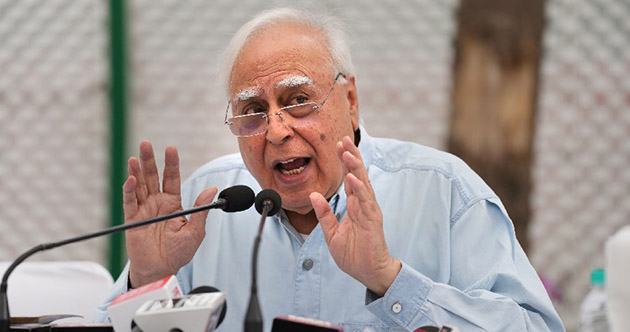
Congress must lead coalition against BJP in 2024: Kapil Sibal

News Network
April 9, 2023

kapilsibal.jpg

The Congress has to be at the centre of any coalition that would take on the BJP in the 2024 general elections and all Opposition parties should be more mindful of sensitivities as well as be circumspect in criticising each other's ideologies in order to build a strong alliance, Rajya Sabha MP Kapil Sibal said on Sunday.

Sibal, a prominent voice in the Opposition ranks, gave a clarion call to all political parties opposed to the BJP-led government to first find a common platform which, he said, could also be his newly-launched 'Insaaf' platform for fighting injustice.

In an interview with PTI, the former Union minister said the leadership question of an Opposition coalition for 2024 need not be answered at this stage and also cited the example of 2004 when the incumbent Atal Bihari Vajpayee government was voted out of power despite the Opposition not having a declared face.

He asserted that the Congress certainly has to be the fulcrum and at the centre of any coalition of Opposition parties that will take on the BJP in 2024.

Asked if the Nationalist Congress Party (NCP) supremo Sharad Pawar's statement backing the Adani Group which is facing allegations jolted Opposition unity, Sibal said, "If you narrow down issues then you will have differences among political parties. If you have a broad collaborative platform which does not deal with narrow issues, the possibility of consensus is much greater."

"If Rahul Gandhi has a point of view in the context of crony capitalism in India, I think Sharad Pawar  ji would not be averse to a platform relating to crony capitalism, that subsumes individuals. So what we need is to have these broad platforms on the basis of which we can ensure that the Opposition is united," he said.

He said the moment issues are narrowed down problems arise and gave the example of parties having different points of view on a particular legislation.

"You should allow different parties to have different views. We should allow Rahul Gandhi to have a view on an individual and Sharad Pawar also have his point of view. That should not be an example of disunity," said Sibal, who was a Union minister during UPA 1 and 2, and quit the Congress in May last year.

Sibal, who was elected to the Rajya Sabha as an Independent member with the Samajwadi Party's support, recently floated a non-electoral platform 'Insaaf' aimed at fighting injustice.

"Opposition unity will come about only when we have a broad consensus and a platform that elucidates broad issues of that consensus," he said.

Sibal said his message to Opposition parties would be that the bottom line is that great injustices – social, economic and political – are being perpetrated in this country by the diktats of this government.

"In fact the entire Constitution is a narrative of how to achieve justice. So, the fight against injustice can be a common platform," he said.

On whether his newly-floated platform could provide what the Opposition needs, Sibal said "could be", but added that a lot of work needs to be done to bring all political parties on that platform.

Asked if it was practical that the Opposition parties of diverse backgrounds come together and cede parliamentary seats to each other to take on the BJP jointly in 2024, Sibal said parties have to be more generous, more circumspect in criticising each other's ideologies and have to realise that wherever they are weak, they should allow the dominant partner to have a say.

On the strengthened Opposition unity during the second half of the budget session especially after the disqualification of Rahul Gandhi from Lok Sabha, Sibal said as far as the joint protests in Parliament are concerned, that by itself is not a reflection of Opposition unity.

"As far as Opposition unity is concerned this is the first step. We need political parties to be more generous to each other and allow space for each other to have their own ideological moorings but at the same time get together to fight a government which is hell bent on silencing the people of India and converting this so-called democracy into an autocratic country," he said.

Sibal said having a common minimum programme for a united Opposition was a "tall order" and it would be decided only a few months before the general elections.

On whether the Adani issue and the caste census be the main planks for the Opposition going forward towards 2024, Sibal said he cannot suggest that as he is just an independent member of Parliament.

"I think the caste census issue is a big issue. It is a big issue in many states, in particular northern India but whether that will be a unifying factor or whether that will be projected as a national issue, I cannot possibly say," he added.

On the Adani matter, Sibal said the issue is not about A, B or C, it is how the state and big conglomerates are collaborating with each other to control resources, media, centres of power and along with that the central agencies.

Rebutting Prime Minister Narendra Modi's charge that the Opposition is coming together as they are afraid of his government's anti-corruption crusade, he asked if the Centre was so concerned about graft why did it not appoint a Lokpal for five years after coming to power.

Why has the Lokpal been inactive and not investigated anybody in government, he asked.

"Is it the premise of our dear prime minister that nobody in government in any BJP-ruled states and in the central government can ever be charged for corruption, and that each one of them is as white as snow," Sibal asked.

He also questioned the prime minister as to why ongoing investigations against those joining the BJP stopped.

"Why is it that the map of India has been divided into two parts, wherever there are BJP-ruled states, the CBI has no access to, while in the Opposition-ruled states, they have complete access," Sibal said.

This narrative of the prime minister is based on a weak premise, he asserted.

Comments

Add new comment

  • Coastaldigest.com reserves the right to delete or block any comments.
  • Coastaldigset.com is not responsible for its readers’ comments.
  • Comments that are abusive, incendiary or irrelevant are strictly prohibited.
  • Please use a genuine email ID and provide your name to avoid reject.
News Network
November 21,2025

israel.jpg

Local authorities say the Israeli military has expanded the so-called “yellow line” truce demarcation in Gaza City and repositioned its forces deeper into the territory in violation of a ceasefire agreement that came into force on October 10, besieging dozens of Palestinian families.

Gaza’s Government Media Office announced in a statement on Thursday that Israeli forces widened the boundary by shifting the markers, and advanced roughly 300 meters (984 feet) into the neighborhoods of Ash-Shaaf, An-Nazzaz and Baghdad Street.

The move pushed further into civilian areas, trapping families who were unable to flee as tanks rolled forward, it added.

“The fate of many of these families remains unknown amidst the shelling that targeted the area,” the office said, adding that the expansion of the yellow line shows a “blatant disregard” for the ceasefire deal.

On Friday, sources said the Israeli military carried out continued air and artillery strikes inside the so-called “yellow line” east of Khan Younis in the southern Gaza Strip.

According to the reports, Israeli warplanes and tanks targeted areas within the zone. One Palestinian was reported killed and several others wounded in the strikes, the sources said.

The fresh aggression came only a day after 25 Palestinians were killed in Israeli airstrikes on Gaza City and Khan Younis on Wednesday.

The media office reported that Israel has consistently violated the truce deal since its implementation last month, with near-daily attacks by air, artillery and direct shootings.

The office said over 400 violations have been documented. These breaches have resulted in the deaths of more than 300 Palestinians and left hundreds injured.

The Government Media Office in Gaza urged the guarantors of the ceasefire — the US, Egypt, Qatar and Turkey — to take swift action to halt the ongoing violations and facilitate the delivery of food, shelter materials, medical aid, and infrastructure equipment.

The so-called “yellow line,” set out in the agreement between Israel and Hamas resistance movement, refers to a non-physical partition where the Israeli military repositioned itself when the truce deal took effect.

It has allowed Israel, which routinely fires at Palestinians who approach the line, to retain control over more than half of the Gaza Strip.

International bodies, including the UN Independent International Commission of Inquiry, the International Association of Genocide Scholars, Amnesty International, Human Rights Watch, B’Tselem, and other rights groups, have concluded that the Israeli war on Gaza amounts to genocide.

In the attacks in Gaza since October 2023, Israel has killed at least 69,546 people and injured 170,833 others, leveling large swaths of the territory and displacing almost all of the population. 

Comments

Add new comment

  • Coastaldigest.com reserves the right to delete or block any comments.
  • Coastaldigset.com is not responsible for its readers’ comments.
  • Comments that are abusive, incendiary or irrelevant are strictly prohibited.
  • Please use a genuine email ID and provide your name to avoid reject.
News Network
December 2,2025

Puttur: The long-cherished dream of a government medical college in Puttur has moved a decisive step closer to reality, with the Karnataka State Finance Department granting its official approval for the construction of a new 300-bed hospital.

Puttur MLA Ashok Kumar Rai announced the crucial development to reporters on Monday, confirming that the official communication from the finance department was issued on November 27. This 300-bed facility is intended to be the cornerstone for the establishment of the government medical college, a project announced in the state budget.

Fast-Track Implementation

The MLA outlined an aggressive timeline for the project:

•    A Detailed Project Report (DPR) for the hospital is expected to be ready within 45 days.

•    The tender process for the construction will be completed within two months.

Following the completion of the tender process, Chief Minister Siddaramaiah is scheduled to lay the foundation stone for the project.

"Setting up a medical college in Puttur is a historical decision by the Congress government in Karnataka," Rai stated. The project has an estimated budget allocation of Rs 1,000 crore for the medical college.

Focus on Medical Education Department

The MLA highlighted a key strategic move: requesting the government to implement the hospital construction through the Medical Education Department instead of the Health and Family Welfare Department. This is intended to streamline the entire process of establishing the full medical college, ensuring the facilities—including labs, operation theatres, and other necessary infrastructure—adhere to the strict guidelines set by the Medical Council of India (MCI). The proposed site for the project is in Bannur.

Rai also took the opportunity to address political criticism, stating that the government has fulfilled its promise despite "apprehensions" and "mocking and criticising" from opposition parties who had failed to take similar initiatives when they were in power. "Chief Minister Siddaramaiah has kept his word," he added.

Comments

Add new comment

  • Coastaldigest.com reserves the right to delete or block any comments.
  • Coastaldigset.com is not responsible for its readers’ comments.
  • Comments that are abusive, incendiary or irrelevant are strictly prohibited.
  • Please use a genuine email ID and provide your name to avoid reject.
News Network
December 4,2025

indigocrisis.jpg

Angry outbursts, long queues, and desperate appeals filled airports across India today as IndiGo grappled with a severe operational breakdown. Hundreds of flights have been cancelled or delayed, leaving thousands of passengers stranded through the night and forcing many to spend long hours at helpdesks.

Social media was flooded with videos of fliers pleading for assistance, accusing the airline of misleading updates, and demanding accommodation after being stuck for 10 to 12 hours at airports such as Hyderabad and Bengaluru.

What Triggered the Meltdown?

IndiGo has attributed the widespread disruption to “a multitude of unforeseen operational challenges.” These include:

•    Minor technology glitches
•    Winter-season schedule adjustments
•    Bad weather
•    Congestion in the aviation network
•    New crew rostering rules (Flight Duty Time Limitations or FDTL)

Among these, the most disruptive has been the implementation of the updated FDTL norms introduced by the Directorate General of Civil Aviation (DGCA) in January 2024.

These rules were designed to reduce pilot fatigue and improve passenger safety. Key changes include:

•    Longer weekly rest periods for flight crew
•    A revised definition of “night,” extending it by an extra hour
•    Tighter caps on flight duty timing and night landings
•    Cutting night shifts for pilots and crew from six per roster cycle to just two

Once these norms became fully enforceable, airlines were required to overhaul rosters well in advance. For IndiGo, this triggered a sudden shortage of crew available for duty, leading to cascading delays and cancellations.

Why IndiGo Was Hit the Hardest

IndiGo is India’s largest airline by a wide margin, operating over 2,200 flights daily. That’s roughly double the number operated by Air India.

When an airline of this size experiences even a 10–20% disruption, it translates to 200–400 flights being delayed or grounded — producing massive spillover effects across the country.

IndiGo also relies heavily on high-frequency overnight operations, a model typical of low-cost carriers that aim to maximise aircraft utilisation and reduce downtime. The stricter FDTL norms clash with these overnight-heavy schedules, forcing the airline to pull back services.

Aviation bodies have also criticised IndiGo’s preparedness. The Airline Pilots' Association of India (ALPA) said airlines were given a two-year window to plan for the new rules but “started preparing rather late.” IndiGo, it said, failed to rebuild crew rosters 15 days in advance as required.

The Federation of Indian Pilots (FIP) went further, calling the crisis the result of IndiGo’s “prolonged and unorthodox lean manpower strategy,” and alleging that the airline adopted a hiring freeze even as it knew the new rules would require more careful staffing.

How Many Flights Are Affected?

In the past 48 hours, over 300 flights have been cancelled. At least 100 more are expected to be cancelled today.

City-wise impact:

•    Hyderabad: 33 expected cancellations; several fliers stranded overnight
•    Bengaluru: over 70 expected cancellations
•    Delhi, Mumbai, Chennai, Kolkata: widespread delays and missed connections

Passengers shared distressing accounts online.

One customer at Hyderabad airport said they waited from 6 PM to 9 AM with “no action taken” regarding their delayed Pune flight. Another said IndiGo repeatedly told them the crew was “arriving soon,” only for the delay to stretch over 12 hours.

IndiGo has apologised for the disruption and promised that operations will stabilise within 48 hours, adding that “calibrated adjustments” are being made to contain the chaos.

What Should Passengers Do Now?

For those flying in the next few days, especially with IndiGo, here are key precautions:

1. Keep Checking Flight Status
Monitor your flight closely before leaving for the airport, as delays may be announced last-minute.

2. Arrive Early
Expect long queues at counters and security due to crowding and rescheduling.

3. Carry Essentials
Pack snacks, water, basic medicines, chargers, and items for children or senior citizens. Extended waiting times should be anticipated.

4. Use Flexible Booking Options
If you booked tickets with a free-date-change or cancellation option, consider using them.
If you haven’t booked yet, prefer refundable or flexible fares, or even consider alternate airlines.

5. Follow IndiGo’s Updates
Keep an eye on IndiGo’s official social media channels and contact customer support for rebooking and refund queries.

What Needs to Change?

Pilot groups have raised concerns not just about staffing but also the planning practices behind it.
The Federation of Indian Pilots accused IndiGo of:

•    Imposing an unexplained hiring freeze despite knowing the FDTL changes were coming
•    Entering non-poaching agreements that limited talent movement
•    Keeping pilot pay frozen
•    Underestimating the need to restructure operations in advance

They have urged DGCA to approve seasonal schedules only after airlines prove they have adequate pilot strength under the new norms.

ALPA also warned that some airlines might be using the delays as an “immature pressure tactic” to push DGCA for relaxations in the new rules — which, if granted, could compromise the very safety standards the norms were meant to protect.

Both pilot bodies stressed that no exemption should dilute safety, and any deviations should be based solely on scientific risk assessment.

Is a Solution in Sight?

While IndiGo says normalcy will return within two days, aviation experts believe that fully stabilising operations could take longer, depending on how quickly the airline can:
•    Re-align rosters
•    Mobilise rested crew
•    Boost staffing
•    Adjust its winter schedule to match regulatory requirements
Passengers are advised to remain prepared for continued delays over the next few days as the airline works through its backlog. 

Comments

Add new comment

  • Coastaldigest.com reserves the right to delete or block any comments.
  • Coastaldigset.com is not responsible for its readers’ comments.
  • Comments that are abusive, incendiary or irrelevant are strictly prohibited.
  • Please use a genuine email ID and provide your name to avoid reject.