



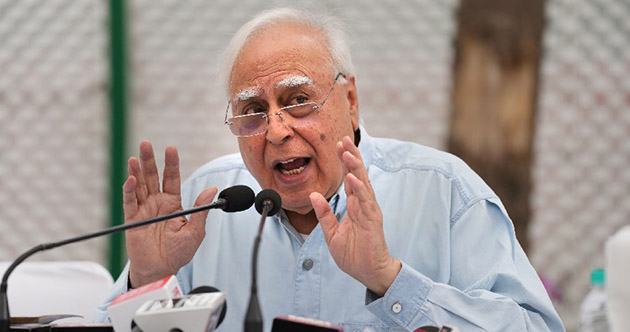
Congress must lead coalition against BJP in 2024: Kapil Sibal

News Network
April 9, 2023

kapilsibal.jpg

The Congress has to be at the centre of any coalition that would take on the BJP in the 2024 general elections and all Opposition parties should be more mindful of sensitivities as well as be circumspect in criticising each other's ideologies in order to build a strong alliance, Rajya Sabha MP Kapil Sibal said on Sunday.

Sibal, a prominent voice in the Opposition ranks, gave a clarion call to all political parties opposed to the BJP-led government to first find a common platform which, he said, could also be his newly-launched 'Insaaf' platform for fighting injustice.

In an interview with PTI, the former Union minister said the leadership question of an Opposition coalition for 2024 need not be answered at this stage and also cited the example of 2004 when the incumbent Atal Bihari Vajpayee government was voted out of power despite the Opposition not having a declared face.

He asserted that the Congress certainly has to be the fulcrum and at the centre of any coalition of Opposition parties that will take on the BJP in 2024.

Asked if the Nationalist Congress Party (NCP) supremo Sharad Pawar's statement backing the Adani Group which is facing allegations jolted Opposition unity, Sibal said, "If you narrow down issues then you will have differences among political parties. If you have a broad collaborative platform which does not deal with narrow issues, the possibility of consensus is much greater."

"If Rahul Gandhi has a point of view in the context of crony capitalism in India, I think Sharad Pawar  ji would not be averse to a platform relating to crony capitalism, that subsumes individuals. So what we need is to have these broad platforms on the basis of which we can ensure that the Opposition is united," he said.

He said the moment issues are narrowed down problems arise and gave the example of parties having different points of view on a particular legislation.

"You should allow different parties to have different views. We should allow Rahul Gandhi to have a view on an individual and Sharad Pawar also have his point of view. That should not be an example of disunity," said Sibal, who was a Union minister during UPA 1 and 2, and quit the Congress in May last year.

Sibal, who was elected to the Rajya Sabha as an Independent member with the Samajwadi Party's support, recently floated a non-electoral platform 'Insaaf' aimed at fighting injustice.

"Opposition unity will come about only when we have a broad consensus and a platform that elucidates broad issues of that consensus," he said.

Sibal said his message to Opposition parties would be that the bottom line is that great injustices – social, economic and political – are being perpetrated in this country by the diktats of this government.

"In fact the entire Constitution is a narrative of how to achieve justice. So, the fight against injustice can be a common platform," he said.

On whether his newly-floated platform could provide what the Opposition needs, Sibal said "could be", but added that a lot of work needs to be done to bring all political parties on that platform.

Asked if it was practical that the Opposition parties of diverse backgrounds come together and cede parliamentary seats to each other to take on the BJP jointly in 2024, Sibal said parties have to be more generous, more circumspect in criticising each other's ideologies and have to realise that wherever they are weak, they should allow the dominant partner to have a say.

On the strengthened Opposition unity during the second half of the budget session especially after the disqualification of Rahul Gandhi from Lok Sabha, Sibal said as far as the joint protests in Parliament are concerned, that by itself is not a reflection of Opposition unity.

"As far as Opposition unity is concerned this is the first step. We need political parties to be more generous to each other and allow space for each other to have their own ideological moorings but at the same time get together to fight a government which is hell bent on silencing the people of India and converting this so-called democracy into an autocratic country," he said.

Sibal said having a common minimum programme for a united Opposition was a "tall order" and it would be decided only a few months before the general elections.

On whether the Adani issue and the caste census be the main planks for the Opposition going forward towards 2024, Sibal said he cannot suggest that as he is just an independent member of Parliament.

"I think the caste census issue is a big issue. It is a big issue in many states, in particular northern India but whether that will be a unifying factor or whether that will be projected as a national issue, I cannot possibly say," he added.

On the Adani matter, Sibal said the issue is not about A, B or C, it is how the state and big conglomerates are collaborating with each other to control resources, media, centres of power and along with that the central agencies.

Rebutting Prime Minister Narendra Modi's charge that the Opposition is coming together as they are afraid of his government's anti-corruption crusade, he asked if the Centre was so concerned about graft why did it not appoint a Lokpal for five years after coming to power.

Why has the Lokpal been inactive and not investigated anybody in government, he asked.

"Is it the premise of our dear prime minister that nobody in government in any BJP-ruled states and in the central government can ever be charged for corruption, and that each one of them is as white as snow," Sibal asked.

He also questioned the prime minister as to why ongoing investigations against those joining the BJP stopped.

"Why is it that the map of India has been divided into two parts, wherever there are BJP-ruled states, the CBI has no access to, while in the Opposition-ruled states, they have complete access," Sibal said.

This narrative of the prime minister is based on a weak premise, he asserted.

Comments

Add new comment

  • Coastaldigest.com reserves the right to delete or block any comments.
  • Coastaldigset.com is not responsible for its readers’ comments.
  • Comments that are abusive, incendiary or irrelevant are strictly prohibited.
  • Please use a genuine email ID and provide your name to avoid reject.
News Network
February 1,2026

US President Donald Trump on Saturday claimed that the government of India led by Prime Minister Narendra Modi has made a deal to buy Venezuelan oil, as opposed to purchasing it from Iran.

"We've already made that deal, the concept of the deal," he told reporters on Air Force One.

Trump had imposed 25% tariffs on countries buying Venezuelan oil, including India, in March 2025. He had also hit India with tariffs for buying Russian oil, saying it was "funding" President Vladimir Putin's war against Ukraine.

Trump has said that the US has taken control of the oil-rich Venezuela after capturing former President Nicolas Maduro in January.

A fleet of 18 ships loaded with crude oil bound for refineries in Texas, Louisiana, and Mississippi in January, the most since December 2024, according to a report by the news agency Bloomberg.

Combined crude deliveries to the US will reach about 2,75,000 barrels a day, more than doubling volumes seen in December last year. Shipments to China, which averaged 4,00,000 barrels a day last year, fell to zero in January.

PM Modi, Venezuelan President Agree To Expand Ties

Prime Minister Narendra Modi and Venezuela's acting President Delcy Rodriguez spoke on Friday and agreed to take the bilateral relations to "new heights" in the years ahead.

It was the first phone call between the two leaders since the capture of Maduro and his wife by the US on January 3.

"Spoke with Acting President of Venezuela, Ms. Delcy Rodriguez. We agreed to further deepen and expand our bilateral partnership in all areas, with a shared vision of taking India-Venezuela relations to new heights in the years ahead," PM Modi said in a post on X.

A statement from Prime Minister Modi's office said the two leaders agreed to further expand and deepen the India-Venezuela partnership in all areas, including trade and investment, energy, digital technology, health, agriculture, and people-to-people ties.

They exchanged views on various regional and global issues of mutual interest and underscored the importance of their close cooperation for the Global South, the statement said.

Rodriguez also said that they discussed partnerships in the fields of agriculture, science and technology, mining, and tourism, as well as the pharmaceutical and automotive industries.

Comments

Add new comment

  • Coastaldigest.com reserves the right to delete or block any comments.
  • Coastaldigset.com is not responsible for its readers’ comments.
  • Comments that are abusive, incendiary or irrelevant are strictly prohibited.
  • Please use a genuine email ID and provide your name to avoid reject.
News Network
February 1,2026

Bengaluru, Feb 1: For travelers landing at Kempegowda International Airport (KIA), the sleek, wood-paneled curves of Terminal 2 promise a world-class welcome. But the famed “Garden City” charm quickly withers at the curb. As India’s aviation sector swells to record numbers—handling over 43 million passengers in Bengaluru alone this past year—the “last mile” has turned into a marathon of frustration.

The Bengaluru Logjam: Rules vs Reality

While the city awaits the 2027 completion of the Namma Metro Blue Line, the interim has been chaotic. Recent “decongestion” rules at Terminal 1 have pushed app-based cab pickups to distant parking zones, forcing weary passengers into a 20-minute walk with luggage.

“I landed after ten months away and felt like a stranger in my own city,” says Ruchitha Jain, a Koramangala resident. “My driver couldn’t find me, staff couldn’t guide me, and the so-called ‘Premium’ lane is just a fancy tax on convenience.”

•    The Cost of Distance: A 40-km cab ride can now easily cross ₹1,500, driven by demand pricing and airport surcharges.

•    The Bus Gap: While Vayu Vajra remains a lifeline, its ₹300–₹400 fare is often cited as the most expensive airport bus service in the country.

A National Pattern of Disconnect

The struggle is not unique to Karnataka. From Chennai’s coast to Hyderabad’s plateau, India’s airports tell a familiar story: brilliant runways, broken exits.

City:    Primary Issue   |    Recent Development

Bengaluru:    Cab pickup restrictions & distance  |    App-based taxis shifted to far parking zones; long walks and fare spikes reported

Chennai:    Multi-Level Parking (MLCP) hike  |    Passengers report 40-minute walks to reach cab pickup points

Hyderabad:    “Taxi mafia” & touting  |    Over 440 touting cases reported; security presence intensified

Mumbai:    Fare scams  |     Tourists charged ₹18,000 for just 400 metres, triggering police action

In Hyderabad, travelers continue to battle entrenched local groups that intimidate Uber and Ola drivers, pushing passengers toward overpriced private taxis. Chennai flyers, meanwhile, complain that reaching the designated pickup zones now takes longer than short-haul flights from cities like Coimbatore.

The ‘Budget Day’ Hope

As Finance Minister Nirmala Sitharaman presents the Union Budget 2026 today, the aviation sector is watching closely. With the government’s renewed emphasis on multimodal integration, there is cautious hope for funding toward seamless airport-metro-bus hubs.

The vision is clear: a future where planes, trains, and metros speak the same language. Until then, passengers at KIA—and airports across India—will continue to discover that the hardest part of flying isn’t the thousands of kilometres in the air, but the last few on the ground.

Comments

Add new comment

  • Coastaldigest.com reserves the right to delete or block any comments.
  • Coastaldigset.com is not responsible for its readers’ comments.
  • Comments that are abusive, incendiary or irrelevant are strictly prohibited.
  • Please use a genuine email ID and provide your name to avoid reject.
News Network
February 5,2026

In an era where digital distractions are the primary rival to academic excellence, the Karnataka Education Department is taking the fight directly to the living room. As the SSLC (Class 10) annual examinations loom, officials have launched a localized "digital strike" to ensure students aren't losing their competitive edge to scrolling or soap operas.

The 7-to-9 Lockdown

The department has issued a formal directive urging—and in some cases, enforcing via home visits—a total blackout of mobile phones and television sets between 7:00 PM and 9:00 PM. This two-hour window is being designated as "sacred study time" across the state until the examinations conclude on April 2.

Key Pillars of the Initiative:

•    Doorstep Advocacy: Teachers are transitioning from classrooms to living rooms, meeting parents to explain the psychological benefits of a distraction-free environment.

•    Parental Accountability: The campaign shifts the burden of discipline from the student to the household, asking parents to lead by example and switch off their own devices.

•    The Timeline: The focus remains sharp on the upcoming exam block, scheduled from March 18 to April 2.

"The objective is simple: uninterrupted focus. We are reclaiming the evening hours for the students, ensuring their environment is as prepared as their minds," stated a senior department official.

Student vs. Reality

While the student community has largely welcomed the "forced focus"—with many admitting they lack the willpower to ignore notifications—the move has sparked a debate on enforceability. Without a "TV Police," the success of this initiative rests entirely on the shoulders of parents and the persuasive power of visiting educators.

Comments

Add new comment

  • Coastaldigest.com reserves the right to delete or block any comments.
  • Coastaldigset.com is not responsible for its readers’ comments.
  • Comments that are abusive, incendiary or irrelevant are strictly prohibited.
  • Please use a genuine email ID and provide your name to avoid reject.