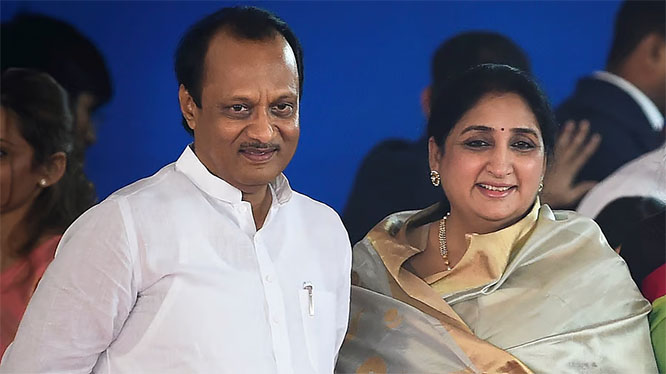
Gautam Adani-led group overtakes Tatas to become India's ‘most valued conglomerate’; Ambani's group stands 3rd

News Network
September 19, 2022

The Adani group of firms' overall market capitalisation on the BSE at over ₹ 22 lakh crore makes it the most valued in India, overtaking the Tata-led conglomerate.

Based on Friday's close, the market valuation of all BSE listed stocks of Adani Group, totalling nine firms, including the recently acquired Ambuja cement and ACC LTD, stood at over ₹ 22 lakh crore, surpassing 27 of Tata Group of firms listed with a market capitalisation (market cap) of more than ₹ 20 lakh crore.

Mukesh Ambani's group of nine companies stood third on the list with a market capitalisation of more than ₹ 17 lakh crore.

That reflects a broader run-up in Adani stock, which pushed Gautam Adani to become the third richest in the world on the Forbes list of billionaires, overtaking Amazon founder Jeff Bezos, and behind Elon Musk and Louis Vitton's Bernard Arnault.

While Mr Adani, with a net valuation of  $154.7 billion currently, briefly surpassed Louis Vitton's Bernard Arnault, a bloodbath in domestic stocks on Friday pushed him back to No. 3 on the Real-Time Billionaires List compiled by Forbes.

That is largely driven by the wealth erosion of American billionaires from the recent market crash on expectations for a very aggressive Federal Reserve after a red-hot inflation reading.

Still, Elon Musk remains the richest person, with a net worth of $273.5 billion.

Gautam Adani's rise in wealth is also more a measure of a jump in the valuation of stocks rather than the result of a rise in fundamentals, such as earnings and growth, with many of the entities' shares controlled by him rising sharply.

Still, Gautam Adani's ascent, by about any measure, has been nothing short of remarkable.

First, he became the richest person in Asia. Then his net worth surpassed those of Warren Buffett and Bill Gates. Now he's fast approaching a level of wealth only rivalled by Louis Vitton's Bernard Arnault and Elon Musk.

The market valuation of the Adani Group of firms is more spread across entities, while one or two large entities form the majority of Tatas and Reliance's market cap.

The Adani Group, which consists of seven publicly listed companies in the infrastructure, mining, energy, and other industries, is led by Mr Adani, a first-generation entrepreneur.

A rapid diversification spree has pushed his vast, largely fossil-fuel driven conglomerate into a raft of new sectors in and outside of India, and Mr Adani is seeking to reinvent himself for the global stage.

Adani Enterprises has made significant investments in emerging industries over the past five years, including airports, cement, copper refining, data centres, green hydrogen, petrochemical refining, roadways, and solar cell production.

Adani group became the second-largest cement maker in the country after completing its acquisition of Ambuja Cements and ACC on Friday. The group had no cement-making operations previously but had said the firms were a good fit given its ports and logistics, energy and real estate businesses.

Adani Group has big intentions to expand its green hydrogen and airport operations and enter the telecom industry. It has also pledged to invest $70 billion in infrastructure for renewable energy.

A separate report showed Adani Wilmar is scouting for local and overseas acquisition targets as Asia's richest man doubles down on boosting his empire's food operations.


Comments

Add new comment

  • Coastaldigest.com reserves the right to delete or block any comments.
  • Coastaldigset.com is not responsible for its readers’ comments.
  • Comments that are abusive, incendiary or irrelevant are strictly prohibited.
  • Please use a genuine email ID and provide your name to avoid reject.
News Network
November 22,2025

gaza.jpg

The Israeli regime’s forces have killed two Palestinian children in the Gaza Strip every day since the ceasefire began in early October, UNICEF has warned.

The UN children’s agency said on Friday that Israeli forces continue to attack Palestinians in Gaza even though the agreement was meant to stop the killing.

“Since 11 October, while the ceasefire has been in effect, at least 67 children have been killed in conflict-related incidents in the Gaza Strip. Dozens more have been injured. That is an average of almost two children killed every day since the ceasefire took effect,” UNICEF spokesperson Ricardo Pires said in Geneva, reminding that each number in the statistics represents a child whose life had ended violently.

“These are not statistics,” he said. “Each child had a story, a family, and a future that was stolen from them.”

Data from Palestinian factions, human rights groups, and government bodies recorded since the US-brokered ceasefire deal went into effect on October 10 show that Israeli forces have carried out numerous attacks, each constituting a separate ceasefire violation.

UNICEF teams say they repeatedly continue to witness heart-wrenching scenes of fearful Palestinian children sleeping outdoors with amputated limbs, while others live as orphans in flooded, makeshift shelters.

“I saw this myself in August. There is no safe place for them. The world cannot normalize their suffering,” Pires said, lamenting that the UN could “do a lot more if the aid that is really needed was entering faster.”

The UNICEF spokesperson warned that with the advent of winter, the risks for hundreds of thousands of displaced children will increase.

He warned, “The stakes are incredibly high” for children as winter acts as a threat multiplier, where children have no heating, no insulation, and few blankets. He said respiratory infections rise.

“Too many children have already paid the highest price,” Pires said. “Too many are still paying it, even under a ceasefire. The world promised them it would stop and that we would protect them.”

“Now we must act like it,” the UNICEF spokesperson added.

Since the Israeli regime launched its genocidal war against Palestinians in Gaza in October 2023, it has killed nearly 70,000 people in the territory, most of them women and children, and injured over 170,000 more, while reducing most of the structures in the enclave to rubble.

Comments

Add new comment

  • Coastaldigest.com reserves the right to delete or block any comments.
  • Coastaldigset.com is not responsible for its readers’ comments.
  • Comments that are abusive, incendiary or irrelevant are strictly prohibited.
  • Please use a genuine email ID and provide your name to avoid reject.
News Network
December 2,2025

DKSsiddu.jpg

Bengaluru: 'Nati koli saaru' (country chicken curry) considered one of Chief Minister Siddaramaiah’s favourites along with steaming hot idlis was on the breakfast menu at Deputy CM D K Shivakumar’s residence on Tuesday, according to official sources.

The spread also included 'nati koli' fry, vada and pongal, among other items, they said.

In an apparent show of unity, Siddaramaiah visited Shivakumar’s residence for breakfast, just days after the two leaders shared a meal amid a simmering power tussle in the state Congress.

Siddaramaiah drove to the Deputy CM’s residence in Sadashivanagar, where he was received by Shivakumar and his brother D K Suresh, who is a former Congress MP.

Suresh and Kunigal MLA H D Ranganath, a relative of Shivakumar, joined them for breakfast, which featured a mix of vegetarian and non-vegetarian dishes.

Speaking to reporters later, Siddaramaiah said Shivakumar had invited him during his visit to the CM’s residence for breakfast on Saturday.

Asked about the difference between the two meals, the chief minister said, "At his (Shivakumar’s) house it was non-veg, while at my house it was veg. He is a vegetarian, I am a non-vegetarian. I had not prepared non-veg. I told DK to get chicken from the village as you won’t get the original in Bengaluru."

Shivakumar said he had initially invited Siddaramaiah to his residence, but the CM had suggested visiting his place first and reciprocating later. "It was a vegetarian breakfast at the CM’s house on Saturday," he noted.

"Today, I invited him (the CM) to my house. He enjoyed the breakfast, which had his Mysuru taste," Shivakumar added. At this point, Siddaramaiah remarked that Shivakumar’s wife is also from Mysuru.

Saturday’s breakfast at Siddaramaiah’s official residence, held as part of efforts by the Congress high command to ease tensions in the leadership dispute between the two, reportedly included idlis and sambar, according to official sources.

Comments

Add new comment

  • Coastaldigest.com reserves the right to delete or block any comments.
  • Coastaldigset.com is not responsible for its readers’ comments.
  • Comments that are abusive, incendiary or irrelevant are strictly prohibited.
  • Please use a genuine email ID and provide your name to avoid reject.
News Network
November 26,2025

students.jpg

Bengaluru, Nov 26: Karnataka is taking its first concrete steps towards lifting a three-decade-old ban on student elections in colleges and universities. Deputy Chief Minister D.K. Shivakumar announced Wednesday that the state government will form a small committee to study the reintroduction of campus polls, a practice halted in 1989 following incidents of violence.

Speaking at a 'Constitution Day' event organised by the Karnataka Congress, Mr. Shivakumar underscored the move's aim: nurturing new political leadership from the grassroots.

"Recently, (Leader of the Opposition in Lok Sabha) Rahul Gandhi wrote a letter to me and Chief Minister (Siddaramaiah) asking us to think about restarting student elections," Shivakumar stated. "I'm announcing today that we'll form a small committee and seek a report on this."

Student elections were banned in Karnataka in 1989, largely due to concerns over violence and the infiltration of political party affiliates into campus life. The ban effectively extinguished vibrant student bodies and the pipeline of young leaders they often produced.

Mr. Shivakumar, who also serves as the Karnataka Congress president, said that former student leaders will be consulted to "study the pros and cons" of the re-introduction.

Acknowledging the history of the ban, he added, "There were many criminal activities taking place back then. We’ll see how we can conduct (student) elections by regulating such criminal activities."

The Deputy CM reminisced about his own journey, which began on campus. He recalled his political activism at Sri Jagadguru Renukacharya College leading to his first Assembly ticket in 1985 at the age of 23. "That's how student leadership was at the time. Such leadership has gone today. College elections have stopped," he lamented, adding that for many, college elections were "like a big movement" where leaders were forged.

The move, driven by the Congress high command's push to cultivate young talent, will face scrutiny from academics and university authorities who have, in the past, expressed concern that the return of polls could disrupt the peaceful academic environment and turn campuses into political battlegrounds.

Comments

Add new comment

  • Coastaldigest.com reserves the right to delete or block any comments.
  • Coastaldigset.com is not responsible for its readers’ comments.
  • Comments that are abusive, incendiary or irrelevant are strictly prohibited.
  • Please use a genuine email ID and provide your name to avoid reject.