



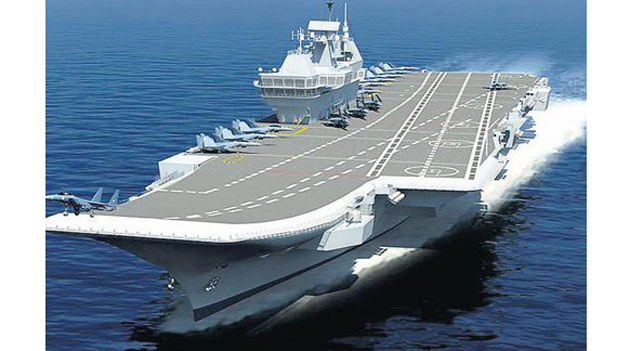
India gets first indigenous aircraft carrier as Prime Minister commissions INS Vikrant 

News Network
September 2, 2022

insvikrant.jpg

Kochi, Sept 2: Prime Minister Narendra Modi on Friday commissioned the first indigenously designed and built aircraft carrier INS Vikrant at Cochin Shipyard Limited in Kochi. PM Modi Modi received the Guard of Honour as he arrived for the Commissioning ceremony of INS Vikrant in Kerala.

He then unveiled the new Naval Ensign (Nishaan), doing away with the colonial past on the occasion. Naval Ensigns are flags that naval ships or formations bear to denote nationality. The current Indian Naval Ensign consists of a St. George's Cross -- a red cross with white background.

In one corner of the cross, the Indian flag was put when the country attained freedom, replacing the Union Jack in that place.

Modi has described September 2 as a "landmark day for India's efforts to become Aatmanirbhar in the defence sector" as the first indigenously designed and built aircraft carrier has been commissioned.

A host of dignitaries including Defence Minister Rajnath, Shipping Minister Sarbananda Sonowal, Governor Arif Mohamad Khan, Chief Minister Pinarayi Vijayan, Ernakulam MP Hibi Eden, Navy Chief Admiral R Hari Kumar and top officials of Navy and Cochin Shipyard Limited (CSL) attended the event.

Designed by the Indian Navy's in-house Warship Design Bureau (WDB) and built by Cochin Shipyard Limited, Vikrant has been built with state-of-the-art automation features.

It has a large amount of indigenous equipment and machinery, involving major industrial houses in the country- BEL, BHEL, GRSE, Keltron, Kirloskar, Larsen & Toubro, Wartsila India etc. as well as over 100 MSMEs. With the commissioning of Vikrant, India will have two operational aircraft carriers, which will bolster the maritime security of the nation.

The Indigenous Aircraft Carrier (IAC) is named after her illustrious predecessor, India's first aircraft carrier, which had played a vital role in the 1971 war.

As per the Indian Navy, the 262-meter-long carrier has a full displacement of close to 45,000 tonnes which is much larger and more advanced than her predecessor.

With Vikrant, India has joined a select group of nations (the US, Russia, France, the UK and China) having the niche capability to indigenously design and build an aircraft carrier.

IAC Vikrant consists of 14 decks with 2,300 compartments that can carry around 1,500 sea warriors and to cater to the food requirements, around 10,000 chapatis or rotis are made in the ship's kitchen, which is called the ship's galley.

The ship is powered by four Gas Turbines totalling 88 MW power and has a maximum speed of 28 Knots. Built at an overall cost of close to ₹20,000 crores, the project has been progressed in three Phases of the contract between MoD and CSL, concluded in May 2007, December 2014 and October 2019 respectively. The ship's keel was laid in Feb 2009, followed by launching in August 2013.

The ship would be capable of operating an air wing consisting of 30 aircraft comprising of MIG-29K fighter jets, Kamov-31, MH-60R multi-role helicopters, in addition to indigenously manufactured Advanced Light Helicopters (ALH) and Light Combat Aircraft (LCA) (Navy).

INS Vikrant history

INS Vikrant began her journey as the HMS Hercules, an aircraft carrier in the (British) Royal Navy in 1943 during the second world war. But it remained incomplete as the war ended, and in 1946, the work on the ship was suspended.

After the war, the UK and US navies wanted to sell the ships they no longer needed. So, in 1957, the Indian government purchased HMS Hercules. It became INS Vikrant when it was commissioned into the Indian Navy on 4 March 1961 in Belfast. The name Vikrant was derived from the Sanskrit word 'Vikranta', meaning 'Very powerful' and 'brave'. The ship formally joined Indian Navy in the Bombay harbour on 3 November 1961 and was received by then PM Jawaharlal Nehru at Ballar Pier.

The ship played an active role during the liberation of the Bangladesh war, in 1971. The aircraft carrier remained in service for another 26 years, till she was decommissioned on 31 January 1997. The Vikrant was then converted into a museum ship and remained berthed in Bombay harbour, open to the public to marvel at her glorious past. Due to rising maintenance costs and poor conditions, the Vikran ship was finally scrapped in November 2014.

Comments

Add new comment

  • Coastaldigest.com reserves the right to delete or block any comments.
  • Coastaldigset.com is not responsible for its readers’ comments.
  • Comments that are abusive, incendiary or irrelevant are strictly prohibited.
  • Please use a genuine email ID and provide your name to avoid reject.
News Network
February 1,2026

Bengaluru, Feb 1: For travelers landing at Kempegowda International Airport (KIA), the sleek, wood-paneled curves of Terminal 2 promise a world-class welcome. But the famed “Garden City” charm quickly withers at the curb. As India’s aviation sector swells to record numbers—handling over 43 million passengers in Bengaluru alone this past year—the “last mile” has turned into a marathon of frustration.

The Bengaluru Logjam: Rules vs Reality

While the city awaits the 2027 completion of the Namma Metro Blue Line, the interim has been chaotic. Recent “decongestion” rules at Terminal 1 have pushed app-based cab pickups to distant parking zones, forcing weary passengers into a 20-minute walk with luggage.

“I landed after ten months away and felt like a stranger in my own city,” says Ruchitha Jain, a Koramangala resident. “My driver couldn’t find me, staff couldn’t guide me, and the so-called ‘Premium’ lane is just a fancy tax on convenience.”

•    The Cost of Distance: A 40-km cab ride can now easily cross ₹1,500, driven by demand pricing and airport surcharges.

•    The Bus Gap: While Vayu Vajra remains a lifeline, its ₹300–₹400 fare is often cited as the most expensive airport bus service in the country.

A National Pattern of Disconnect

The struggle is not unique to Karnataka. From Chennai’s coast to Hyderabad’s plateau, India’s airports tell a familiar story: brilliant runways, broken exits.

City:    Primary Issue   |    Recent Development

Bengaluru:    Cab pickup restrictions & distance  |    App-based taxis shifted to far parking zones; long walks and fare spikes reported

Chennai:    Multi-Level Parking (MLCP) hike  |    Passengers report 40-minute walks to reach cab pickup points

Hyderabad:    “Taxi mafia” & touting  |    Over 440 touting cases reported; security presence intensified

Mumbai:    Fare scams  |     Tourists charged ₹18,000 for just 400 metres, triggering police action

In Hyderabad, travelers continue to battle entrenched local groups that intimidate Uber and Ola drivers, pushing passengers toward overpriced private taxis. Chennai flyers, meanwhile, complain that reaching the designated pickup zones now takes longer than short-haul flights from cities like Coimbatore.

The ‘Budget Day’ Hope

As Finance Minister Nirmala Sitharaman presents the Union Budget 2026 today, the aviation sector is watching closely. With the government’s renewed emphasis on multimodal integration, there is cautious hope for funding toward seamless airport-metro-bus hubs.

The vision is clear: a future where planes, trains, and metros speak the same language. Until then, passengers at KIA—and airports across India—will continue to discover that the hardest part of flying isn’t the thousands of kilometres in the air, but the last few on the ground.

Comments

Chandramohan
 - 
Friday, 6 Feb 2026

Sir, I request the airport authorities to introduce a free transport services from terminal 1 to terminal 2 as is very difficult for the passengers to reach terminal 2 along with their luggage. Also a trolley should be provided to reach the counter. Hope the authorities would help the passengers as soon as possible.

Add new comment

  • Coastaldigest.com reserves the right to delete or block any comments.
  • Coastaldigset.com is not responsible for its readers’ comments.
  • Comments that are abusive, incendiary or irrelevant are strictly prohibited.
  • Please use a genuine email ID and provide your name to avoid reject.
News Network
February 4,2026

Mangaluru: Urban local bodies and gram panchayats should make the use of Kannada on signboards mandatory while issuing trade licences to commercial establishments, Dakshina Kannada Deputy Commissioner Darshan HV said. He also called for regular inspections to ensure compliance.

Presiding over the District Kannada Awareness Committee meeting at the deputy commissioner’s office, Darshan said the city corporation would be directed to ensure that shops operating in malls prominently display their names in Kannada. “All commercial establishments, including shops, companies, offices and hotels, must mandatorily display their names in Kannada on signboards,” he said.

The deputy commissioner added that the National Highways Authority of India (NHAI) would be instructed to include Kannada on signboards along national highways. Banks, he said, would be directed through committee meetings to provide application forms in Kannada.

“Even if English-medium schools and colleges impart education in English, their signboards must display the institution’s name in Kannada. Steps will also be taken to ensure that private buses display place names in Kannada,” Darshan said.

During the meeting, committee members raised concerns over the closure of Kannada-medium schools in rural areas due to a shortage of teachers and stressed the need for immediate corrective measures. They also pointed out that several industries employ workers from other states while overlooking local candidates.

Members further demanded that nationalised banks provide deposit and withdrawal slips in Kannada. It was brought to the deputy commissioner’s notice that the presence of staff without knowledge of Kannada in rural branches of nationalised banks is causing hardship to local customers.

Meanwhile, MP Srinath, president of the District Kannada Sahitya Parishat, urged the district administration to allot land for the construction of a district Kannada Bhavana in Mangaluru.

Comments

Add new comment

  • Coastaldigest.com reserves the right to delete or block any comments.
  • Coastaldigset.com is not responsible for its readers’ comments.
  • Comments that are abusive, incendiary or irrelevant are strictly prohibited.
  • Please use a genuine email ID and provide your name to avoid reject.
News Network
February 1,2026

Bengaluru, Feb 1: For travelers landing at Kempegowda International Airport (KIA), the sleek, wood-paneled curves of Terminal 2 promise a world-class welcome. But the famed “Garden City” charm quickly withers at the curb. As India’s aviation sector swells to record numbers—handling over 43 million passengers in Bengaluru alone this past year—the “last mile” has turned into a marathon of frustration.

The Bengaluru Logjam: Rules vs Reality

While the city awaits the 2027 completion of the Namma Metro Blue Line, the interim has been chaotic. Recent “decongestion” rules at Terminal 1 have pushed app-based cab pickups to distant parking zones, forcing weary passengers into a 20-minute walk with luggage.

“I landed after ten months away and felt like a stranger in my own city,” says Ruchitha Jain, a Koramangala resident. “My driver couldn’t find me, staff couldn’t guide me, and the so-called ‘Premium’ lane is just a fancy tax on convenience.”

•    The Cost of Distance: A 40-km cab ride can now easily cross ₹1,500, driven by demand pricing and airport surcharges.

•    The Bus Gap: While Vayu Vajra remains a lifeline, its ₹300–₹400 fare is often cited as the most expensive airport bus service in the country.

A National Pattern of Disconnect

The struggle is not unique to Karnataka. From Chennai’s coast to Hyderabad’s plateau, India’s airports tell a familiar story: brilliant runways, broken exits.

City:    Primary Issue   |    Recent Development

Bengaluru:    Cab pickup restrictions & distance  |    App-based taxis shifted to far parking zones; long walks and fare spikes reported

Chennai:    Multi-Level Parking (MLCP) hike  |    Passengers report 40-minute walks to reach cab pickup points

Hyderabad:    “Taxi mafia” & touting  |    Over 440 touting cases reported; security presence intensified

Mumbai:    Fare scams  |     Tourists charged ₹18,000 for just 400 metres, triggering police action

In Hyderabad, travelers continue to battle entrenched local groups that intimidate Uber and Ola drivers, pushing passengers toward overpriced private taxis. Chennai flyers, meanwhile, complain that reaching the designated pickup zones now takes longer than short-haul flights from cities like Coimbatore.

The ‘Budget Day’ Hope

As Finance Minister Nirmala Sitharaman presents the Union Budget 2026 today, the aviation sector is watching closely. With the government’s renewed emphasis on multimodal integration, there is cautious hope for funding toward seamless airport-metro-bus hubs.

The vision is clear: a future where planes, trains, and metros speak the same language. Until then, passengers at KIA—and airports across India—will continue to discover that the hardest part of flying isn’t the thousands of kilometres in the air, but the last few on the ground.

Comments

Chandramohan
 - 
Friday, 6 Feb 2026

Sir, I request the airport authorities to introduce a free transport services from terminal 1 to terminal 2 as is very difficult for the passengers to reach terminal 2 along with their luggage. Also a trolley should be provided to reach the counter. Hope the authorities would help the passengers as soon as possible.

Add new comment

  • Coastaldigest.com reserves the right to delete or block any comments.
  • Coastaldigset.com is not responsible for its readers’ comments.
  • Comments that are abusive, incendiary or irrelevant are strictly prohibited.
  • Please use a genuine email ID and provide your name to avoid reject.