



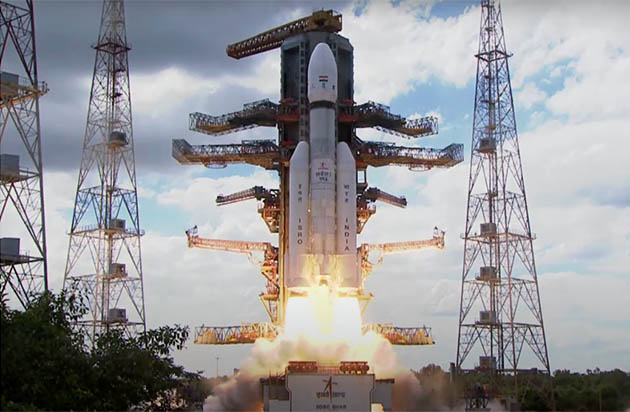
India’s Chandrayaan-3 blasts off to the moon from Sriharikota

News Network
July 14, 2023

chandrayan.jpg

New Delhi, July 14: India’s third unmanned lunar mission, Chandrayaan-3, aimed at exploring the south polar region of the moon, soared into the sky successfully at 2.35 pm on Friday as planned from the second launch pad of the Satish Dhawan Space Centre (SDSC) here. 
 
The precise goal is to make a soft and safe landing on the lunar surface, and if the mission is successful, India will only be the fourth country to have achieved the feat, joining the elite club of the US, Russia, and China. The south-polar region of the moon is of intense interest due to the presence of many permanently shadowed craters which could contain water ice and precious minerals. 
 
At the end of the 25-hour and 30-minute countdown, LVM3-M4, India’s largest and heaviest launch vehicle, LVM3-M4, lifted off at 2:35 pm with the 3,900-kg Chandrayaan-3 spacecraft, including the lander. Minutes later, it transferred the satellites into the Geo Transfer orbit as scientists, including ISRO Chairman S Somnath and his predecessors, were watching the launch from the Control Command Centre. 

Billed as a follow-up mission to Chandrayaan-2 which failed after the lander crash-landed on the moon 48 days later, Chandrayaan-3 will seek to demonstrate end-to-end landing and roving capabilities. The spacecraft will take about 40 days to make a soft landing on the lunar surface which is expected to be between August 23 and 24, eight days lesser than what the Chandrayaan-2 mission took. 
 
The success of Chandrayaan-3 will also help the ISRO fast-tracking its planned manned mission to the space, named Gaganyaan. 
 
The Chandrayaan-3 lander carrying a rover within it will be carried into an orbit around the moon by the propulsion module. A little later, the lander will separate from that module and will attempt to make a soft landing in the south polar region of the moon, which is of intense interest as it has many permanently shadowed craters which could contain water ice and precious minerals. 
 
India’s first unmanned mission, Chandrayaan-1, which took off on October 22, 2008, demonstrated the country’s ability to reach the surface of the moon and discover water on the lunar surface, while the Chandrayaan-2 mission’s aim was to make a soft landing on the moon. 
 
Learning lessons from the failure, the ISRO has made several significant modifications to Friday's mission with officials attributing the 2019 failure to malfunctioning of the onboard computer and propulsion system. 
 
This time around, the lander’s legs have been strengthened, a fifth engine has been removed to reduce the weight, and the landing area has been expanded from 500mx500m (in Chandrayaan-2) to 4kmx2.4 km area in Chandrayaan-3. Several special tests like Integrated Cold and Integrated Hot tests and Lander Leg mechanism performance tests have also been conducted to ensure the success of the mission, the officials added.
 
The Chandrayaan-3 mission is yet another attempt to achieve the goal with the help of a rover. The spacecraft, according to officials, will have four payloads which will study moon quakes, how the surface of the moon allows heat to flow through it, the plasma environment near the moon's surface, and enable scientists to measure the distance between Earth and moon “very accurately.”
 
The two rover payloads study composition of the moon’s surface using X-rays and LASER, while the propulsion module payload will explore the Spectro-polarimetric signatures of the habitable planet, Earth. The mission is divided into three phases -- Earth Centric, Lunar Transfer, and Moon Centric. 
 
The work on Chandrayaan-3 began just a few months after the failure of Chandrayaan-2, but the Covid-19 pandemic and the subsequent lockdown delayed ISRO’s plans. By demonstrating its capabilities to soft-land on the moon, the ISRO is also hoping to expand its business as it is already launching private satellites from Sriharikota.

Comments

Add new comment

  • Coastaldigest.com reserves the right to delete or block any comments.
  • Coastaldigset.com is not responsible for its readers’ comments.
  • Comments that are abusive, incendiary or irrelevant are strictly prohibited.
  • Please use a genuine email ID and provide your name to avoid reject.
News Network
February 5,2026

Bengaluru: As air quality continues to worsen across several parts of the city, hospitals in Bengaluru are reporting a steady rise in patients suffering from respiratory illnesses such as asthma, bronchitis and Chronic Obstructive Pulmonary Disease (COPD), health officials and doctors said.

Data from the Suvarna Arogya Suraksha Trust (SAST) shows that 3,891 patients received treatment for respiratory ailments between April and November 2024. The figure rose to 4,187 during the same period in 2025.

Private hospitals, too, are witnessing a 10–15 per cent year-on-year increase in such cases.

While doctors caution that the rise cannot be attributed solely to air pollution, a significant number of patients are non-smokers with no prior history of respiratory disease.

“Nearly 70 per cent of the patients we see are non-smokers with no previous respiratory issues. When other causes are ruled out, air pollution emerges as the most likely factor,” said Dr Manjunath PH, consultant interventional pulmonologist at a hospital in Kengeri.

Doctors noted that patient footfall spikes during the winter months and around Deepavali, when air quality typically worsens.

“There is a clear correlation between poor air quality and the rise in cases. People commonly present with persistent cough, breathlessness and irritation of the respiratory tract, indicating the impact of polluted air on their health,” said Dr Sheetal Chaurasia, consultant in pulmonary medicine at a private hospital in Whitefield.

Dr Chaurasia added that respiratory tract infections are also on the rise.

“Poor air quality leads to chronic airway inflammation, making the airways more vulnerable to infections. We are seeing an increase in both upper and lower respiratory tract infections,” she said.

Patients with pre-existing respiratory conditions remain the worst affected.

“For those already diagnosed with respiratory illnesses, deteriorating air quality significantly worsens the condition. Both the frequency and severity of attacks increase sharply,” said Dr Vandana P, a pulmonologist at a hospital on Bannerghatta Road.

Doctors also flagged a worrying trend of rising respiratory problems among younger adults and children.

To reduce exposure, they advised people to wear masks while travelling on two-wheelers or autos and ensure adequate ventilation at home to minimise indoor air pollution.

Comments

Add new comment

  • Coastaldigest.com reserves the right to delete or block any comments.
  • Coastaldigset.com is not responsible for its readers’ comments.
  • Comments that are abusive, incendiary or irrelevant are strictly prohibited.
  • Please use a genuine email ID and provide your name to avoid reject.
News Network
January 23,2026

Mangaluru: The Karnataka Government Polytechnic (KPT), Mangaluru, has achieved autonomous status from the All India Council for Technical Education (AICTE), becoming the first government polytechnic in the country to receive such recognition in its 78-year history. The status was granted by AICTE, New Delhi, and subsequently approved by the Karnataka Board of Technical Education in October last year.

Officials said the autonomy was conferred a few months ago. Until recently, AICTE extended autonomous status only to engineering colleges, excluding diploma institutions. However, with a renewed national focus on skill development, several government polytechnics across India have now been granted autonomy.

KPT, the second-largest polytechnic in Karnataka, was established in 1946 with four branches and has since expanded to offer eight diploma programmes, including computer science and polymer technology. The institution is spread across a 19-acre campus.

Ravindra M Keni, the first dean of the institution, told The Times of India that AICTE had proposed autonomous status for polytechnic institutions that are over 25 years old. “Many colleges applied. In the first round, 100 institutions were shortlisted, which was further narrowed down to 15 in the second round. We have already completed one semester after becoming an autonomous institution,” he said. He added that nearly 500 students are admitted annually across eight three-year diploma courses.

Explaining the factors that helped KPT secure autonomy, Keni said the institution has consistently recorded 100 per cent admissions and placements for its graduates. He also noted its strong performance in sports, with the college emerging champions for 12 consecutive years, along with active student participation in NCC and NSS activities.

Autonomous status allows KPT to design industry-oriented curricula, conduct examinations, prepare question papers, and manage academic documentation independently. The institution can also directly collaborate with industries and receive priority funding from AICTE or the Ministry of Education. While academic autonomy has been granted, financial control will continue to rest with the state government.

“There will be separate committees for examinations, question paper setting, boards of studies, and boards of examiners. The institution will now have the freedom to conduct admissions without government notifications and issue its own marks cards,” Keni said, adding that new academic initiatives would be planned after a year of functioning under the autonomous framework.

Comments

Add new comment

  • Coastaldigest.com reserves the right to delete or block any comments.
  • Coastaldigset.com is not responsible for its readers’ comments.
  • Comments that are abusive, incendiary or irrelevant are strictly prohibited.
  • Please use a genuine email ID and provide your name to avoid reject.
News Network
February 1,2026

Bengaluru: Karnataka Deputy Chief Minister D K Shivakumar on Sunday criticised the Union Budget presented by Finance Minister Nirmala Sitharaman, claiming it offered no tangible benefit to the state.

Though he said he was yet to study the budget in detail, Shivakumar asserted that Karnataka had gained little from it. “There is no benefit for our state from the central budget. I was observing it. They have now named a programme after Mahatma Gandhi, after repealing the MGNREGA Act that was named after him,” he said.

Speaking to reporters here, the Deputy Chief Minister demanded the restoration of MGNREGA, and made it clear that the newly enacted rural employment scheme — VB-G RAM G — which proposes a 60:40 fund-sharing formula between the Centre and the states, would not be implemented in Karnataka.

“I don’t see any major share for our state in this budget,” he added.

Shivakumar, who also holds charge of Bengaluru development, said there were high expectations for the city from the Union Budget. “The Prime Minister calls Bengaluru a ‘global city’, but what has the Centre done for it?” he asked.

He also drew attention to the problems faced by sugar factories, particularly those in the cooperative sector, alleging a lack of timely decisions and support from the central government.

Noting that the Centre has the authority to fix the minimum support price (MSP) for agricultural produce, Shivakumar said the Union government must take concrete steps to protect farmers’ interests.

Comments

Add new comment

  • Coastaldigest.com reserves the right to delete or block any comments.
  • Coastaldigset.com is not responsible for its readers’ comments.
  • Comments that are abusive, incendiary or irrelevant are strictly prohibited.
  • Please use a genuine email ID and provide your name to avoid reject.