Military might, women power on full display at India’s 75th Republic Day Parade

News Network
January 26, 2024

narishakti.jpg

New Delhi: India ushered in its 75th Republic Day on Friday with a grand display of its women power and military might that included elite marching contingents, missiles, warplanes, surveillance gadgets and lethal weapon systems, with French President Emmanuel Macron gracing the occasion as the chief guest.

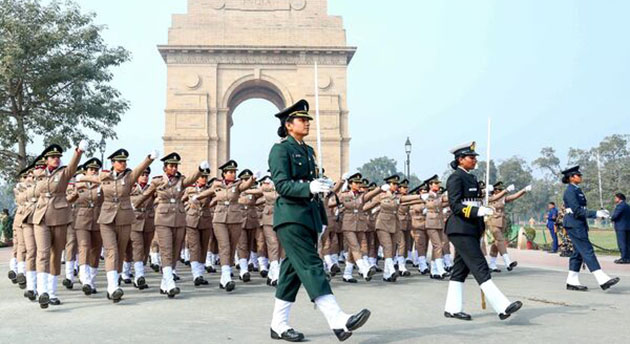
For the first time, an all-women tri-services contingent marched down the Kartavya Path, reflecting the country's growing 'Nari Shakti' (women power).

In another first, the parade was heralded by over 100 women artistes playing Indian musical instruments such as sankh, naadswaram and nagada instead of traditional military bands kickstarting the celebrations.

The parade commenced with President Droupadi Murmu taking the salute shortly after she and Macron, flanked by the Indian president's bodyguards, arrived at the Kartavya Path in a 'traditional buggy'.

Prime Minister Narendra Modi, Defence Minister Rajnath Singh, several other Union ministers, the country's top military brass, foreign diplomats and senior officials were among the spectators at the biggest event on Kartavya Path, the centrepiece boulevard of the national capital.

The first Army contingent leading the mechanised column was the 61 Cavalry which was raised in 1953. It was followed by 11 mechanised columns, 12 marching contingents and a fly-past by advanced light helicopters of the Army Aviation Corps.

Tank T-90 Bhishma, NAG missile systems, infantry combat vehicles, all-terrain vehicles, weapon locating radar system 'Swathi', drone jammer system, and medium-range surface-to-air missile were among the key displays by the mechanised columns.

The all-women tri-service contingent, led by Captain Sandhya of Army Military Police, with three supernumerary officers Captain Sharanya Rao, Sub Lieutenant Anshu Yadav and Flight Lieutenant Shrishti Rao drew huge applause.

Another all-women Armed Forces Medical Services contingent, headed by Major Srishti Khullar with Captain Amba Samant of the Army Dental Corps, Surgeon Lieutenant Kanchana of the Indian Navy and Flight Lieutenant Dhivya Priya of the Indian Air Force also marched down the ceremonial boulevard.

The Army's marching contingents included the Madras Regiment, the Grenadiers, the Rajputana Rifles, the Sikh Regiment and the Kumaon Regiment.

The Indian Navy's contingent consisted of 144 men and women Agniveers, led by Lt Prajwal M as contingent commander and Lt Mudita Goyal, Lt Sharvani Supreiya and Lt Devika H as platoon commanders.

It was followed by a naval tableau, depicting the themes 'Nari Shakti' and 'Sea Power Across the Oceans Through Indigenisation'.

The first part of the tableau showcased the women in the Indian Navy in all roles and ranks, while the second part depicted the very first indigenous Carrier Battle Group, comprising aircraft carrier INS Vikrant, her highly capable escort ships Delhi, Kolkata and Shivalik and the Kalvari class submarine and Rukmani satellite among others.

The Indian Air Force contingent comprised 144 airmen and four officers, and it was led by Squadron Leader Rashmi Thakur. Squadron Leaders Sumita Yadav and Pratiti Ahluwalia and Flight Lieutenant Kirti Rohil were the supernumerary officers.

The IAF tableau was themed 'Bharatiya Vayu Sena: Saksham, Sashakt, Aatmanirbhar'.

The tableau depicted LCA Tejas and Su-30 flying over the Indian Ocean Region and a C-295 transport aircraft being flown by women aircrew in the cockpit.

The GSAT-7A positioned on the tableau represented the IAF's incorporation of space technology in its operations.

The tableau showed that IAF has been at the forefront of rendering humanitarian aid, both within and across borders.

Another highlight of the parade was the veterans' tableau on the theme 'Rashtra Nirmaan: Pehle Bhi, Ab Bhi, Aage Bhi aur Hamesha'. It showcased the bravery and sacrifices of the ex-servicemen towards the nation.

In its tableau, the Defence Research and Development Organisation (DRDO) displayed many home-grown critical systems and technologies developed by it.

The tableau was based on the theme of women power in protecting the nation by providing the defence shield in all the five domains of land, air, sea, cyber and space.

Outstanding scientist Sunita Devi Jena was the contingent commander, with P Laxmi Madhavi, J Sujana Choudhary and A Bhuvaneswari also present on the tableau.

The tableau displayed a man-portable anti-tank guided missile, anti-satellite missile, Agni-5, surface-to-surface ballistic missile, very short range air defence system, naval anti-ship missile'“short range (NASM-SR) and anti-tank guided missile 'HELINA'.

Quick reaction surface-to-air missile (QRSAM), Astra, Light Combat Aircraft 'Tejas', Uttam active electronically scanned array radar (AESAR), advanced electronic warfare system and Shakti Cyber Security systems were also on display.

The themes of the celebrations were -- 'Viksit Bharat' and 'Bharat -- Loktantra Ki Matruka' (India--Mother of Democracy). A 95-member marching contingent and a 30-member band contingent from France also took part in the parade.

Two Rafale fighters and an Airbus A330 multi-role tanker transport aircraft of the French air force also featured in the celebrations.

The celebrations ended with a jaw-dropping flypast by 46 aircraft of the Indian Air Force.

The IAF fleet included 29 fighter jets, seven transport aircraft, nine helicopters and one heritage plane. All these aircraft operated from six different bases.

Fifteen women pilots, including six from the fighter streams, operated the IAF platforms during the fly-past.

For the first time, indigenously-built Tejas aircraft flew in a formation of four aircraft.

There was a previous occasion of one Tejas jet being part of the Republic Day parade but this was the first time that the aircraft flew in a formation.

Comments

Add new comment

  • Coastaldigest.com reserves the right to delete or block any comments.
  • Coastaldigset.com is not responsible for its readers’ comments.
  • Comments that are abusive, incendiary or irrelevant are strictly prohibited.
  • Please use a genuine email ID and provide your name to avoid reject.
News Network
February 1,2026

Bengaluru, Feb 1: For travelers landing at Kempegowda International Airport (KIA), the sleek, wood-paneled curves of Terminal 2 promise a world-class welcome. But the famed “Garden City” charm quickly withers at the curb. As India’s aviation sector swells to record numbers—handling over 43 million passengers in Bengaluru alone this past year—the “last mile” has turned into a marathon of frustration.

The Bengaluru Logjam: Rules vs Reality

While the city awaits the 2027 completion of the Namma Metro Blue Line, the interim has been chaotic. Recent “decongestion” rules at Terminal 1 have pushed app-based cab pickups to distant parking zones, forcing weary passengers into a 20-minute walk with luggage.

“I landed after ten months away and felt like a stranger in my own city,” says Ruchitha Jain, a Koramangala resident. “My driver couldn’t find me, staff couldn’t guide me, and the so-called ‘Premium’ lane is just a fancy tax on convenience.”

•    The Cost of Distance: A 40-km cab ride can now easily cross ₹1,500, driven by demand pricing and airport surcharges.

•    The Bus Gap: While Vayu Vajra remains a lifeline, its ₹300–₹400 fare is often cited as the most expensive airport bus service in the country.

A National Pattern of Disconnect

The struggle is not unique to Karnataka. From Chennai’s coast to Hyderabad’s plateau, India’s airports tell a familiar story: brilliant runways, broken exits.

City:    Primary Issue   |    Recent Development

Bengaluru:    Cab pickup restrictions & distance  |    App-based taxis shifted to far parking zones; long walks and fare spikes reported

Chennai:    Multi-Level Parking (MLCP) hike  |    Passengers report 40-minute walks to reach cab pickup points

Hyderabad:    “Taxi mafia” & touting  |    Over 440 touting cases reported; security presence intensified

Mumbai:    Fare scams  |     Tourists charged ₹18,000 for just 400 metres, triggering police action

In Hyderabad, travelers continue to battle entrenched local groups that intimidate Uber and Ola drivers, pushing passengers toward overpriced private taxis. Chennai flyers, meanwhile, complain that reaching the designated pickup zones now takes longer than short-haul flights from cities like Coimbatore.

The ‘Budget Day’ Hope

As Finance Minister Nirmala Sitharaman presents the Union Budget 2026 today, the aviation sector is watching closely. With the government’s renewed emphasis on multimodal integration, there is cautious hope for funding toward seamless airport-metro-bus hubs.

The vision is clear: a future where planes, trains, and metros speak the same language. Until then, passengers at KIA—and airports across India—will continue to discover that the hardest part of flying isn’t the thousands of kilometres in the air, but the last few on the ground.

Comments

Add new comment

  • Coastaldigest.com reserves the right to delete or block any comments.
  • Coastaldigset.com is not responsible for its readers’ comments.
  • Comments that are abusive, incendiary or irrelevant are strictly prohibited.
  • Please use a genuine email ID and provide your name to avoid reject.
News Network
February 3,2026

manjeshwar.jpg

Kasaragod: An 18-year-old girl was stabbed to death at Thuminad in Manjeshwar panchayat on Monday, allegedly by her father following a domestic dispute. 

The victim has been identified as K U Mariyamath Jumaila. Her father, Umar Farooq, has been taken into police custody, Manjeshwar Station House Officer Inspector Ajith Kumar P said.

According to the police, Umar Farooq had been working in a West Asian country and returned home about three months ago. 

Family tensions reportedly escalated after his wife, Thahira (41), decided to seek a divorce and asked him to leave her life. Kasaragod district panchayat member Harshad Vorkady alleged that Umer was addicted to marijuana and frequently caused disturbances at home.

On Monday, Thahira asked Umar to come to her sister’s house in Thuminad to discuss the dispute. Jumaila accompanied her mother. 

Manjeshwar panchayat member Illiyas Thuminad said Umar arrived along with his brother, following which Thahira handed over gold ornaments and property documents to him and asked him to sever ties with her.

However, the police said a property dispute had been ongoing between Umar Farooq and his sister-in-law’s husband. During a heated argument, Umar allegedly attempted to attack the man with a sharp weapon. When Jumaila intervened to stop the assault, she was stabbed in the neck.

The teenager collapsed after bleeding profusely and was rushed to a private hospital in Mangaluru, where doctors declared her dead. Her body was later shifted to Mangalpady Taluk Hospital for post-mortem examination.

Jumaila was a former student of Sirajul Huda English Medium Higher Secondary School, Manjeshwar. 

Comments

Add new comment

  • Coastaldigest.com reserves the right to delete or block any comments.
  • Coastaldigset.com is not responsible for its readers’ comments.
  • Comments that are abusive, incendiary or irrelevant are strictly prohibited.
  • Please use a genuine email ID and provide your name to avoid reject.
News Network
February 1,2026

US President Donald Trump on Saturday claimed that the government of India led by Prime Minister Narendra Modi has made a deal to buy Venezuelan oil, as opposed to purchasing it from Iran.

"We've already made that deal, the concept of the deal," he told reporters on Air Force One.

Trump had imposed 25% tariffs on countries buying Venezuelan oil, including India, in March 2025. He had also hit India with tariffs for buying Russian oil, saying it was "funding" President Vladimir Putin's war against Ukraine.

Trump has said that the US has taken control of the oil-rich Venezuela after capturing former President Nicolas Maduro in January.

A fleet of 18 ships loaded with crude oil bound for refineries in Texas, Louisiana, and Mississippi in January, the most since December 2024, according to a report by the news agency Bloomberg.

Combined crude deliveries to the US will reach about 2,75,000 barrels a day, more than doubling volumes seen in December last year. Shipments to China, which averaged 4,00,000 barrels a day last year, fell to zero in January.

PM Modi, Venezuelan President Agree To Expand Ties

Prime Minister Narendra Modi and Venezuela's acting President Delcy Rodriguez spoke on Friday and agreed to take the bilateral relations to "new heights" in the years ahead.

It was the first phone call between the two leaders since the capture of Maduro and his wife by the US on January 3.

"Spoke with Acting President of Venezuela, Ms. Delcy Rodriguez. We agreed to further deepen and expand our bilateral partnership in all areas, with a shared vision of taking India-Venezuela relations to new heights in the years ahead," PM Modi said in a post on X.

A statement from Prime Minister Modi's office said the two leaders agreed to further expand and deepen the India-Venezuela partnership in all areas, including trade and investment, energy, digital technology, health, agriculture, and people-to-people ties.

They exchanged views on various regional and global issues of mutual interest and underscored the importance of their close cooperation for the Global South, the statement said.

Rodriguez also said that they discussed partnerships in the fields of agriculture, science and technology, mining, and tourism, as well as the pharmaceutical and automotive industries.

Comments

Add new comment

  • Coastaldigest.com reserves the right to delete or block any comments.
  • Coastaldigset.com is not responsible for its readers’ comments.
  • Comments that are abusive, incendiary or irrelevant are strictly prohibited.
  • Please use a genuine email ID and provide your name to avoid reject.