Military might, women power on full display at India’s 75th Republic Day Parade

News Network
January 26, 2024

narishakti.jpg

New Delhi: India ushered in its 75th Republic Day on Friday with a grand display of its women power and military might that included elite marching contingents, missiles, warplanes, surveillance gadgets and lethal weapon systems, with French President Emmanuel Macron gracing the occasion as the chief guest.

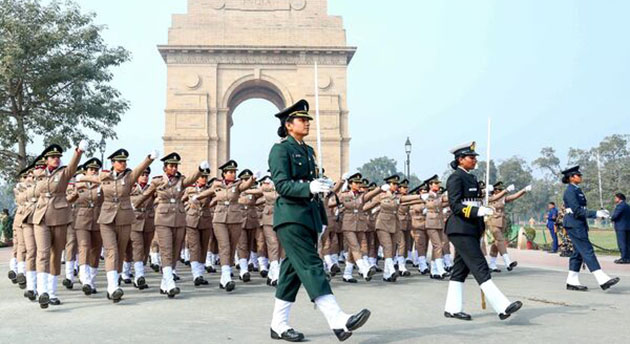
For the first time, an all-women tri-services contingent marched down the Kartavya Path, reflecting the country's growing 'Nari Shakti' (women power).

In another first, the parade was heralded by over 100 women artistes playing Indian musical instruments such as sankh, naadswaram and nagada instead of traditional military bands kickstarting the celebrations.

The parade commenced with President Droupadi Murmu taking the salute shortly after she and Macron, flanked by the Indian president's bodyguards, arrived at the Kartavya Path in a 'traditional buggy'.

Prime Minister Narendra Modi, Defence Minister Rajnath Singh, several other Union ministers, the country's top military brass, foreign diplomats and senior officials were among the spectators at the biggest event on Kartavya Path, the centrepiece boulevard of the national capital.

The first Army contingent leading the mechanised column was the 61 Cavalry which was raised in 1953. It was followed by 11 mechanised columns, 12 marching contingents and a fly-past by advanced light helicopters of the Army Aviation Corps.

Tank T-90 Bhishma, NAG missile systems, infantry combat vehicles, all-terrain vehicles, weapon locating radar system 'Swathi', drone jammer system, and medium-range surface-to-air missile were among the key displays by the mechanised columns.

The all-women tri-service contingent, led by Captain Sandhya of Army Military Police, with three supernumerary officers Captain Sharanya Rao, Sub Lieutenant Anshu Yadav and Flight Lieutenant Shrishti Rao drew huge applause.

Another all-women Armed Forces Medical Services contingent, headed by Major Srishti Khullar with Captain Amba Samant of the Army Dental Corps, Surgeon Lieutenant Kanchana of the Indian Navy and Flight Lieutenant Dhivya Priya of the Indian Air Force also marched down the ceremonial boulevard.

The Army's marching contingents included the Madras Regiment, the Grenadiers, the Rajputana Rifles, the Sikh Regiment and the Kumaon Regiment.

The Indian Navy's contingent consisted of 144 men and women Agniveers, led by Lt Prajwal M as contingent commander and Lt Mudita Goyal, Lt Sharvani Supreiya and Lt Devika H as platoon commanders.

It was followed by a naval tableau, depicting the themes 'Nari Shakti' and 'Sea Power Across the Oceans Through Indigenisation'.

The first part of the tableau showcased the women in the Indian Navy in all roles and ranks, while the second part depicted the very first indigenous Carrier Battle Group, comprising aircraft carrier INS Vikrant, her highly capable escort ships Delhi, Kolkata and Shivalik and the Kalvari class submarine and Rukmani satellite among others.

The Indian Air Force contingent comprised 144 airmen and four officers, and it was led by Squadron Leader Rashmi Thakur. Squadron Leaders Sumita Yadav and Pratiti Ahluwalia and Flight Lieutenant Kirti Rohil were the supernumerary officers.

The IAF tableau was themed 'Bharatiya Vayu Sena: Saksham, Sashakt, Aatmanirbhar'.

The tableau depicted LCA Tejas and Su-30 flying over the Indian Ocean Region and a C-295 transport aircraft being flown by women aircrew in the cockpit.

The GSAT-7A positioned on the tableau represented the IAF's incorporation of space technology in its operations.

The tableau showed that IAF has been at the forefront of rendering humanitarian aid, both within and across borders.

Another highlight of the parade was the veterans' tableau on the theme 'Rashtra Nirmaan: Pehle Bhi, Ab Bhi, Aage Bhi aur Hamesha'. It showcased the bravery and sacrifices of the ex-servicemen towards the nation.

In its tableau, the Defence Research and Development Organisation (DRDO) displayed many home-grown critical systems and technologies developed by it.

The tableau was based on the theme of women power in protecting the nation by providing the defence shield in all the five domains of land, air, sea, cyber and space.

Outstanding scientist Sunita Devi Jena was the contingent commander, with P Laxmi Madhavi, J Sujana Choudhary and A Bhuvaneswari also present on the tableau.

The tableau displayed a man-portable anti-tank guided missile, anti-satellite missile, Agni-5, surface-to-surface ballistic missile, very short range air defence system, naval anti-ship missile'“short range (NASM-SR) and anti-tank guided missile 'HELINA'.

Quick reaction surface-to-air missile (QRSAM), Astra, Light Combat Aircraft 'Tejas', Uttam active electronically scanned array radar (AESAR), advanced electronic warfare system and Shakti Cyber Security systems were also on display.

The themes of the celebrations were -- 'Viksit Bharat' and 'Bharat -- Loktantra Ki Matruka' (India--Mother of Democracy). A 95-member marching contingent and a 30-member band contingent from France also took part in the parade.

Two Rafale fighters and an Airbus A330 multi-role tanker transport aircraft of the French air force also featured in the celebrations.

The celebrations ended with a jaw-dropping flypast by 46 aircraft of the Indian Air Force.

The IAF fleet included 29 fighter jets, seven transport aircraft, nine helicopters and one heritage plane. All these aircraft operated from six different bases.

Fifteen women pilots, including six from the fighter streams, operated the IAF platforms during the fly-past.

For the first time, indigenously-built Tejas aircraft flew in a formation of four aircraft.

There was a previous occasion of one Tejas jet being part of the Republic Day parade but this was the first time that the aircraft flew in a formation.


Comments

Add new comment

  • Coastaldigest.com reserves the right to delete or block any comments.
  • Coastaldigset.com is not responsible for its readers’ comments.
  • Comments that are abusive, incendiary or irrelevant are strictly prohibited.
  • Please use a genuine email ID and provide your name to avoid reject.
News Network
January 23,2026

oscar.jpg

The Voice of Hind Rajab, inspired by the tragic final moments of a young Palestinian girl killed by Israeli fire in Gaza, has been nominated for an Academy Award in the Best International Feature Film category.

Directed by Tunisian filmmaker Kaouther Ben Hania, the film recounts the true story of five-year-old Hind Rajab, who lost her life in January 2024 while fleeing Israeli bombardment with her family.

The film features the real audio of Hind’s desperate call to the Palestinian Red Crescent Society, where she pleaded for help moments before the vehicle she was in was struck by 355 bullets.

The haunting narrative begins with a brief call made from the besieged Tel al-Hawa neighborhood of Gaza, where gunfire and armored vehicles drowned out every sound.

After witnessing the brutal killing of her family, she made a trembling call, her voice reduced to a whisper as she spoke of the massacre and her unbearable loneliness as the sole survivor.

Premiering at the Venice International Film Festival in September 2025, The Voice of Hind Rajab garnered widespread acclaim, receiving a record-setting 23-minute standing ovation and the Silver Lion Grand Jury Prize, the festival’s second-highest honor.

In her acceptance speech, Ben Hania dedicated the film to humanitarian workers and first responders in Gaza, emphasizing that Hind's voice symbolizes countless civilians affected by war.

She aims to give voice to victims often reduced to mere statistics, highlighting the broader suffering of civilians in war zones.

The film’s Oscar nomination underscores its powerful storytelling and ethical approach to depicting real-life tragedy, making it a crucial piece of contemporary cinema.

It serves not only as a narration of individual tragedy but also as an artistic and documentary response to the silence and censorship that often overshadow West Asian struggles and wars.

Using an innovative method she calls docufiction, Ben Hania bridges unvarnished reality and narrative structure, creating a work that is both artistically valuable and socially impactful.

Born in 1977 in Sidi Bouzid—later the epicenter of the Arab revolution—her background profoundly influenced her worldview and artistic approach.

She is a graduate of the Higher School of Audiovisual Arts of Tunis, Pantheon-Sorbonne University, and La Fémis in Paris, where her studies equipped her with the technical and theoretical tools needed to address complex subjects. 

Comments

Add new comment

  • Coastaldigest.com reserves the right to delete or block any comments.
  • Coastaldigset.com is not responsible for its readers’ comments.
  • Comments that are abusive, incendiary or irrelevant are strictly prohibited.
  • Please use a genuine email ID and provide your name to avoid reject.
News Network
January 20,2026

DGP.jpg

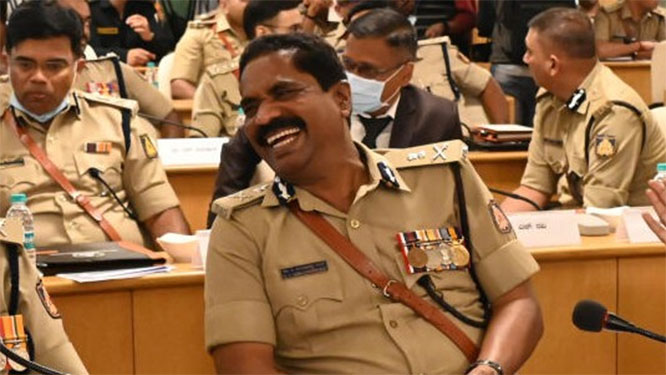
Karnataka DGP (Civil Rights Enforcement) K Ramachandra Rao was suspended with immediate effect, as per a state government order issued on Monday, 19 January. The order cited conduct unbecoming of a government servant and causing embarrassment to the state administration.

The Karnataka government suspended Rao after a purported video showed him in a compromising position with a woman inside his official chamber. The video went viral on social media. Rao rejected the videos outright, terming them "fabricated and false".

Who is K Ramachandra Rao?

Rao is a DGP-rank officer who was heading the Directorate of Civil Rights Enforcement until his suspension. He was promoted to DGP in September 2023 and assumed office in October 2023, the Sunday Guardian reported.

He also served as the Chairman and Managing Director of the Karnataka State Police Housing and Infrastructure Development Corporation Limited.

His stint as the Inspector General of Police (IGP) for the Southern Range was also marred by controversy. In 2014, during a cash seizure near Mysuru’s Yelwal, officials claimed the seized amount was ₹20 lakh, while the accused (Kerala-based merchants) claimed it was around ₹2.27 crore.

Rao, who was present during the seizure, denied all allegations. However, he was transferred soon after.

Allegations of collusion with a businessman surfaced, and a senior police officer was quoted by The Sunday Guardian as saying, “In Rao’s case, the CID has clearly mentioned that there was a great degree of lapse on the part of Rao and a deputy superintendent of police after it was brought to their notice that a few policemen, including a gunman attached to the IGP, were involved in the robbery.”

Rao had denied all wrongdoing in that incident. Despite past controversies, he rose to the state’s top police position, the Sunday Guardian reported.

Ranya Rao’s stepfather

Rao is the stepfather of Kannada actress Harshavardhini Ranya alias Ranya Rao, accused of orchestrating the illegal import of gold worth over ₹12.56 crore from Dubai to India along with two others — businessman Tarun Raju, and jewellery dealer Sahil Jain.

‘Obscene video’ controversy

A viral video showed Rao behaving inappropriately with a woman inside his office while in uniform.

The Karnataka government said in its Monday order that “vide videos and news reports widely broadcast on public news channels and media platforms, it is observed that Dr K Ramachandra Rao has acted in an obscene manner which is unbecoming of a Government Servant and also causing embarrassment to the Government.”

The order said the matter was examined by the state government, which found that the officer's conduct amounted to a violation of Rule 3 of the All India Services (Conduct) Rules, 1968.

The government said it is prima facie satisfied that "it is necessary to place Rao under suspension with immediate effect, pending inquiry".

During the suspension period, Rao will be entitled to subsistence allowance as per Rule 4 of the All India Services (Discipline and Appeal) Rules, 1969.

The order also places restrictions on his movement, stating that during the period of suspension, the officer must not leave headquarters under any circumstances without the written permission of the state government.

Comments

Add new comment

  • Coastaldigest.com reserves the right to delete or block any comments.
  • Coastaldigset.com is not responsible for its readers’ comments.
  • Comments that are abusive, incendiary or irrelevant are strictly prohibited.
  • Please use a genuine email ID and provide your name to avoid reject.
News Network
February 1,2026

Bengaluru, Feb 1: For travelers landing at Kempegowda International Airport (KIA), the sleek, wood-paneled curves of Terminal 2 promise a world-class welcome. But the famed “Garden City” charm quickly withers at the curb. As India’s aviation sector swells to record numbers—handling over 43 million passengers in Bengaluru alone this past year—the “last mile” has turned into a marathon of frustration.

The Bengaluru Logjam: Rules vs Reality

While the city awaits the 2027 completion of the Namma Metro Blue Line, the interim has been chaotic. Recent “decongestion” rules at Terminal 1 have pushed app-based cab pickups to distant parking zones, forcing weary passengers into a 20-minute walk with luggage.

“I landed after ten months away and felt like a stranger in my own city,” says Ruchitha Jain, a Koramangala resident. “My driver couldn’t find me, staff couldn’t guide me, and the so-called ‘Premium’ lane is just a fancy tax on convenience.”

•    The Cost of Distance: A 40-km cab ride can now easily cross ₹1,500, driven by demand pricing and airport surcharges.

•    The Bus Gap: While Vayu Vajra remains a lifeline, its ₹300–₹400 fare is often cited as the most expensive airport bus service in the country.

A National Pattern of Disconnect

The struggle is not unique to Karnataka. From Chennai’s coast to Hyderabad’s plateau, India’s airports tell a familiar story: brilliant runways, broken exits.

City:    Primary Issue   |    Recent Development

Bengaluru:    Cab pickup restrictions & distance  |    App-based taxis shifted to far parking zones; long walks and fare spikes reported

Chennai:    Multi-Level Parking (MLCP) hike  |    Passengers report 40-minute walks to reach cab pickup points

Hyderabad:    “Taxi mafia” & touting  |    Over 440 touting cases reported; security presence intensified

Mumbai:    Fare scams  |     Tourists charged ₹18,000 for just 400 metres, triggering police action

In Hyderabad, travelers continue to battle entrenched local groups that intimidate Uber and Ola drivers, pushing passengers toward overpriced private taxis. Chennai flyers, meanwhile, complain that reaching the designated pickup zones now takes longer than short-haul flights from cities like Coimbatore.

The ‘Budget Day’ Hope

As Finance Minister Nirmala Sitharaman presents the Union Budget 2026 today, the aviation sector is watching closely. With the government’s renewed emphasis on multimodal integration, there is cautious hope for funding toward seamless airport-metro-bus hubs.

The vision is clear: a future where planes, trains, and metros speak the same language. Until then, passengers at KIA—and airports across India—will continue to discover that the hardest part of flying isn’t the thousands of kilometres in the air, but the last few on the ground.

Comments

Add new comment

  • Coastaldigest.com reserves the right to delete or block any comments.
  • Coastaldigset.com is not responsible for its readers’ comments.
  • Comments that are abusive, incendiary or irrelevant are strictly prohibited.
  • Please use a genuine email ID and provide your name to avoid reject.