‘Muslim quota is unconstitutional’: Karnataka BJP govt tells Supreme Court

News Network
April 26, 2023

SC.jpg

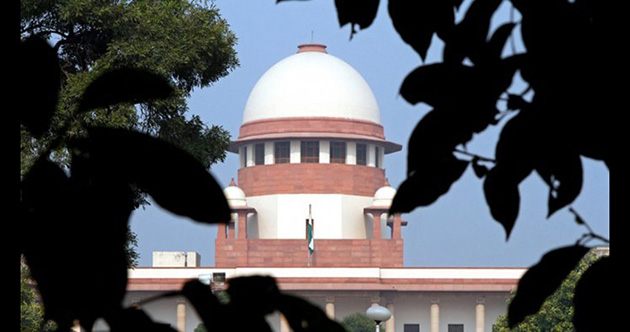
New Delhi, Apr 26: The Karnataka government defended before the Supreme Court its decision to scrap reservation on the sole basis of religion for Muslim community, saying it is  unconstitutional and contrary to the mandate of Article 14 to 16 of the Constitution of India.

Such a decision is also against the principles of social justice and secularism, it said.

The state government, however, pointed out the groups within the Muslim community who were found to be backward and found mention in Group I of the 2002 reservation order continued to enjoy the benefits of reservation. 

"Merely because reservations have been provided in the past on the basis of religion, it is no ground to continue the same for perpetuity, more so when it is on the basis of an unconstitutional principle," it said, contending that to provide the quota to the community was not justified.

Maintaining that the power to classify a group of citizens as Socially and Educationally Backward Class (SEBC) has to be constitutionally exercised in accordance with the provisions of Articles 14, 15 and 16 of the Constitution, it contended that assuming for the moment that any of the commissions had recommended for the inclusion of Muslims as Backward castes, the same does not denude the power of the State Government to take a decision in accordance with law.

In an affidavit to the challenge to the validity of its March 27 order, the state government said the power has been constitutionally conferred upon the state government to provide for protection to the Backward Classes. 

The government asserted that reservation can be provided to the Socially and Educationally backward classes in society who have been historically deprived and discriminated against within the society. "The same cannot be equated with an entire religion," it said.

The Karnataka government also pointed out there is no reservation given to Muslim community on the basis of religion as a whole in the Central List. 

"Even throughout the country, it is believed verily, except State of Kerala, there is no state that provides for reservation for the Muslim community as a whole," the state government said. 

There are various communities from the Muslim religion who are included in the SEBC which also continues to be the case in Karnataka. As such, the same in itself shows that the reservation solely on the basis of religion is not the practice followed anywhere in the country except Kerala and in the State of Karnataka, till recently, it added. 

"Reservation solely on the basis of religion is also contrary to the principles of social justice. The concept of social justice aims to protect those who are deprived and discriminated against within the society. Including within the said ambit an entire religion would be an antithesis to the concept of social justice and the ethos of the Constitution. Therefore reservation cannot be extended to any community on the sole basis of religion," it said.

The provision of reservation on the basis of religion would also be contrary to the concept of secularism. Further it would be violative of right to equality and non-discrimination on the basis of race, religion, caste, gender etc, it added.

The state government further said the issue of reservations has anyway undergone a radical shift with the introduction of reservation on the basis of economic criteria (EWS) by virtue of the 103rd Amendment. It is pertinent to state that the said amendment has been upheld by this Court in Janhit Abhiyan Vs Union of India, (2022). Therefore, the Muslim community suffers no prejudice as they can avail the benefit of EWS reservation which is 10 per cent. 

In the case of Andhra Pradesh, the Supreme Court permitted the reservation for only limited identifiable communities amongst Muslims and not the entire religion, it pointed out.

"The petitioners herein have sought to give a colour to the exercise in question which is completely baseless. The timing of the decision, etc, are immaterial without the petitioners clearly demonstrating that the reservation on the basis of religion is constitutional and permissible," it said.

The state government also said that its March 27 order was passed following the High Court's order on March 23.

The initial inclusion of Muslim community into the category of Other Backward Classes in 1979 was contrary to the recommendations of the first backward class commission headed by L G Havanur. The said inclusion has thereafter been continued subsequently primarily on the ground of economic backwardness. It is pertinent to state that the constitutional scheme at that stage did not contemplate reservations to economically weaker sections, it said. 

Comments

Add new comment

  • Coastaldigest.com reserves the right to delete or block any comments.
  • Coastaldigset.com is not responsible for its readers’ comments.
  • Comments that are abusive, incendiary or irrelevant are strictly prohibited.
  • Please use a genuine email ID and provide your name to avoid reject.
coastaldigest.com news network
February 5,2026

protestkerala.jpg

Mangaluru: The KSRTC Mangaluru division has rolled back the fare hike on buses operating on the Mangaluru–Kasaragod route following the suspension of toll collection at the Arikkady toll plaza near Kumbala in Kasaragod district.

The fare revision had been implemented after the National Highways Authority of India (NHAI) began toll collection at the Arikkady plaza on NH-66. As a result, fares for ordinary and Rajahamsa services were increased by ₹7 and ₹10, respectively, raising the bus fare from Mangaluru to Kasaragod from ₹81 to ₹88.

Senior Divisional Controller of KSRTC’s Mangaluru division, Rajesh Shetty, said the fares were reduced after toll collection at the Arikkady plaza was stopped. “The tollgate began operations on January 13, and the toll amount was deducted from the FASTag accounts of KSRTC buses operating on the route. Following an order from the central government to suspend toll collection, KSRTC has also withdrawn the additional fare with immediate effect,” he said.

At present, vehicles travelling on the Mangaluru–Kasaragod route pay toll only at the Talapady toll plaza. The toll for light motor vehicles (LMVs) at Talapady is ₹80 for a same-day return, while heavy vehicles, including buses, are charged ₹250. At Arikkady, the toll rates were ₹130 for LMVs (same-day return) and ₹450 for buses.

Protests against Arikkady toll plaza

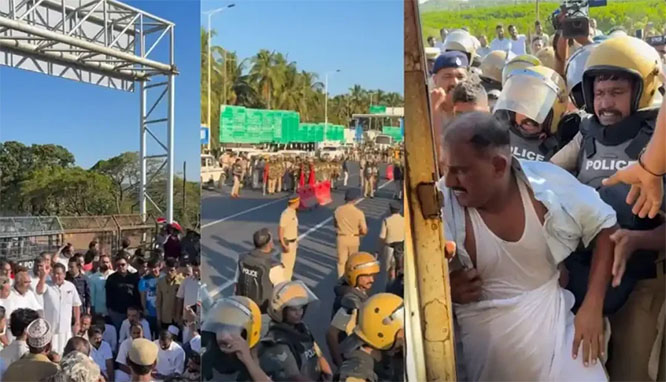
The Arikkady toll plaza witnessed widespread protests from January 12, the day toll collection commenced. On the second day, an action committee led by Manjeshwar MLA A K M Ashraf launched an indefinite protest at the site. Except for the BJP, leaders and workers of most major political parties participated in the agitation.

On the night of January 14, a large number of protesters gathered at the plaza and vandalised property, following which authorities temporarily suspended toll operations. The BJP later also expressed opposition to the toll plaza and criticised NHAI’s decision. 

Comments

Add new comment

  • Coastaldigest.com reserves the right to delete or block any comments.
  • Coastaldigset.com is not responsible for its readers’ comments.
  • Comments that are abusive, incendiary or irrelevant are strictly prohibited.
  • Please use a genuine email ID and provide your name to avoid reject.
News Network
February 5,2026

In an era where digital distractions are the primary rival to academic excellence, the Karnataka Education Department is taking the fight directly to the living room. As the SSLC (Class 10) annual examinations loom, officials have launched a localized "digital strike" to ensure students aren't losing their competitive edge to scrolling or soap operas.

The 7-to-9 Lockdown

The department has issued a formal directive urging—and in some cases, enforcing via home visits—a total blackout of mobile phones and television sets between 7:00 PM and 9:00 PM. This two-hour window is being designated as "sacred study time" across the state until the examinations conclude on April 2.

Key Pillars of the Initiative:

•    Doorstep Advocacy: Teachers are transitioning from classrooms to living rooms, meeting parents to explain the psychological benefits of a distraction-free environment.

•    Parental Accountability: The campaign shifts the burden of discipline from the student to the household, asking parents to lead by example and switch off their own devices.

•    The Timeline: The focus remains sharp on the upcoming exam block, scheduled from March 18 to April 2.

"The objective is simple: uninterrupted focus. We are reclaiming the evening hours for the students, ensuring their environment is as prepared as their minds," stated a senior department official.

Student vs. Reality

While the student community has largely welcomed the "forced focus"—with many admitting they lack the willpower to ignore notifications—the move has sparked a debate on enforceability. Without a "TV Police," the success of this initiative rests entirely on the shoulders of parents and the persuasive power of visiting educators.

Comments

Add new comment

  • Coastaldigest.com reserves the right to delete or block any comments.
  • Coastaldigset.com is not responsible for its readers’ comments.
  • Comments that are abusive, incendiary or irrelevant are strictly prohibited.
  • Please use a genuine email ID and provide your name to avoid reject.
News Network
January 23,2026

modIKERALA.jpg

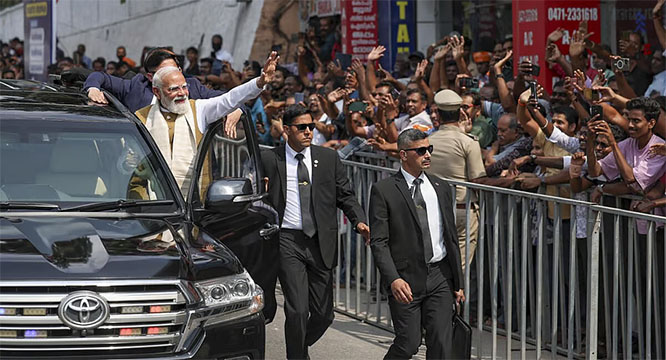
Prime Minister Narendra Modi, during his visit to Thiruvananthapuram on Friday, January 23, indicated that the Bharatiya Janata Party (BJP) is aiming to expand its political footprint in Kerala ahead of the Assembly elections scheduled in the coming months.

Speaking at a BJP-organised public meeting, Modi drew parallels between the party’s early electoral gains in Gujarat and its recent victory in the Thiruvananthapuram Municipal Corporation. The civic body win, which ended decades of Left control, was cited by the Prime Minister as a possible starting point for the party’s broader ambitions in the state.

Recalling BJP’s political trajectory in Gujarat, Modi said the party was largely insignificant before 1987 and received little media attention. He pointed out that the BJP’s first major breakthrough came with its victory in the Ahmedabad Municipal Corporation that year.

“Just as our journey in Gujarat began with one city, Kerala’s journey has also started with a single city,” Modi said, suggesting that the party’s municipal-level success could translate into wider electoral acceptance.

The Prime Minister alleged that successive governments led by the Left Democratic Front (LDF) and the United Democratic Front (UDF) had failed to adequately develop Thiruvananthapuram. He accused both fronts of corruption and neglect, claiming that basic infrastructure and facilities were denied to the capital city for decades.

According to Modi, the BJP’s control of the civic body represents a shift driven by public dissatisfaction with the existing political alternatives. He asserted that the BJP administration in Thiruvananthapuram had begun working towards development, though no specific details or timelines were outlined.

Addressing the gathering at Putharikandam Maidan, Modi said the BJP intended to project Thiruvananthapuram as a “model city,” reiterating his party’s commitment to governance-led change.

The Prime Minister’s visit to Kerala also included the inauguration of several development projects and the flagging off of new train services, as the BJP intensifies its political outreach in the poll-bound state.

Comments

Add new comment

  • Coastaldigest.com reserves the right to delete or block any comments.
  • Coastaldigset.com is not responsible for its readers’ comments.
  • Comments that are abusive, incendiary or irrelevant are strictly prohibited.
  • Please use a genuine email ID and provide your name to avoid reject.