



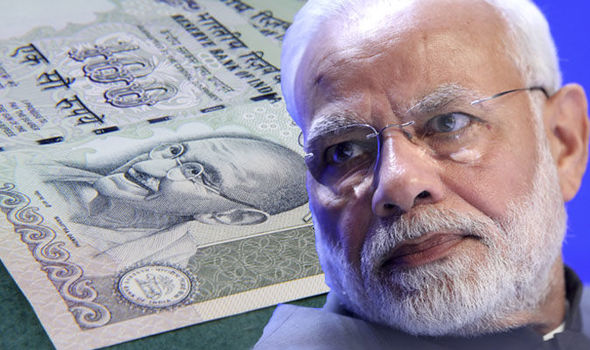
Rupee at record low, breaches 80-mark against US dollar: Here's how it may impact you

News Network
July 19, 2022

modiji.jpg

New Delhi, July 19: The Indian currency depreciated for the eighth consecutive session on Tuesday to fall past 80-mark against the US dollar for the first-time ever.

At the interbank forex market, rupee was trading at 79.93 at 9.31am, after breaching the 80-mark against the US dollar- a historic low for the Indian currency. It sank to 80.06 against dollar in opening trade.

The rupee had ended at 79.97 on Monday.

The US dollar extended its rally and hovered just above a one-week low reached overnight versus major peers as markets reduced the odds of a percentage-point Federal Reserve rate hike this month.

The local currency has now declined over 7 per cent since the start of this year. It was at Rs 78.94 per dollar as of June 30 and rapidly plunged to touch the Rs 80-mark in the next few sessions.

If we compare with historical data, since December 2014, the value of the rupee declined from 63.33 against a dollar on December 31, 2014, to 80.06 today -- that is, a depreciation of 26.27 per cent.

However, rupee's loss meant gains for the US dollar. In fact, the US currency has had a wonderful stretch. Since the start of the year, it has gained almost 8 per cent.

On the flip side, a rising dollar is surely not a favourable scenario for Indian rupee. The rupee has been staggering since the beginning of the year and has fallen 7.72 per cent so far.

The surprise rate hike by Reserve Bank of India's (RBI) monetary policy committee (MPC) last month could not stop rupee's decline as a widening current account deficit came to the forefront after the country's June trade deficit hit a record high, raising concerns. In fact, it seems to have heightened volatility.

How it may impact you

From imports to exports to travel abroad to foreign studies, a falling rupee impacts our lives in several ways.

Imports to be more expensive: The primary and immediate impact of a depreciating rupee is on the importers as they need to spend more for same quantity and price.

The basket of Indian imports includes crude oil, coal, plastic material, chemicals, electronic goods, vegetable oil, fertiliser, machinery, gold, pearls, precious and semi-precious stones, and iron and steel.

With the dip in the rupee, importing items will get more expensive. Not just oil but electronic items, such as mobile phones, some cars and appliances, are likely to get expensive.

The falling rupee is also likely to impact spending decisions of households as certain things may become expensive.

Boost for exports: While imports become costlier, exports from India will become cheaper. It is a boon for the exporters as they receive more rupees in exchange for dollars.

Pay more for foreign studies: For people looking to study abroad during this time, the fees amount will rise as a dollar would now cost more in terms of rupee than earlier. Prospective students or even existing ones may face a hike in their spending.

Foreign trips to cost more: Another major impact of falling rupee might be felt on the tourism sector. With Covid-19 cases remaining in control, many people would want to resume their abroad travel plans. Such people might end up spending much higher than they would have a few days back.

More values for remittances: In terms of remittances, or the money that people residing abroad send to their families back home in India, they will end up sending more in terms of rupee value.


Comments

Add new comment

  • Coastaldigest.com reserves the right to delete or block any comments.
  • Coastaldigset.com is not responsible for its readers’ comments.
  • Comments that are abusive, incendiary or irrelevant are strictly prohibited.
  • Please use a genuine email ID and provide your name to avoid reject.
News Network
December 2,2025

DKSsiddu.jpg

Bengaluru: 'Nati koli saaru' (country chicken curry) considered one of Chief Minister Siddaramaiah’s favourites along with steaming hot idlis was on the breakfast menu at Deputy CM D K Shivakumar’s residence on Tuesday, according to official sources.

The spread also included 'nati koli' fry, vada and pongal, among other items, they said.

In an apparent show of unity, Siddaramaiah visited Shivakumar’s residence for breakfast, just days after the two leaders shared a meal amid a simmering power tussle in the state Congress.

Siddaramaiah drove to the Deputy CM’s residence in Sadashivanagar, where he was received by Shivakumar and his brother D K Suresh, who is a former Congress MP.

Suresh and Kunigal MLA H D Ranganath, a relative of Shivakumar, joined them for breakfast, which featured a mix of vegetarian and non-vegetarian dishes.

Speaking to reporters later, Siddaramaiah said Shivakumar had invited him during his visit to the CM’s residence for breakfast on Saturday.

Asked about the difference between the two meals, the chief minister said, "At his (Shivakumar’s) house it was non-veg, while at my house it was veg. He is a vegetarian, I am a non-vegetarian. I had not prepared non-veg. I told DK to get chicken from the village as you won’t get the original in Bengaluru."

Shivakumar said he had initially invited Siddaramaiah to his residence, but the CM had suggested visiting his place first and reciprocating later. "It was a vegetarian breakfast at the CM’s house on Saturday," he noted.

"Today, I invited him (the CM) to my house. He enjoyed the breakfast, which had his Mysuru taste," Shivakumar added. At this point, Siddaramaiah remarked that Shivakumar’s wife is also from Mysuru.

Saturday’s breakfast at Siddaramaiah’s official residence, held as part of efforts by the Congress high command to ease tensions in the leadership dispute between the two, reportedly included idlis and sambar, according to official sources.

Comments

Add new comment

  • Coastaldigest.com reserves the right to delete or block any comments.
  • Coastaldigset.com is not responsible for its readers’ comments.
  • Comments that are abusive, incendiary or irrelevant are strictly prohibited.
  • Please use a genuine email ID and provide your name to avoid reject.
News Network
November 30,2025

The United Nations Committee against Torture (CAT) has condemned the Israeli regime for enforcing a policy of “organized torture” against Palestinians.

In a report published on Friday, CAT stated that the occupying regime enforces a deliberate policy of “organized and widespread torture and ill-treatment” against Palestinian abductees, particularly since October 7, 2023, when Israel launched its genocidal war on Gaza.

The committee expressed “deep concern over repeated severe beatings, dog attacks, electrocution, water-boarding, use of prolonged stress positions [and] sexual violence” inflicted on Palestinians.

Palestinian prisoners were degraded by “being made to act like animals or being urinated on,” systematically denied medical care, and subjected to excessive restraints, “in some cases resulting in amputation,” the report added.

CAT also condemned the routine application of “unlawful combatants law” to justify the prolonged detention without trial of thousands of Palestinian men, women, and children.

More than 10,000 Palestinians, including women and children, are currently held in Israeli prisons, according to Palestinian and international human rights groups, with 3,474 Palestinians in “administrative detention,” meaning they are imprisoned without trial for indefinite periods.

The report highlighted the “high proportion of children who are currently detained without charge or on remand,” noting that while Israel sets the age of criminal responsibility at 12, even younger children have been abducted.

Children designated as security prisoners face severe restrictions on family contact, may be subjected to solitary confinement, and are denied access to education, in clear violation of international law.

The committee further suggested that Israel’s policies across the Occupied Territories constitute collective torture against the Palestinian population.

“A range of policies adopted by Israel in the course of its continued unlawful presence in the Occupied Palestinian Territory amounts to cruel, inhuman or degrading living conditions for the Palestinian population,” the report said.

On Thursday, the Palestinian resistance movement Hamas condemned the systematic killing and torture of Palestinian abductees in Israeli prisons, urging international action to halt these abuses.

Citing human rights data, Hamas stated that 94 Palestinians have been killed in Israeli prisons since the start of Tel Aviv’s genocidal war on Gaza.

“This reflects an organized criminal approach that has turned these prisons into direct killing grounds to eliminate our people,” the resistance movement said.

Hamas called on the international community, the UN, and human rights organizations to immediately pressure Israel to end crimes against prisoners and uphold their rights as guaranteed by all international conventions and norms.

Comments

Add new comment

  • Coastaldigest.com reserves the right to delete or block any comments.
  • Coastaldigset.com is not responsible for its readers’ comments.
  • Comments that are abusive, incendiary or irrelevant are strictly prohibited.
  • Please use a genuine email ID and provide your name to avoid reject.
News Network
November 21,2025

Tejas.jpg

An Indian Air Force (IAF) Tejas fighter jet crashed on Friday, November 21, afternoon during its aerial demonstration at the Dubai Air Show, plunging to the ground at around 2:10 pm local time while performing a manoeuvre before thousands of spectators.

The IAF confirmed the incident, stating that a Tejas aircraft participating in the show had crashed and that further details were being gathered. An Air Force spokesperson said more information would be shared after initial assessments.

The crash sent thick black smoke billowing into the sky near the airport, causing panic among visitors, including families and children who had gathered to watch the display. Authorities have not yet confirmed whether the pilot managed to eject before the aircraft went down. Emergency response teams rushed to the scene, and officials have not released information on casualties or damage so far.

The Tejas is a 4.5-generation, multi-role fighter aircraft developed indigenously by Hindustan Aeronautics Limited (HAL). Designed for versatility, it is capable of offensive air support, close combat, ground attack missions and maritime operations. The aircraft family includes single-seat fighters and twin-seat trainers for both the Air Force and Navy.

HAL describes the latest version, the LCA Mk1A, as the most advanced in the series, featuring an AESA radar, an upgraded electronic warfare suite with radar-warning and self-protection jamming, smart multifunction displays, a digital map generator, a combined interrogator–transponder system and a modern radio altimeter. These enhancements significantly improve the aircraft’s combat capability and survivability.

Further updates from IAF and UAE authorities are awaited.

Comments

Add new comment

  • Coastaldigest.com reserves the right to delete or block any comments.
  • Coastaldigset.com is not responsible for its readers’ comments.
  • Comments that are abusive, incendiary or irrelevant are strictly prohibited.
  • Please use a genuine email ID and provide your name to avoid reject.