



Indian export subsidy hurting American firms: US complains at WTO

Agencies
March 15, 2018

Washington, Mar 15: The US on Wednesday challenged Indian export subsidy schemes at the World Trade Organisation, saying these programmes harm American workers by creating an "uneven" playing field, officials said.

The US Trade Representative (USTR) argued that at least half a dozen Indian programmes provide financial benefits to Indian exporters, which allow them to sell their goods more cheaply to the detriment of American workers and manufacturers.

These programs are: the Merchandise Exports from India Scheme; Export Oriented Units Scheme and sector specific schemes, including Electronics Hardware Technology Parks Scheme, Special Economic Zones, Export Promotion Capital Goods Scheme and Duty Free Imports for Exporters Programme.

"These export subsidy programmes harm American workers by creating an uneven playing field on which they must compete," said Lighthizer.

"USTR will continue to hold our trading partners accountable by vigorously enforcing US rights under our trade agreements and by promoting fair and reciprocal trade through all available tools, including the WTO," Lighthizer said.

The announcement from Lighthizer came while Indian Foreign Secretary Vijay Gokhale was on his maiden visit to the US. He was scheduled to hold meetings with the USTR.

In a statement, the USTR alleged that through these programmes, India is given exemption from certain duties, taxes, and fees which benefits numerous Indian exporters, including producers of steel products, pharmaceuticals, chemicals, information technology products, textiles, and apparel.

According to the Indian government documents, thousands of Indian companies are receiving benefits totaling to over $7 billion annually from these programs.

The USTR said export subsidies provide an unfair competitive advantage to recipients.

A limited exception to this rule is for specified developing countries that may continue to provide export subsidies temporarily until they reach a defined economic benchmark.

India was initially within this group, but it surpassed the benchmark in 2015. India's exemption has expired, but India has not withdrawn its export subsidies, USTR alleged.

"In fact, India has increased the size and scope of these programs," USTR charged.

For example, India introduced the Merchandise Exports from India Scheme in 2015, which has rapidly expanded to include more than 8,000 eligible products, nearly double the number of products covered at its inception, it alleged.

Exports from Special Economic Zones increased over 6,000 per cent from 2000 to 2017, and in 2016, exports from Special Economic Zones accounted for over $82 billion in exports, or 30 per cent of India's export volume.

Exports from the Export Oriented Units Scheme and sector specific schemes, including Electronics Hardware Technology Parks Scheme, increased by over 160 per cent from 2000 to 2016, it asserted.

Noting that consultations are the first step in the WTO dispute settlement process, The USTR said if the US and India are not able to reach a mutually agreed solution through consultations, it may request the establishment of a WTO dispute settlement panel to review the matter.

The House Ways and Means Committee Chairman Kevin Brady applauded the USTR's decision to challenge through the WTO.

"The Administration's decision to challenge India's USD7 billion worth of prohibited subsidies is a plain and unmistakable signal that we will not tolerate any failure by our trading partners to live up to their commitments at the expense of US manufacturers, service providers, farmers, and ranchers," Brady said.

"Today's action highlights the value of ensuring that our trade agreements are fully enforceable through binding dispute settlement. We must continue to hold our trading partners accountable and ensure a level playing field for American workers and businesses," he said.

"In responding to India's prohibited subsidisation of its steel industry in this manner, we prove the significance of the WTO dispute settlement process as a powerful, valuable, and appropriate tool in the administration's toolbox to address unfair practices that hurt our steel workers and companies. I join the Administration in calling on India to end its unfair trading immediately," Brady said.

Comments

Add new comment

  • Coastaldigest.com reserves the right to delete or block any comments.
  • Coastaldigset.com is not responsible for its readers’ comments.
  • Comments that are abusive, incendiary or irrelevant are strictly prohibited.
  • Please use a genuine email ID and provide your name to avoid reject.
coastaldigest.com news network
February 5,2026

protestkerala.jpg

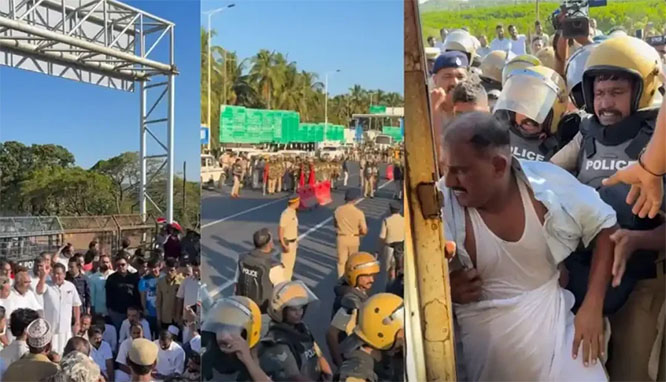
Mangaluru: The KSRTC Mangaluru division has rolled back the fare hike on buses operating on the Mangaluru–Kasaragod route following the suspension of toll collection at the Arikkady toll plaza near Kumbala in Kasaragod district.

The fare revision had been implemented after the National Highways Authority of India (NHAI) began toll collection at the Arikkady plaza on NH-66. As a result, fares for ordinary and Rajahamsa services were increased by ₹7 and ₹10, respectively, raising the bus fare from Mangaluru to Kasaragod from ₹81 to ₹88.

Senior Divisional Controller of KSRTC’s Mangaluru division, Rajesh Shetty, said the fares were reduced after toll collection at the Arikkady plaza was stopped. “The tollgate began operations on January 13, and the toll amount was deducted from the FASTag accounts of KSRTC buses operating on the route. Following an order from the central government to suspend toll collection, KSRTC has also withdrawn the additional fare with immediate effect,” he said.

At present, vehicles travelling on the Mangaluru–Kasaragod route pay toll only at the Talapady toll plaza. The toll for light motor vehicles (LMVs) at Talapady is ₹80 for a same-day return, while heavy vehicles, including buses, are charged ₹250. At Arikkady, the toll rates were ₹130 for LMVs (same-day return) and ₹450 for buses.

Protests against Arikkady toll plaza

The Arikkady toll plaza witnessed widespread protests from January 12, the day toll collection commenced. On the second day, an action committee led by Manjeshwar MLA A K M Ashraf launched an indefinite protest at the site. Except for the BJP, leaders and workers of most major political parties participated in the agitation.

On the night of January 14, a large number of protesters gathered at the plaza and vandalised property, following which authorities temporarily suspended toll operations. The BJP later also expressed opposition to the toll plaza and criticised NHAI’s decision. 

Comments

Add new comment

  • Coastaldigest.com reserves the right to delete or block any comments.
  • Coastaldigset.com is not responsible for its readers’ comments.
  • Comments that are abusive, incendiary or irrelevant are strictly prohibited.
  • Please use a genuine email ID and provide your name to avoid reject.
News Network
February 5,2026

Bengaluru: As air quality continues to worsen across several parts of the city, hospitals in Bengaluru are reporting a steady rise in patients suffering from respiratory illnesses such as asthma, bronchitis and Chronic Obstructive Pulmonary Disease (COPD), health officials and doctors said.

Data from the Suvarna Arogya Suraksha Trust (SAST) shows that 3,891 patients received treatment for respiratory ailments between April and November 2024. The figure rose to 4,187 during the same period in 2025.

Private hospitals, too, are witnessing a 10–15 per cent year-on-year increase in such cases.

While doctors caution that the rise cannot be attributed solely to air pollution, a significant number of patients are non-smokers with no prior history of respiratory disease.

“Nearly 70 per cent of the patients we see are non-smokers with no previous respiratory issues. When other causes are ruled out, air pollution emerges as the most likely factor,” said Dr Manjunath PH, consultant interventional pulmonologist at a hospital in Kengeri.

Doctors noted that patient footfall spikes during the winter months and around Deepavali, when air quality typically worsens.

“There is a clear correlation between poor air quality and the rise in cases. People commonly present with persistent cough, breathlessness and irritation of the respiratory tract, indicating the impact of polluted air on their health,” said Dr Sheetal Chaurasia, consultant in pulmonary medicine at a private hospital in Whitefield.

Dr Chaurasia added that respiratory tract infections are also on the rise.

“Poor air quality leads to chronic airway inflammation, making the airways more vulnerable to infections. We are seeing an increase in both upper and lower respiratory tract infections,” she said.

Patients with pre-existing respiratory conditions remain the worst affected.

“For those already diagnosed with respiratory illnesses, deteriorating air quality significantly worsens the condition. Both the frequency and severity of attacks increase sharply,” said Dr Vandana P, a pulmonologist at a hospital on Bannerghatta Road.

Doctors also flagged a worrying trend of rising respiratory problems among younger adults and children.

To reduce exposure, they advised people to wear masks while travelling on two-wheelers or autos and ensure adequate ventilation at home to minimise indoor air pollution.

Comments

Add new comment

  • Coastaldigest.com reserves the right to delete or block any comments.
  • Coastaldigset.com is not responsible for its readers’ comments.
  • Comments that are abusive, incendiary or irrelevant are strictly prohibited.
  • Please use a genuine email ID and provide your name to avoid reject.
News Network
February 1,2026

Bengaluru: The Karnataka High Court has refused to quash an investigation against a WhatsApp group administrator accused of allowing the circulation of obscene and offensive images depicting Hindutva politicians and idols in 2021.

Justice M Nagaprasanna observed that, prima facie, the ingredients of the offence under Section 295A of the Indian Penal Code were made out. “The offence under Section 295A of the IPC is met to every word of its ingredient, albeit prima facie,” the judge said.

The petitioner, Sirajuddin, a resident of Belthangady taluk in Dakshina Kannada district, had challenged the FIR registered against him at the CEN (Cyber, Economics and Narcotics) police station, Mangaluru, for offences under Section 295A of the IPC and Section 67 of the Information Technology Act. Section 295A relates to punishment for deliberate and malicious acts intended to outrage the religious feelings of any class of citizens.

According to the complaint filed by K Jayaraj Salian, also a resident of Belthangady taluk, he received a WhatsApp group link from an unknown source and was added to the group after accessing it. The group reportedly had six administrators and around 250 participants, where obscene and offensive images depicting Hindu deities and certain political figures were allegedly circulated repeatedly.

Sirajuddin was arrested in connection with the case and later released on bail on February 16, 2021. He argued before the court that he was being selectively targeted, while other administrators—including the creator of the group—were neither arrested nor investigated. He also contended that the Magistrate could not have taken cognisance of the offence under Section 295A without prior sanction under Section 196(1) of the CrPC.

Rejecting the argument, Justice Nagaprasanna held that prior sanction is required only at the stage of taking cognisance, and not at the stage of registration of the crime or during investigation.

The judge noted that the State had produced the entire investigation material before the court. “A perusal of the material reveals depictions of Hindu deities in an extraordinarily obscene, demeaning and profane manner. The content is such that its reproduction in a judicial order would itself be inappropriate,” the court said, adding that the material, on its face, had the tendency to outrage religious feelings and disturb communal harmony.

Observing that the case was still at the investigation stage, the court said it could not interdict the probe at this juncture. However, it expressed concern that the investigating officer appeared to have not proceeded uniformly against all administrators. The court clarified that if the investigation revealed the active involvement of any member in permitting the circulation of such content, they must also be proceeded against.

“At this investigative stage, any further observation by this Court would be unnecessary,” the order concluded.

Comments

Add new comment

  • Coastaldigest.com reserves the right to delete or block any comments.
  • Coastaldigset.com is not responsible for its readers’ comments.
  • Comments that are abusive, incendiary or irrelevant are strictly prohibited.
  • Please use a genuine email ID and provide your name to avoid reject.